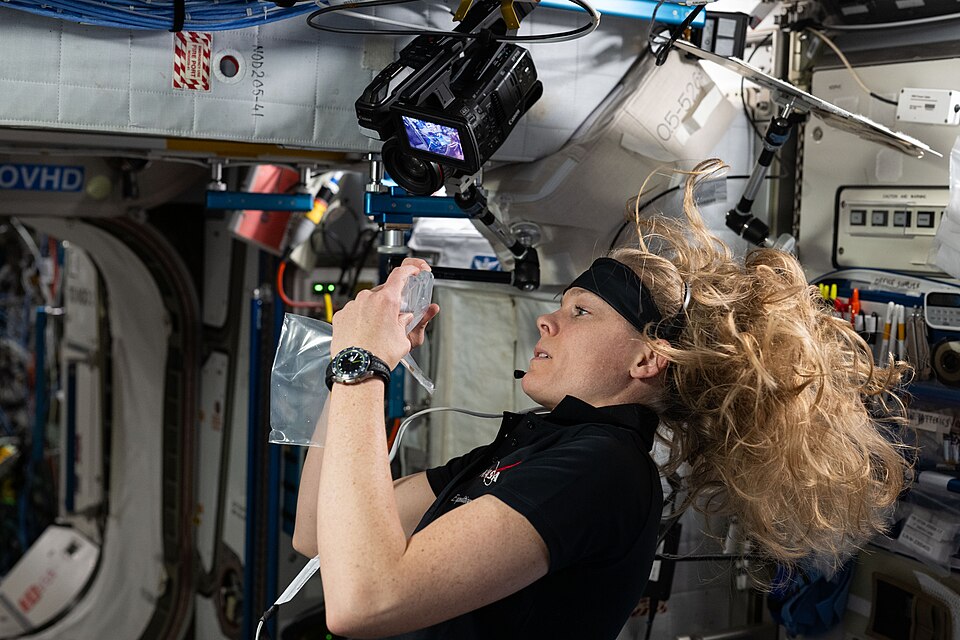
Floating in Microgravity
One of the most unusual things about living on the ISS is that everything floats. Because the station is in a constant state of free fall around Earth, astronauts experience microgravity, which makes them feel weightless. They float through the station’s modules instead of walking, and they have to strap themselves into sleeping bags attached to the walls so they do not drift away while they sleep. Even water floats in the air as wobbly bubbles, so astronauts cannot pour a glass of water the way we do on Earth. It takes some time for new crew members to get used to moving around without bumping into equipment or each other.
Eating in Space
Astronauts on the ISS eat three meals a day, but their food looks quite different from what you might find in a school cafeteria. Most space food comes in sealed pouches and is either freeze-dried, thermostabilized, or dehydrated to keep it fresh without refrigeration. Astronauts add water to rehydrate some meals and warm others in a small food warmer. Tortillas are used instead of bread because bread creates crumbs that float around and could get into equipment or astronauts’ eyes. Crew members can choose from hundreds of different menu items, and space agencies from different countries contribute their own dishes.
Sleeping and Daily Routines
A typical day on the ISS follows a strict schedule to help astronauts stay productive and healthy. The crew wakes up around 6:00 a.m. Greenwich Mean Time and begins the day with personal hygiene, breakfast, and a daily planning conference with mission control. Astronauts work for about eight and a half hours each day on science experiments, station maintenance, and other tasks. They are scheduled for two hours of exercise every day using special equipment like a treadmill with harnesses and a resistance exercise device, because without gravity their muscles and bones would weaken quickly. Evenings are set aside for dinner, free time, and communication with family back on Earth.
Science Experiments
The ISS is one of the most important science laboratories in the world because it allows researchers to study how things behave without the pull of gravity. Scientists on the station conduct experiments in biology, physics, medicine, and Earth science that cannot be done anywhere else. For example, researchers have grown crystals, studied how flames burn differently in microgravity, and even grown lettuce and other plants in space. These experiments help scientists understand how the human body changes during long space missions, which is important for future trips to the Moon and Mars. Thousands of scientific investigations have been carried out on the ISS since it began operating.
Spacewalks and Station Maintenance
Sometimes astronauts need to go outside the station to make repairs, install new equipment, or conduct experiments. These trips outside are called extravehicular activities, or EVAs, but most people know them as spacewalks. Preparing for a spacewalk takes several hours because astronauts must put on bulky spacesuits that protect them from the extreme temperatures and vacuum of space. A single spacewalk can last six to eight hours, and astronauts are always tethered to the station so they cannot float away. Hundreds of spacewalks have been performed at the ISS to keep the station running smoothly.
Working Together as a Global Team
The ISS is a partnership among five space agencies representing 15 countries, including NASA from the United States, Roscosmos from Russia, ESA from Europe, JAXA from Japan, and CSA from Canada. Crew members often speak different languages, and the two official languages on the station are English and Russian. Astronauts train together for months before their missions so they can work as a team and handle emergencies. Living in a small space with the same people for months at a time requires patience, cooperation, and good communication skills. The ISS shows that people from different nations can accomplish amazing things when they work together.
The Future of the Space Station
The ISS has been orbiting Earth for more than 25 years, and space agencies are now planning for what comes next. NASA expects the ISS to continue operating until around 2030 before it is safely deorbited into the Pacific Ocean. Several private companies are developing new commercial space stations that could replace the ISS and allow even more people to visit space. The lessons learned from the ISS about living and working in space will help engineers design spacecraft for longer missions to the Moon and Mars. Everything astronauts have discovered about staying healthy, growing food, and recycling water in space will shape the future of human space exploration.
 OtterKnow Kids Encyclopedia