The Real Piranha vs. the Legend
Much of the piranha’s terrifying reputation can be traced back to a famous incident involving President Theodore Roosevelt. When Roosevelt visited Brazil in 1913, local fishermen put on a dramatic show for him by trapping piranhas in a small section of river and starving them before tossing in a cow carcass. The piranhas devoured it quickly, and Roosevelt wrote about the spectacular scene in a book, describing piranhas as the most ferocious fish in the world. What he did not know was that the whole event had been staged to impress him. In reality, piranhas are cautious fish that are far more likely to flee from a large animal than to attack one.
What They Look Like
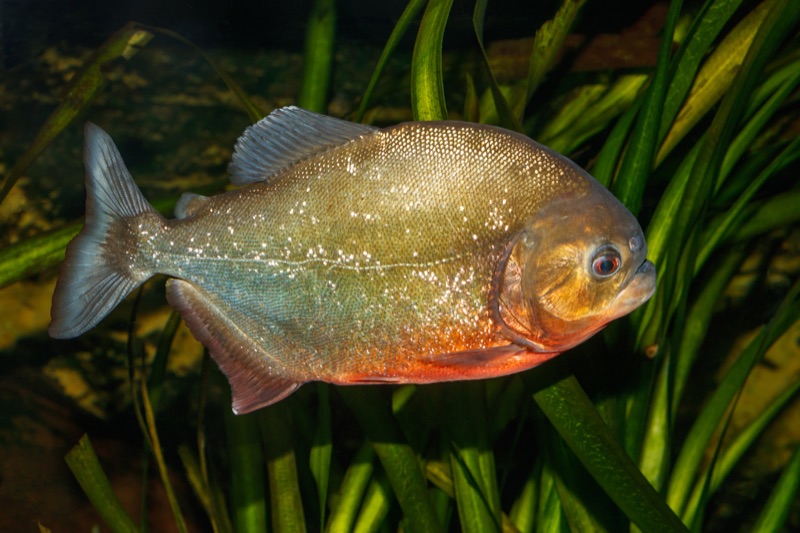
Piranhas have deep, flat bodies shaped a bit like a dinner plate turned sideways, which helps them move quickly through the water in short bursts. Most species are silvery with darker backs, and some, like the red-bellied piranha, have bright orange or red coloring on their undersides. Their lower jaws jut forward slightly, giving them a natural underbite that shows off their famous teeth. Piranhas have large eyes relative to their body size, which gives them excellent vision in the murky, sediment-filled waters where they often live.
The Teeth
A piranha’s teeth are one of its most remarkable features. Each tooth is triangular, razor-sharp, and serrated along the edges — much like a tiny steak knife. When a piranha closes its mouth, the upper and lower teeth interlock perfectly, creating a bite that can slice through flesh, scales, and even bone with surprising ease. Piranhas also replace their teeth throughout their lives, losing them in blocks on one side of the jaw and regrowing them, so they always have a fresh set ready. Scientists have found that the black piranha has one of the strongest bites relative to body size of any living fish.
What They Eat
Here is where the piranha’s reputation really falls apart: most piranha species are actually omnivores, and many eat more plants than meat. Fruits, seeds, and aquatic plants make up a large portion of the diet for species like the wimple piranha and the vegetarian piranha (yes, that is a real species). Meat-eating piranhas mostly feed on smaller fish, insects, snails, and worms rather than hunting large animals. Even the red-bellied piranha, the species most often shown in scary movies, mainly scavenges dead or dying animals instead of attacking healthy ones. Piranhas are opportunistic feeders that eat whatever is most available, which is often plant material that falls into the water from overhanging trees.
Schools
Piranhas are well known for swimming in large groups called schools, which can contain dozens or even hundreds of fish. Many people assume piranhas school together to hunt cooperatively, but research suggests the real reason is self-defense. Piranhas face many predators in South American rivers, including caimans, river dolphins, large herons, and even jaguars. By swimming in a tight group, each individual piranha lowers its own chances of being singled out and eaten. Scientists have observed that piranhas placed alone in a tank become much more stressed and fearful than those kept in groups, which supports the idea that schooling is about safety rather than aggression.
Where They Live
Piranhas are found exclusively in South America, inhabiting the river systems of the Amazon, Orinoco, and Paraguay-Parana basins, as well as many smaller rivers and tributaries. They prefer warm, slow-moving or still freshwater and are especially common in floodplain lakes that form during the rainy season. During floods, piranhas spread out into newly submerged forests and grasslands where food is plentiful, feeding on fruits and seeds that drop from trees. When the dry season arrives and water levels fall, piranhas become concentrated in shrinking pools, which is when feeding frenzies are most likely to occur — not because the fish are especially aggressive, but because many hungry fish are crowded into a small space with limited food.
Piranhas in the Ecosystem
Far from being destructive, piranhas are actually vital to the health of South American rivers. As scavengers, they clean up dead fish and animal carcasses that would otherwise rot and pollute the water, acting like an underwater cleanup crew. The plant-eating species help disperse seeds by consuming fruits and then depositing the seeds in new locations through their waste, much like birds do on land. Piranhas also serve as an important food source for larger predators, connecting different levels of the food web. Without piranhas, river ecosystems in South America would likely become less balanced and less productive, which is why scientists consider them a keystone part of their environment.
Piranhas and People
In the communities along South American rivers, people have lived alongside piranhas for thousands of years without the fear that Hollywood movies might suggest. Local fishermen regularly catch piranhas for food, and piranha soup is a popular dish in parts of Brazil and Venezuela. Swimmers and bathers share the water with piranhas daily, and serious bite injuries are uncommon, though they do occasionally happen — usually when water levels are very low and the fish are stressed. Piranhas are also kept in aquariums around the world, though they require experienced caretakers who understand their needs. Today, some piranha populations face threats from pollution, dam construction, and overfishing, reminding us that these misunderstood fish need protection rather than fear.
 OtterKnow Kids Encyclopedia