What They Look Like
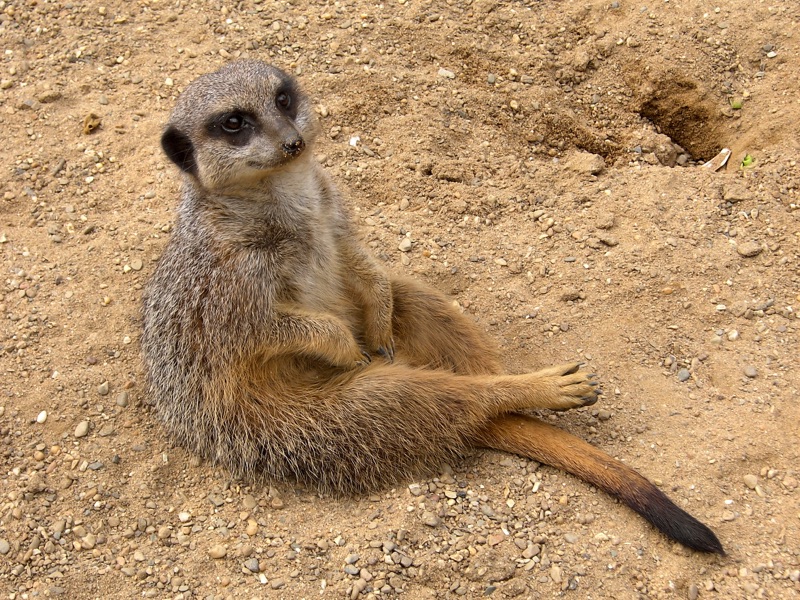
A meerkat’s body is slender and built for life in the desert. They measure about 25 to 35 centimeters (10 to 14 inches) from head to tail base, with a thin tail adding another 18 to 25 centimeters. Adults typically weigh less than one kilogram (about two pounds), making them roughly the size of a large squirrel. Their fur is gray or tan with dark bands across the back, and they have small, crescent-shaped ears that can close to keep out sand while digging. Perhaps their most striking feature is the dark patches around their eyes, which reduce the glare of the bright desert sun, working much like the eye black that baseball players wear.
Habitat and Range
Meerkats live in the dry, open plains and semi-arid lowlands of southern Africa, particularly in the Kalahari Desert, which stretches across parts of Botswana, Namibia, and South Africa. They prefer areas with hard or stony ground where they can dig extensive burrow systems. These burrows are impressive underground networks that can stretch up to five meters (16 feet) across and extend about 1.5 meters (5 feet) deep, with multiple entrance holes and several levels of tunnels. A single mob of meerkats may maintain several burrow systems within their territory and rotate between them.
Social Structure
Meerkats are among the most social of all mammals, living in groups called mobs or gangs that typically contain 10 to 25 individuals, though some mobs can grow to as many as 30 members. Each mob is led by a dominant breeding pair, usually the oldest and strongest male and female. The dominant female produces most of the group’s pups, and the other members pitch in to help raise them. Babysitters stay behind at the burrow to watch over young pups, while other helpers bring food back to the babies. This cooperative style of living, where the whole group shares responsibility for raising young, is one of the things that makes meerkats so successful in a harsh environment.
Sentinel Behavior
One of the most fascinating meerkat behaviors is their sentry system. While the rest of the mob forages for food, one meerkat climbs to the highest point it can find, such as a termite mound or a low tree branch, and stands guard. The sentinel stands upright on its hind legs, often using its stiff tail as a support, and watches for predators like eagles, jackals, and snakes. If the lookout spots danger, it issues a sharp alarm call, and the entire mob dashes into the nearest burrow entrance. Researchers have identified at least ten distinct meerkat vocalizations, including different alarm calls for threats coming from the air versus threats on the ground, allowing the group to respond in the most effective way.
Diet and Foraging
Meerkats are primarily insectivores, meaning most of their diet is made up of insects. They spend five to eight hours a day foraging, digging through sand and soil to find beetles, caterpillars, termites, and spiders. They also eat scorpions, small lizards, snakes, bird eggs, and even some plant material like roots and tubers. One of their most impressive abilities is their immunity to certain venoms. A meerkat can eat a scorpion, including its venomous stinger, without being harmed. Adult meerkats teach pups how to handle dangerous prey like scorpions by first bringing them dead ones, then ones with the stinger removed, and finally live scorpions, gradually building the pup’s skills.
Raising Pups
Meerkat pups are born in litters of two to five after a pregnancy of about 11 weeks. Newborns are tiny, blind, and helpless, weighing only around 30 grams (about one ounce). They stay in the safety of the burrow for their first two to three weeks before venturing outside. The whole mob takes part in raising the young. Babysitters guard the pups at the den, sometimes going without food themselves for an entire day. Older group members also act as tutors, teaching pups how to forage and handle prey. By about two months old, pups begin foraging alongside the adults, learning the survival skills they will need for the rest of their lives.
Predators and Threats
Life in the open desert leaves meerkats exposed to many predators. From above, martial eagles and other birds of prey pose a constant threat. On the ground, jackals, wild cats, and snakes hunt meerkats as well. Their burrow systems and sentinel lookouts are their main lines of defense. When a predator is spotted, meerkats will sometimes mob together to try to scare it off, standing tall and fluffing up their fur to appear larger. Despite these dangers, the biggest long-term threat to meerkat populations comes from habitat loss as human development spreads into their territory. Fortunately, meerkats are currently listed as a species of Least Concern by the International Union for Conservation of Nature (IUCN), meaning their overall population remains stable.
Lifespan
In the wild, meerkats typically live for 12 to 14 years, though many do not survive their first year due to predators and harsh conditions. Meerkats in zoos can live for around 10 to 13 years with proper care. Their strong social bonds and cooperative lifestyle are key to their survival, since a meerkat living alone in the desert would have a very difficult time finding enough food and watching for predators at the same time. It is this teamwork that has made meerkats one of the most successful small predators in the deserts of southern Africa.
 OtterKnow Kids Encyclopedia