Where the Water Is Found
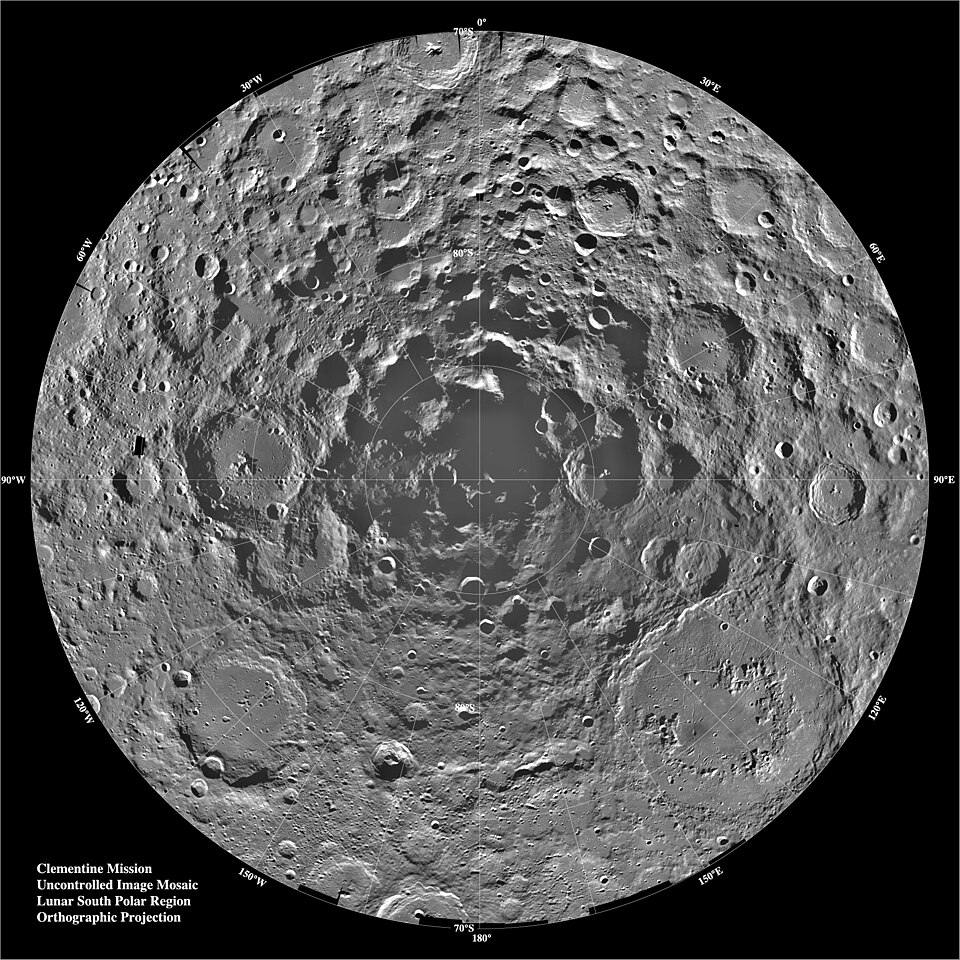
Water on the Moon is mostly found in permanently shadowed craters near the north and south poles. These craters are so deep that sunlight never reaches their floors, keeping temperatures as cold as minus 400 degrees Fahrenheit (minus 240 degrees Celsius). At these extreme cold temperatures, water ice can remain frozen for billions of years without evaporating. In 2020, NASA’s SOFIA telescope also detected water molecules on sunlit parts of the Moon’s surface, trapped in tiny glass beads and between grains of soil.
How Water Got to the Moon
Scientists have several ideas about how water ended up on the Moon. One theory is that comets and asteroids carrying water ice crashed into the Moon over billions of years. Another idea is that the solar wind, a stream of particles from the Sun, interacts with oxygen in Moon rocks to create small amounts of water. It is also possible that water was trapped inside the Moon when it first formed and has been slowly released through volcanic activity. Most likely, the Moon’s water comes from a combination of all these sources.
How Much Water Is There?
The amount of water on the Moon is small compared to Earth, but it is still significant. NASA estimates that the Moon’s south pole alone could contain hundreds of millions of tons of water ice. If you gathered all the water in the permanently shadowed craters, it might fill a medium-sized lake on Earth. The water is not pooled together in one place but is mixed into the lunar soil, called regolith, as tiny ice crystals and thin frost layers. Even the sunlit water detected by SOFIA exists in very small amounts, about the equivalent of a 12-ounce bottle of water spread across a football field of soil.
Why Lunar Water Matters
Water on the Moon could be incredibly useful for future space exploration. Astronauts could use it as drinking water, reducing the need to carry heavy water supplies from Earth. Water can also be split into hydrogen and oxygen using electricity. The oxygen could provide breathable air for lunar bases, and the hydrogen and oxygen together could be used as rocket fuel. Having a source of fuel on the Moon would make it much cheaper and easier to launch missions deeper into space, including trips to Mars.
NASA’s Artemis Program
NASA’s Artemis program aims to send astronauts back to the Moon, with a special focus on the south pole region where water ice has been detected. One of the program’s main goals is to study lunar water up close and figure out how to use it. NASA is also planning to build a small space station called Gateway that will orbit the Moon and serve as a base for exploring the surface. The VIPER rover was designed to drive into shadowed craters and map water ice deposits, helping scientists understand exactly where and how much water is available.
Challenges of Using Lunar Water
Extracting water on the Moon will not be easy. The permanently shadowed craters where most ice is found are among the coldest places in the entire solar system. Rovers and equipment would need to operate in complete darkness and survive extreme cold. The water ice is also mixed into the rocky soil, so it would need to be heated and collected carefully. Engineers are developing special tools and techniques to mine lunar ice, but testing these technologies in such a harsh environment remains a major challenge.
What This Means for the Future
The discovery of water on the Moon has changed how scientists and engineers think about space exploration. Instead of seeing the Moon as a barren, dry wasteland, they now view it as a place with valuable resources. Water could turn the Moon into a refueling station for spacecraft heading to Mars and beyond. International space agencies from the United States, Europe, China, and India are all planning missions to study and eventually use lunar water. The Moon’s water could be the key to making humans a spacefaring species.
 OtterKnow Kids Encyclopedia