Why the Moon Changes Shape
The Moon does not really change shape — what changes is how much of its sunlit side we can see from Earth. As the Moon orbits Earth, the angle between the Sun, Earth, and Moon shifts, creating different phases. The cycle goes from new moon (when the Moon is between Earth and the Sun and we cannot see it) to full moon and back again. The phases in order are new moon, waxing crescent, first quarter, waxing gibbous, full moon, waning gibbous, third quarter, and waning crescent. This cycle repeats every 29.5 days, which is called a synodic month.
Full Moon Names
For centuries, people around the world have given names to each month’s full moon based on nature and the seasons. In North America, many of these names come from Native American traditions. January’s full moon is called the Wolf Moon, while June’s is the Strawberry Moon and October’s is the Hunter’s Moon. The Harvest Moon is the full moon closest to the autumn equinox, usually in September or October, and it rises soon after sunset for several nights in a row. Different cultures have their own names — for example, in Hindu tradition, each full moon is connected to a specific festival or celebration.
The Full Moon and Eclipses
A lunar eclipse can only happen during a full moon, when Earth passes directly between the Sun and the Moon. During a total lunar eclipse, Earth’s shadow completely covers the Moon and turns it a reddish color, which is why people call it a Blood Moon. Lunar eclipses do not happen every month because the Moon’s orbit is tilted about 5 degrees compared to Earth’s orbit around the Sun. This tilt means the Moon usually passes slightly above or below Earth’s shadow. When everything lines up just right, a lunar eclipse can be seen by everyone on the night side of Earth.
How the Full Moon Affects Earth
The full moon has a real effect on Earth’s oceans through its gravitational pull. During a full moon (and a new moon), the Sun, Earth, and Moon line up, creating extra-strong tides called spring tides. These spring tides make high tides higher and low tides lower than usual. Some marine animals, like certain species of coral and crabs, time their spawning and behavior to the full moon cycle. Despite popular myths, scientific studies have found no evidence that the full moon causes unusual human behavior or more emergencies.
Supermoons and Blue Moons
A supermoon occurs when a full moon happens while the Moon is at its closest point to Earth in its orbit, called perigee. During a supermoon, the Moon can appear about 14 percent larger and 30 percent brighter than when it is at its farthest point. A Blue Moon is the name for the second full moon in a single calendar month, which happens roughly every two to three years. Despite the name, a Blue Moon does not actually look blue — it appears the same color as any other full moon. Very rarely, the Moon can look bluish if volcanic ash or wildfire smoke fills the atmosphere with particles that scatter red light.
Observing the Full Moon
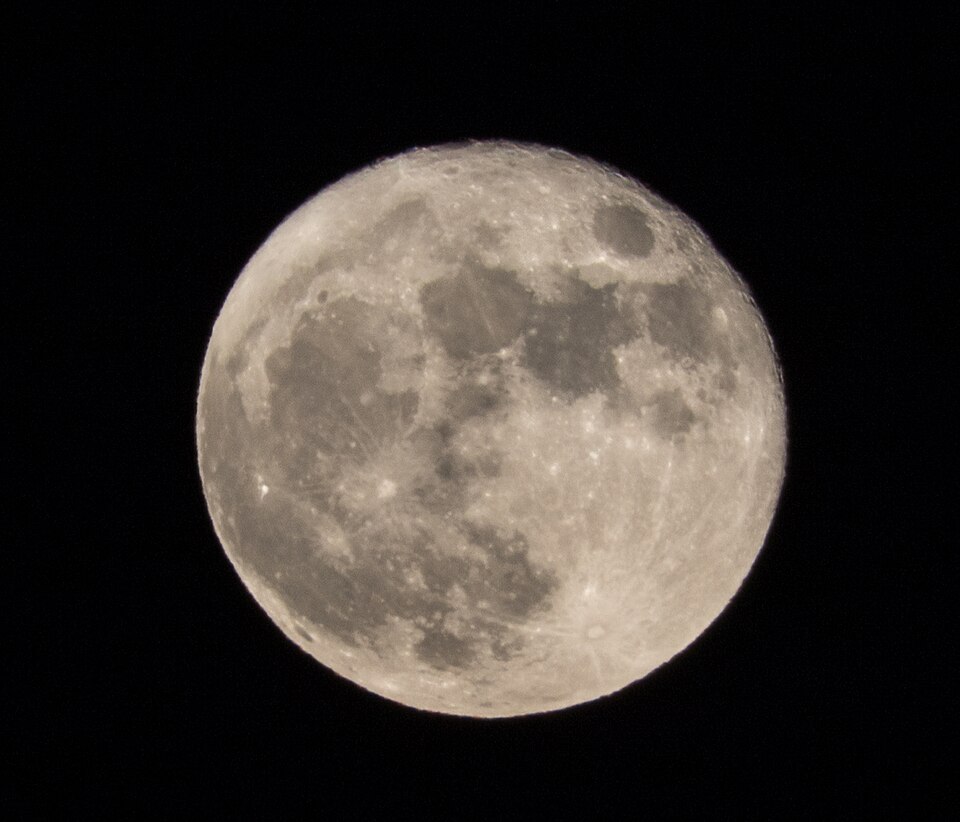
A full moon is one of the easiest objects in the night sky to observe, and you do not need a telescope to enjoy it. With binoculars or a small telescope, you can see the dark flat areas called maria (which means “seas” in Latin) and bright highlands covered with craters. Interestingly, the full moon is not the best time to study craters because the sunlight hits the surface straight on, reducing the shadows that make features stand out. The best time to see crater details is during the first or third quarter phases, when sunlight hits at an angle and casts long shadows. Keeping a Moon journal where you sketch the Moon each night is a great way to learn how it changes through its phases.
The Full Moon in Culture and History
The full moon has inspired people throughout history and plays an important role in many cultures and religions. The Islamic calendar, the Jewish calendar, and the Chinese calendar all use the Moon’s phases to mark months and set dates for holidays. The date of Easter is determined partly by the full moon — it falls on the first Sunday after the first full moon of spring. Ancient farmers used the full moon’s light to harvest crops late into the night, which is how the Harvest Moon got its name. Artists, poets, and musicians have been inspired by the full moon for thousands of years, making it one of the most celebrated objects in the sky.
 OtterKnow Kids Encyclopedia