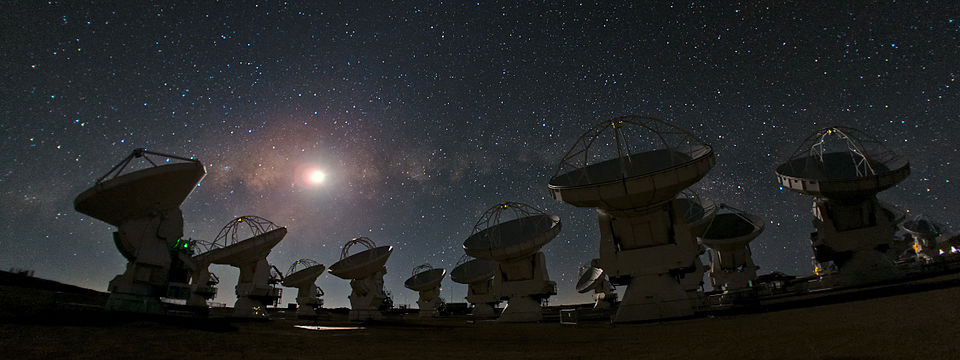
Earth’s Atmosphere Causes Twinkling
The real reason stars twinkle is Earth’s atmosphere, the blanket of air that surrounds our planet. The atmosphere is made up of many layers of gas, and each layer can have a different temperature and density. When starlight passes through these layers, the light gets bent and redirected many times on its way to your eyes. This bending of light is called refraction, and it happens because light changes speed when it moves between areas of different temperature. The constant shifting of air currents makes the starlight wobble, creating the twinkling effect you see.
How Refraction Works
Refraction is the bending of light as it passes from one material to another. You can see refraction in everyday life when a straw in a glass of water looks bent or broken at the surface. Starlight travels in a straight line through space, but as soon as it hits Earth’s atmosphere, it starts bending. The light passes through pockets of warm and cool air, and each pocket bends the light in a slightly different direction. By the time the light reaches your eyes, it has been redirected so many times that the star seems to jump around and change brightness.
Why Planets Don’t Twinkle
If you look carefully at the night sky, you might notice that planets usually shine with a steady light instead of twinkling. This is because planets are much closer to Earth than stars, so they appear as tiny disks rather than pinpoints of light. The light from a planet comes from many slightly different angles, and these different beams of light average out the twinkling effect. Stars are so far away that they appear as single points, making them much more affected by atmospheric disturbances. This difference is actually one way astronomers can tell planets apart from stars without a telescope.
Twinkling Near the Horizon
Stars twinkle more when they are close to the horizon than when they are high overhead. This happens because light from a star near the horizon has to travel through much more of Earth’s atmosphere to reach your eyes. The longer path means the light passes through more pockets of air with different temperatures, causing more refraction. A star directly overhead might pass through about 1 unit of atmosphere, while a star near the horizon passes through roughly 38 times as much atmosphere. That is why stars near the horizon often seem to flash with different colors as their light is bent and separated.
How Astronomers Deal with Twinkling
Twinkling is beautiful to watch, but it causes problems for astronomers trying to study stars. The flickering makes it hard to get clear images of distant objects through telescopes. To solve this problem, scientists developed a technology called adaptive optics, which uses special mirrors that change shape hundreds of times per second to correct for atmospheric distortion. Another solution is to put telescopes in space, like the Hubble Space Telescope, which orbits above the atmosphere where there is no air to cause twinkling. Space telescopes can capture incredibly sharp images because they avoid atmospheric interference entirely.
Twinkling on Other Planets
Twinkling is not unique to Earth. Any planet with an atmosphere would cause starlight to twinkle when viewed from its surface. Mars has a thin atmosphere, so stars viewed from Mars would twinkle less than they do on Earth. A planet with a thicker atmosphere, like Venus, would cause even more twinkling. On the Moon, which has almost no atmosphere at all, stars would appear as steady, unwavering points of light. Astronauts on the International Space Station also see stars without twinkling because they orbit above most of Earth’s atmosphere.
Fun Facts About Twinkling
The famous nursery rhyme “Twinkle, Twinkle, Little Star” was written as a poem by Jane Taylor in 1806, long before scientists fully understood why stars twinkle. Astronomers measure how much stars twinkle at a location to decide if it is a good place to build a telescope. The best observatory sites are usually on high mountains or in dry deserts where the air is thin and steady. The color changes you sometimes see in twinkling stars happen because the atmosphere separates white starlight into its different colors, similar to how a prism creates a rainbow. On a very calm, clear night far from city lights, you can see the difference between twinkling stars and steady planets with just your eyes.
 OtterKnow Kids Encyclopedia