How Big Is the Sun?
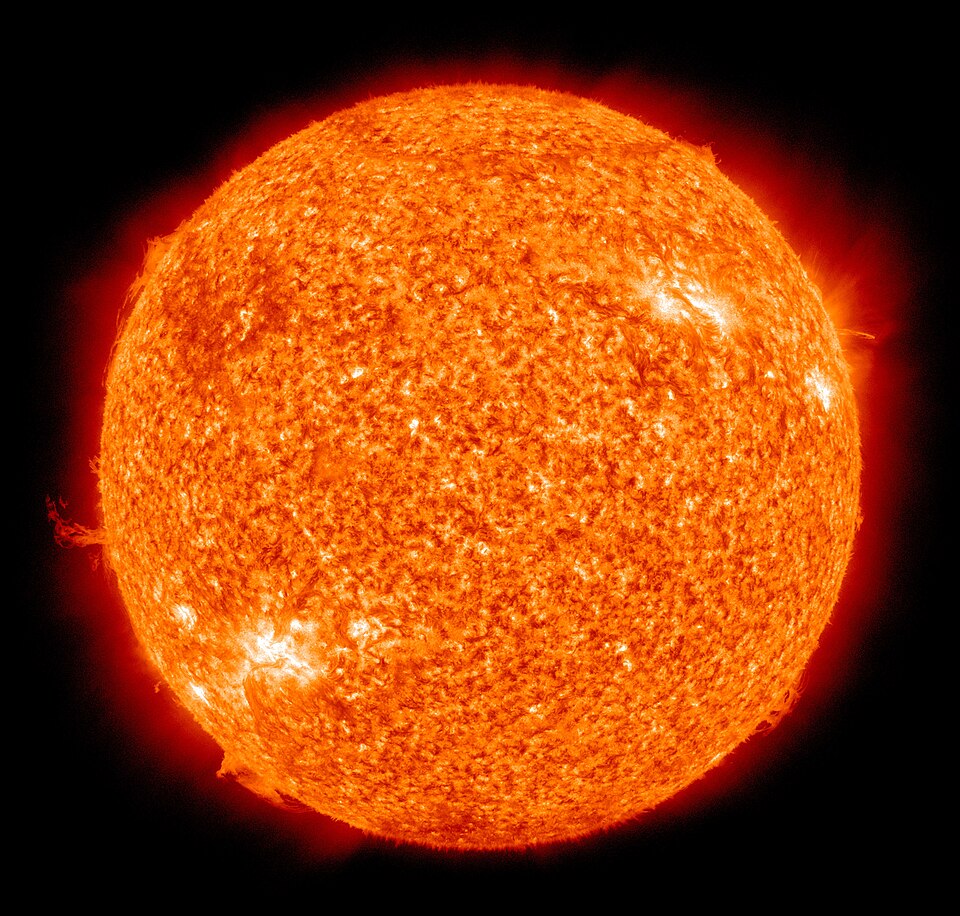
The Sun is so large that about 1.3 million Earths could fit inside it. Its diameter is roughly 864,000 miles, which is about 109 times wider than Earth. If the Sun were a hollow ball, you could pour more than a million Earths into it and still have room left over. The Sun contains about 99.86% of all the mass in the entire solar system. That means all the planets, moons, asteroids, and comets combined make up less than one percent of the solar system’s total weight.
What Is the Sun Made Of?
The Sun is made mostly of two gases called hydrogen and helium. About 73% of the Sun is hydrogen, and about 25% is helium, with small amounts of other elements mixed in. Deep inside the Sun’s core, hydrogen atoms are squeezed together under extreme pressure and temperature. This process is called nuclear fusion, and it is what makes the Sun shine. During fusion, hydrogen atoms combine to form helium, releasing huge amounts of energy as light and heat.
The Sun’s Layers
The Sun has several layers, like an onion. The innermost part is the core, where nuclear fusion happens at temperatures of about 27 million degrees Fahrenheit. Surrounding the core is the radiative zone, where energy slowly bounces outward over thousands of years. The next layer is the convective zone, where hot gas rises and cooler gas sinks in giant circular patterns. The surface we can see is called the photosphere, and it has a temperature of about 10,000 degrees Fahrenheit. Above the surface are the chromosphere and the corona, which can only be seen during a total solar eclipse.
Sunspots and Solar Activity
Sometimes dark patches appear on the Sun’s surface called sunspots. These spots look dark because they are cooler than the surrounding areas, though they are still incredibly hot at around 6,500 degrees Fahrenheit. Sunspots can be as large as Earth or even bigger. The Sun also produces solar flares, which are sudden bursts of energy that shoot out from its surface. The number of sunspots rises and falls in a cycle that lasts about 11 years, known as the solar cycle.
How Far Away Is the Sun?
The Sun is about 93 million miles from Earth, a distance that scientists call one astronomical unit. Light from the Sun takes about 8 minutes and 20 seconds to reach Earth, even though light is the fastest thing in the universe. If you could drive a car to the Sun at highway speed, the trip would take over 100 years. This distance is actually perfect for life on Earth because it keeps our planet at just the right temperature. Scientists sometimes call this ideal distance the “habitable zone” or the “Goldilocks zone.”
The Sun’s Life Cycle
The Sun formed about 4.6 billion years ago from a huge cloud of gas and dust called a nebula. Right now, the Sun is in the middle of its life and has been shining steadily for billions of years. Scientists estimate that the Sun has enough hydrogen fuel to keep burning for about another 5 billion years. When the Sun eventually runs out of hydrogen, it will swell up into a red giant star that could reach as far as Earth’s orbit. After that, it will shrink down into a small, dense star called a white dwarf.
Why the Sun Matters to Us
The Sun is essential for life on Earth in many important ways. Plants use sunlight to make food through a process called photosynthesis, and animals depend on those plants for their own food. The Sun drives our weather by heating the atmosphere and oceans, creating wind and rain patterns around the world. It also gives us our seasons because Earth tilts on its axis as it orbits the Sun. People have studied and respected the Sun for thousands of years, and ancient civilizations even built monuments to track its movements across the sky.
 OtterKnow Kids Encyclopedia