History
NASA Ames traces its origins to December 20, 1939, when the National Advisory Committee for Aeronautics (NACA) established the Ames Aeronautical Laboratory at Moffett Field. The center was named after Joseph Sweetman Ames, a physicist who chaired the NACA for many years and championed government investment in aeronautics research. In its early decades, the lab focused on improving airplane design by testing aircraft models in wind tunnels. When Congress created NASA in 1958, the Ames lab transitioned from NACA to NASA and expanded its mission to include space research. During the Space Race of the 1960s, Ames researchers developed critical technologies for the Apollo program, including heat shield materials that could withstand the extreme temperatures of re-entry.
Aeronautics and Wind Tunnels
One of NASA Ames’s most important contributions has been in the field of aeronautics — the science of flight. The center operates some of the largest and most advanced wind tunnels in the world. The National Full-Scale Aerodynamics Complex, with a test section 80 feet tall and 120 feet wide, is large enough to test full-size aircraft. These wind tunnels create controlled airflows at speeds ranging from gentle breezes to faster than the speed of sound, allowing engineers to study how air moves around wings, fuselages, and spacecraft. Nearly every major American aircraft and many spacecraft designs have been tested in Ames wind tunnels, including the Space Shuttle.
Supercomputing
NASA Ames is home to the NASA Advanced Supercomputing (NAS) facility, which houses some of the most powerful computers on Earth. The center’s Pleiades supercomputer can perform more than seven quadrillion calculations per second. Scientists use these machines to simulate everything from the formation of galaxies to the airflow over new aircraft designs to the behavior of wildfires on Earth. Supercomputing at Ames also supports active NASA missions, processing the enormous amounts of data sent back from spacecraft exploring the solar system.
Astrobiology and the Search for Life
NASA Ames has long been a leader in astrobiology — the study of life in the universe. Researchers at Ames investigate how life began on Earth, what conditions are needed for life to exist, and where life might be found beyond our planet. The center managed the Kepler Space Telescope mission, which launched in 2009 and discovered more than 2,600 confirmed exoplanets — planets orbiting stars other than our Sun. Kepler’s discoveries transformed our understanding of how common planets are in the Milky Way galaxy. Ames scientists also study extremophiles, organisms that survive in extreme environments on Earth, to understand where life might exist on places like Mars or the moons of Jupiter and Saturn.
The Giant Hangar
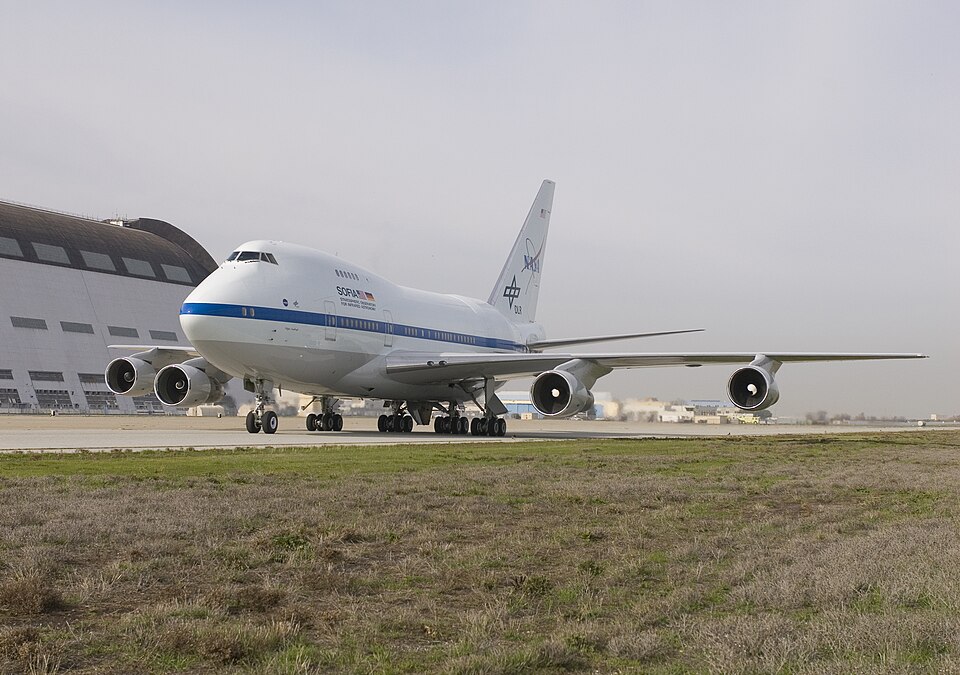
One of the most recognizable landmarks at NASA Ames is Hangar One at Moffett Field. Built in 1933 to house the USS Macon, a massive Navy airship (dirigible), the hangar stands about 200 feet tall and covers eight acres of floor space — large enough that fog has been reported forming inside it. The structure is so enormous that it can be seen from miles away and has become an iconic symbol of the region. After decades of deterioration, a major restoration of Hangar One’s exterior was completed, and the building continues to serve as a striking reminder of the area’s aviation history.
Fun Facts
- NASA Ames was originally built on land that was a naval air station, and the first wind tunnels began operating in 1941.
- The Pleiades supercomputer at Ames is named after the Pleiades star cluster and has been one of the world’s fastest computers since it came online.
- Ames researchers helped develop the thermal protection system used on the Space Shuttle and on the Orion capsule.
- The center has partnerships with more than 600 companies, universities, and government agencies.
- Hangar One is so large that it covers approximately eight acres and stands roughly 200 feet tall — big enough for clouds to reportedly form inside.
 OtterKnow Kids Encyclopedia