Finding Constellations
Constellations are patterns of stars that people have been naming for thousands of years. One of the easiest to find is Orion the Hunter, which is visible in winter and has three bright stars in a row forming his belt. The Big Dipper is another famous pattern, and the two stars at the end of its “bowl” point toward Polaris, the North Star, which always shows you which direction is north. Different constellations appear at different times of year because Earth orbits the Sun, so the part of space we face at night changes with the seasons. Ancient cultures from Greece, China, Egypt, and many Indigenous nations all created their own constellation stories to explain what they saw in the sky.
Spotting Planets
Five planets are bright enough to see without a telescope: Mercury, Venus, Mars, Jupiter, and Saturn. Venus is often the brightest object in the sky after the Sun and Moon, and it appears near the horizon just after sunset or just before sunrise, earning it the nickname “the evening star” or “the morning star.” You can tell planets apart from stars because planets usually shine with a steady light while stars tend to twinkle. Jupiter is so bright that you can sometimes see its four largest moons through a pair of binoculars. Mars has a reddish color that makes it easy to identify, especially when it is closest to Earth during a period called opposition.
Using Binoculars and Telescopes
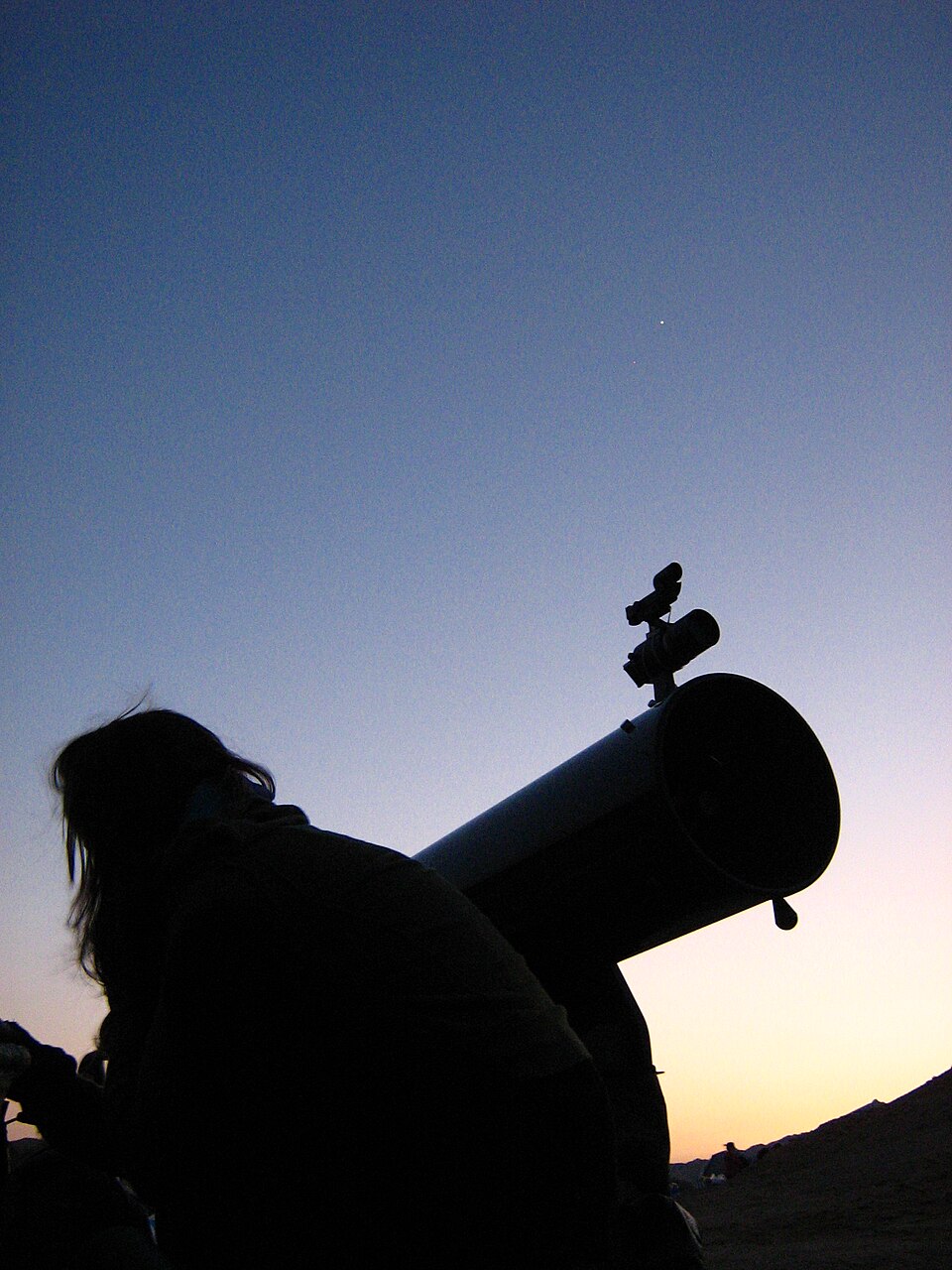
A pair of ordinary binoculars can reveal surprising details in the night sky that your eyes alone cannot see. With binoculars, you can spot craters on the Moon, the Pleiades star cluster, and even the Andromeda Galaxy, which is the farthest object visible to the unaided eye at about 2.5 million light-years away. If you want to go further, a beginner telescope with a 70mm to 90mm aperture can show you Saturn’s rings, Jupiter’s cloud bands, and the phases of Venus. Always start by finding your target with your eyes or binoculars first, then point your telescope to the same spot. Never look at the Sun through binoculars or a telescope without a proper solar filter, because it can cause permanent eye damage in seconds.
Watching Meteor Showers
Meteor showers happen when Earth passes through trails of dust and debris left behind by comets. During a meteor shower, you can see dozens of “shooting stars” streaking across the sky in a single hour. The Perseid meteor shower in August and the Geminid meteor shower in December are two of the best and most reliable showers each year. The Perseids can produce up to 100 meteors per hour under ideal conditions. To watch a meteor shower, find a dark spot, lie on your back, look straight up, and be patient — your eyes need time to catch the quick flashes of light.
The Moon Through the Month
The Moon is the easiest and most rewarding object to observe from your backyard. It goes through a complete cycle of phases — from new moon to full moon and back — every 29.5 days, called a lunar month. During the first quarter and waxing gibbous phases, the shadows along the line between light and dark (called the terminator) make craters and mountains stand out dramatically. Even without binoculars, you can see the dark patches on the Moon called maria, which are ancient lava flows that filled huge impact basins billions of years ago. Keeping a Moon journal where you sketch the Moon’s shape each night is a great way to learn the lunar cycle.
Satellites and the Space Station
On any clear night, you can spot artificial satellites crossing the sky as tiny dots of light moving steadily among the stars. The International Space Station is the brightest satellite and looks like a fast-moving star gliding across the sky in just a few minutes. Websites like NASA’s Spot the Station let you type in your location and find out exactly when the ISS will pass overhead. The ISS is visible because sunlight reflects off its large solar panels, and it is best seen in the hour or two after sunset or before sunrise. Watching the ISS pass over your backyard is exciting because you are seeing a spacecraft with real astronauts living and working inside it.
Keeping an Astronomy Journal
Recording what you observe in the sky is a tradition that goes back centuries and can make stargazing even more fun. In your journal, note the date, time, weather conditions, and what objects you observed. Sketch the Moon’s phase, mark which constellations you found, and write down any interesting sights like a bright planet or a meteor. Over weeks and months, you will notice patterns — how constellations shift across the sky, how planets wander among the stars, and how the Moon changes shape. Famous astronomers like Galileo kept detailed journals of their observations, and those records helped change our understanding of the solar system.
 OtterKnow Kids Encyclopedia