The Cold War and Why It Mattered
After World War II ended in 1945, the United States and the Soviet Union became the two most powerful countries in the world, but they had very different forms of government. The United States was a democracy with a free-market economy, while the Soviet Union was a communist country where the government controlled most aspects of life. Although they never fought each other directly in a major war, the tension between them was called the Cold War. Both sides feared the other might become too powerful, so they competed in building weapons, developing technology, and eventually exploring space. Winning in space would prove to the world which system was stronger.
Sputnik Shocks the World
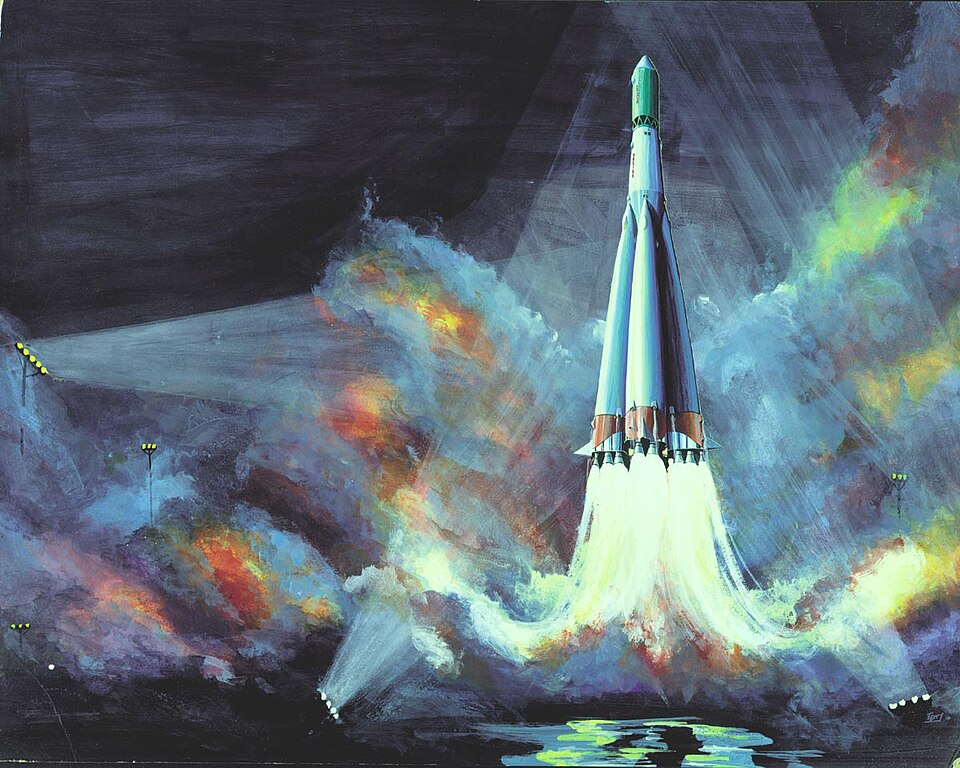
On October 4, 1957, the Soviet Union shocked the world by launching Sputnik 1, the first artificial satellite to orbit Earth. The small, shiny metal sphere sent radio beeps that could be picked up by radios around the globe. Americans were stunned and worried — if the Soviets could launch a satellite, could they also launch weapons from space? The U.S. government quickly created NASA (the National Aeronautics and Space Administration) in 1958 to lead America’s space program. The launch of Sputnik is considered the starting point of the Space Race and changed how both countries thought about science education and technology.
The First People in Space
The Soviet Union scored another major victory on April 12, 1961, when cosmonaut Yuri Gagarin became the first person to orbit Earth aboard Vostok 1. His flight lasted 108 minutes and made him an instant hero around the world. Less than a month later, on May 5, 1961, American astronaut Alan Shepard made a 15-minute suborbital flight, becoming the first American in space. On February 20, 1962, John Glenn became the first American to orbit Earth, circling the planet three times in his Friendship 7 capsule. These early missions were incredibly dangerous, but the brave astronauts and cosmonauts volunteered because they believed in the importance of exploring space.
President Kennedy’s Bold Challenge
On May 25, 1961, President John F. Kennedy made a famous speech to Congress declaring that the United States would land a man on the Moon before the end of the decade. At the time, America had only completed one brief spaceflight, so this goal seemed almost impossible. Kennedy believed that aiming for the Moon would inspire the nation and show the world what Americans could accomplish. NASA’s budget grew enormously, and thousands of engineers, scientists, and workers dedicated themselves to the Apollo program. Kennedy’s challenge gave the Space Race a clear finish line that both nations raced toward.
The Apollo Program and Moon Landing
NASA’s Apollo program was the massive effort to fulfill Kennedy’s promise of reaching the Moon. After years of testing spacecraft and practicing in Earth’s orbit, Apollo 11 launched on July 16, 1969, carrying astronauts Neil Armstrong, Buzz Aldrin, and Michael Collins. On July 20, Armstrong and Aldrin landed on the Moon’s surface in the lunar module called Eagle, while Collins orbited above. An estimated 600 million people around the world watched on television as Armstrong took the first steps on the Moon. The Moon landing is widely considered the moment the United States won the Space Race.
The Space Race involved hundreds of thousands of people working behind the scenes, not just the astronauts who became famous. Katherine Johnson, a brilliant African American mathematician at NASA, calculated the flight paths that kept astronauts safe during crucial missions, including John Glenn’s orbital flight. Engineers like Wernher von Braun designed the powerful Saturn V rocket that carried Apollo missions to the Moon. On the Soviet side, chief rocket designer Sergei Korolev led their space program in secret for many years. Many of these unsung heroes, including women and people of color, overcame discrimination to make major contributions to space exploration.
How the Space Race Changed the World
The Space Race ended with the Apollo 11 Moon landing in 1969, but its effects continue to shape our lives today. Technologies developed for the space program led to inventions we use every day, including satellite television, GPS navigation, memory foam, and water purification systems. The competition inspired millions of young people to study science, technology, engineering, and math. In 1975, the former rivals even cooperated on the Apollo-Soyuz mission, where American and Soviet spacecraft docked together in orbit for the first time. The Space Race proved that when people work together toward a bold goal, they can achieve things that once seemed impossible.
 OtterKnow Kids Encyclopedia