The Space Race
During the 1950s and 1960s, the United States and the Soviet Union competed to see who could achieve the most in space exploration. This competition was called the Space Race. The Soviet Union launched the first satellite, Sputnik, in 1957 and sent the first human, Yuri Gagarin, into orbit in 1961. These achievements motivated the United States to set its sights on the Moon. The Apollo program became America’s answer to the challenge of the Space Race.
The Saturn V Rocket
To reach the Moon, NASA needed the most powerful rocket ever built. The Saturn V rocket stood 363 feet tall, which is taller than the Statue of Liberty. It was designed by a team led by engineer Wernher von Braun and could carry astronauts and their spacecraft all the way to the Moon. The rocket had three stages that fired one after another, each one falling away after its fuel was used up. A total of 13 Saturn V rockets were launched, and none of them ever failed during a mission.
Apollo 11: The First Moon Landing
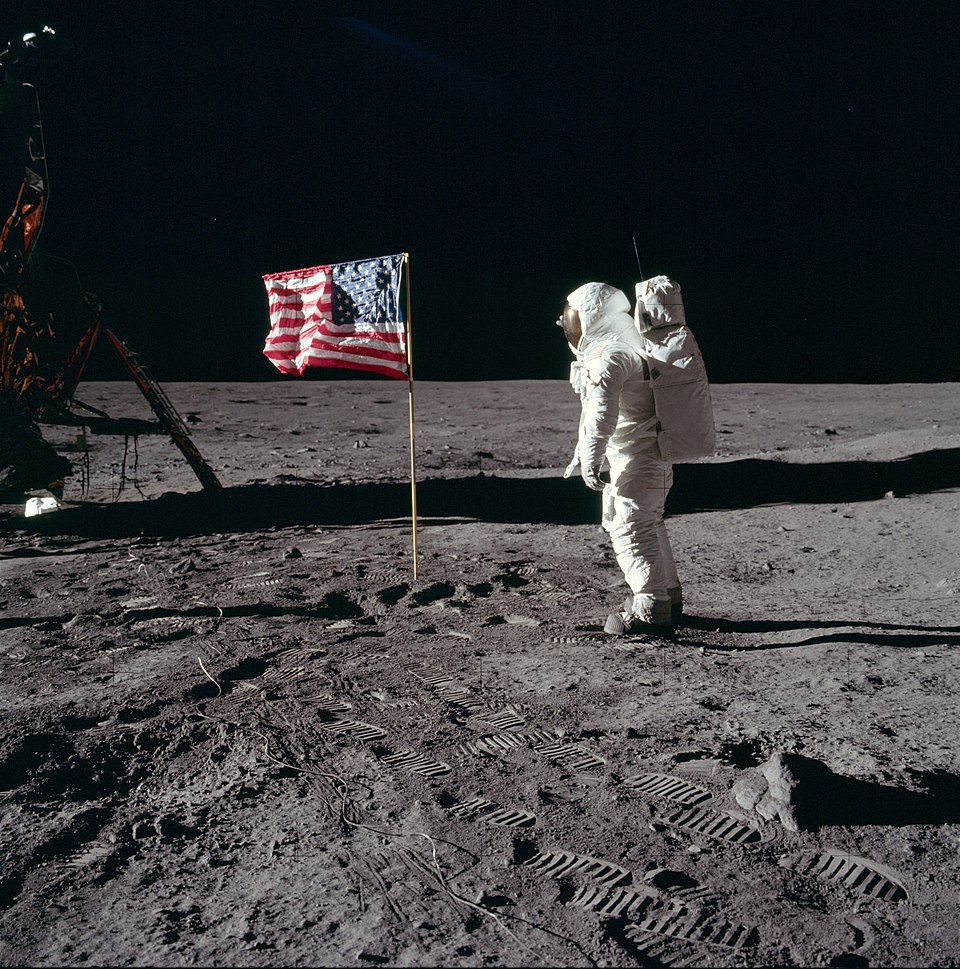
On July 20, 1969, astronauts Neil Armstrong and Buzz Aldrin became the first humans to walk on the Moon during the Apollo 11 mission. Neil Armstrong famously said, “That’s one small step for man, one giant leap for mankind” as he stepped onto the lunar surface. Michael Collins orbited the Moon in the command module while his crewmates explored below. The astronauts collected Moon rocks, planted an American flag, and set up scientific experiments. They spent about two and a half hours walking on the Moon before returning to their spacecraft.
Other Apollo Moon Missions
After Apollo 11, five more missions successfully landed astronauts on the Moon. Apollo 12 through Apollo 17 each explored different areas of the lunar surface, with astronauts collecting hundreds of pounds of Moon rocks and soil. Apollo 15, 16, and 17 brought a lunar rover, a small electric car that let astronauts drive across the Moon’s surface. Apollo 13 is famous for a dangerous emergency when an oxygen tank exploded, but the crew made it home safely thanks to quick thinking by the astronauts and Mission Control. In total, twelve astronauts walked on the Moon during the Apollo program.
What Astronauts Discovered
Apollo astronauts brought back 842 pounds of Moon rocks and soil samples for scientists to study. These samples taught us that the Moon is about 4.5 billion years old, roughly the same age as Earth. Scientists learned that the Moon was likely formed when a large object crashed into Earth billions of years ago, sending debris into orbit that eventually became the Moon. The astronauts also set up instruments on the Moon that measured moonquakes, solar wind, and laser reflectors that scientists still use today. These discoveries changed our understanding of the Moon and the entire solar system.
The People Behind Apollo
The Apollo program employed about 400,000 people across the United States, including engineers, scientists, technicians, and factory workers. Katherine Johnson, a mathematician at NASA, calculated the flight paths that helped astronauts travel safely to the Moon and back. Margaret Hamilton led the team that wrote the computer software for the Apollo spacecraft, and her work prevented errors during the Apollo 11 landing. Flight directors like Gene Kranz managed Mission Control in Houston, Texas, making split-second decisions during missions. Without the dedication of all these people working together, the Moon landings would not have been possible.
The Legacy of Apollo
The Apollo program ended in December 1972 with the Apollo 17 mission, and no human has returned to the Moon since then. The technology and knowledge gained from Apollo helped NASA build the Space Shuttle and the International Space Station. Many everyday inventions came from Apollo-era research, including memory foam, freeze-dried food, and water purification systems. NASA’s Artemis program now plans to send astronauts back to the Moon in the coming years. The Apollo program proved that when people work together toward a big goal, they can accomplish things that once seemed impossible.
 OtterKnow Kids Encyclopedia