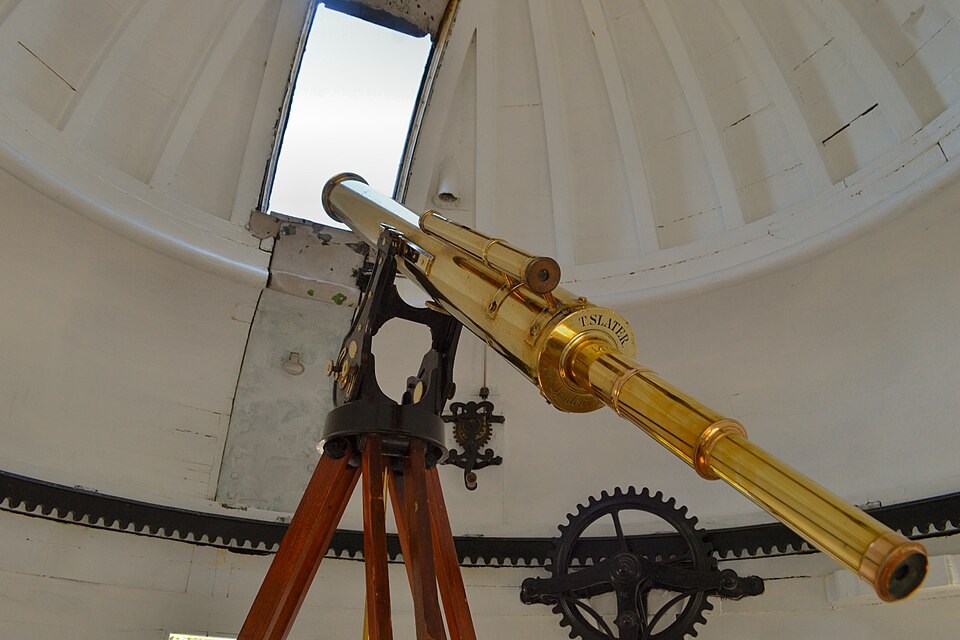
The History of Telescopes
The first practical telescopes were built in the Netherlands around 1608 by eyeglass makers like Hans Lippershey. In 1609, the Italian scientist Galileo Galilei built his own telescope and became the first person to use one to study the sky carefully. Galileo discovered mountains on the Moon, four large moons orbiting Jupiter, and the phases of Venus. Over the centuries, telescopes grew larger and more powerful, letting astronomers see farther into space. Isaac Newton invented a new kind of telescope in 1668 that used mirrors instead of lenses, and this design is still used in many telescopes today.
Types of Telescopes
There are several different types of telescopes, and each one is designed to detect a different kind of light or energy. Optical telescopes use lenses or mirrors to gather visible light, the same kind of light our eyes can see. Radio telescopes have large dish-shaped antennas that pick up radio waves from space, which are invisible to our eyes. Space telescopes like Hubble and the James Webb Space Telescope orbit above Earth’s atmosphere, where they can capture much clearer images. There are also X-ray telescopes and infrared telescopes, each revealing things that other telescopes cannot see.
What Is an Observatory?
An observatory is a building or facility specifically designed for watching and studying objects in space. Most observatories are built on top of tall mountains, far from city lights, where the air is thin and dry. The thin air at high elevations means there is less atmosphere to blur the view of stars and planets. Famous observatories include the Mauna Kea Observatory in Hawaii, which sits nearly 4,200 meters (about 13,800 feet) above sea level. Some observatories are not on mountains at all but are located in space, orbiting Earth or even the Sun.
Famous Observatories Around the World
The Mauna Kea Observatory in Hawaii is home to some of the world’s largest and most powerful telescopes. The European Southern Observatory (ESO) operates several telescopes in the Atacama Desert of Chile, one of the driest places on Earth, which makes it perfect for stargazing. The Arecibo Observatory in Puerto Rico had one of the largest radio telescopes ever built, with a dish 305 meters wide, until it collapsed in 2020. The Very Large Telescope (VLT) in Chile uses four large mirrors that can work together to act like a single enormous telescope. Each of these observatories has helped scientists make important discoveries about the universe.
Space Telescopes
Some of the best views of the universe come from telescopes that are sent into space on rockets. The Hubble Space Telescope, launched in 1990, has taken hundreds of thousands of sharp, detailed images over more than 30 years. Space telescopes have a huge advantage because Earth’s atmosphere bends and blurs light, which makes ground-based images less sharp. The Chandra X-ray Observatory detects X-rays from extremely hot objects like exploding stars and black holes. By placing telescopes above the atmosphere, scientists can see the universe more clearly than ever before.
How Telescopes Help Us Learn
Telescopes have helped scientists make some of the most important discoveries in history. They showed us that Earth is not the center of the universe and that our galaxy is just one of billions. Modern telescopes have found thousands of exoplanets, which are planets orbiting stars other than our Sun. Telescopes also help astronomers study dark matter, black holes, and the expansion of the universe. Every time a more powerful telescope is built, we learn something new and surprising about the universe.
The Future of Telescopes
Scientists and engineers are always working on bigger and better telescopes to see even deeper into space. The Extremely Large Telescope (ELT), being built in Chile, will have a mirror 39 meters across when it is finished, making it the largest optical telescope ever constructed. New radio telescope arrays, like the Square Kilometre Array being built in South Africa and Australia, will be able to detect incredibly faint signals from across the universe. Future space telescopes may one day be able to take direct pictures of Earth-like planets around other stars. As telescope technology improves, there is no telling what we will discover next.
 OtterKnow Kids Encyclopedia