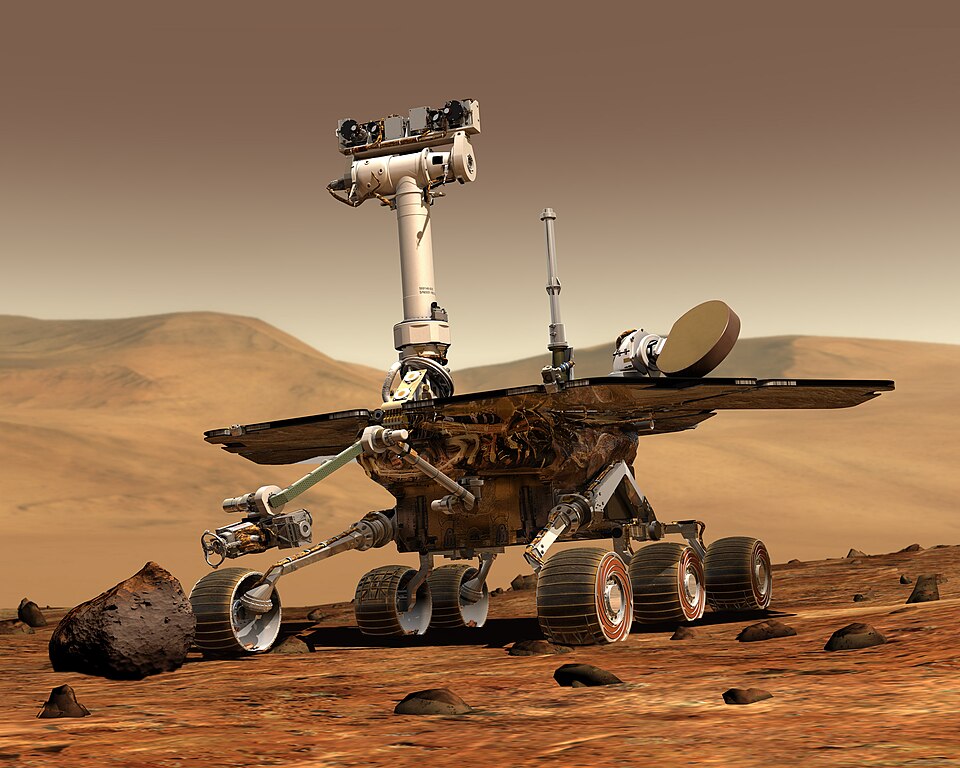
Mars Rovers
Some of the most famous robotic explorers are the rovers that NASA has sent to Mars. The Curiosity rover landed on Mars in 2012 and has been exploring Gale Crater, studying rocks and soil to learn if Mars ever had conditions that could support life. In 2021, the Perseverance rover landed in Jezero Crater, where it collects rock samples that will someday be brought back to Earth. Perseverance also carried Ingenuity, a small helicopter that became the first aircraft to fly on another planet. These rovers move slowly, traveling only about 100 to 200 feet per day, but they have made important discoveries.
Flyby and Orbiter Missions
Not all robotic explorers land on the surfaces of other worlds. Flyby spacecraft zoom past planets and moons, snapping pictures and collecting data as they go. NASA’s Voyager 1 and Voyager 2, launched in 1977, flew past Jupiter, Saturn, Uranus, and Neptune, sending back the first close-up images of those giant planets. Orbiters circle around a planet or moon for months or even years, mapping the surface in great detail. The Cassini spacecraft orbited Saturn for 13 years, discovering ocean worlds hiding beneath the icy shells of Saturn’s moons.
Landers and Probes
Landers are robotic spacecraft designed to touch down on the surface of another world and stay in one place. The Viking 1 lander was the first spacecraft to successfully land on Mars in 1976 and send back pictures from the surface. The Huygens probe, built by the European Space Agency, parachuted through the thick atmosphere of Saturn’s moon Titan in 2005 and landed on its surface. Japan’s Hayabusa2 mission visited the asteroid Ryugu, collected samples from its surface, and brought them back to Earth in 2020. These missions help scientists understand what other worlds are made of.
Exploring the Outer Solar System
Robotic explorers have ventured to the farthest reaches of our solar system. NASA’s New Horizons spacecraft flew past Pluto in 2015, revealing mountains of ice and a heart-shaped plain on this distant dwarf planet. The Juno spacecraft has been orbiting Jupiter since 2016, studying its powerful storms and magnetic field. Voyager 1 is now more than 15 billion miles from Earth, making it the most distant human-made object in existence. It takes over 22 hours for a radio signal from Voyager 1 to reach Earth, traveling at the speed of light.
How Scientists Control Robots in Space
Controlling a robot millions of miles away is very different from using a remote-control car. Because signals travel at the speed of light, commands sent to a Mars rover take between 4 and 24 minutes to arrive, depending on how far apart Earth and Mars are. Scientists at NASA’s Jet Propulsion Laboratory plan each day’s activities carefully and upload a full set of instructions for the rover to follow. The rovers also have some ability to make decisions on their own, like avoiding rocks in their path. This combination of human planning and robot independence keeps the missions running smoothly.
What Robotic Explorers Have Discovered
Robotic explorers have made some of the biggest discoveries in the history of space science. The Curiosity rover found evidence that Mars once had rivers and lakes of liquid water billions of years ago. Cassini discovered that Saturn’s moon Enceladus shoots geysers of water into space from a hidden ocean beneath its icy surface. The MESSENGER spacecraft found water ice hiding in permanently shadowed craters on Mercury, the closest planet to the Sun. These discoveries have changed how scientists think about where life might exist beyond Earth.
The Future of Robotic Exploration
Scientists are planning even more ambitious robotic missions for the future. NASA’s Europa Clipper, launched in 2024, will study Jupiter’s moon Europa to learn more about the ocean of liquid water beneath its icy crust. The Dragonfly mission will send a drone-like rotorcraft to fly across the surface of Saturn’s moon Titan, exploring its strange landscape of methane lakes and sand dunes. China and other countries are also planning missions to Mars, the Moon, and beyond. Robotic explorers will continue to be our scouts, helping us understand the universe before humans follow in their path.
 OtterKnow Kids Encyclopedia