The V-2 Rocket
The V-2 was the world’s first large-scale liquid-fueled rocket, developed in Germany during World War II by a team led by engineer Wernher von Braun. It stood about 46 feet tall and could travel at speeds over 3,500 miles per hour. Although it was originally built as a weapon, the V-2’s technology became the foundation for almost all modern rockets. After the war, both the United States and the Soviet Union brought V-2 rockets and German engineers to their countries to start their own space programs.
The Soviet R-7 and Sputnik
The Soviet Union’s R-7 rocket made history on October 4, 1957, when it launched Sputnik 1, the first artificial satellite ever to orbit Earth. Sputnik was a shiny metal ball about the size of a beach ball that beeped a radio signal as it circled the planet every 96 minutes. The R-7 was designed by Sergei Korolev, who is often called the father of the Soviet space program. The launch of Sputnik shocked the world and started the Space Race between the Soviet Union and the United States.
Vostok and the First Human in Space
On April 12, 1961, Soviet cosmonaut Yuri Gagarin became the first human to travel to space aboard the Vostok 1 spacecraft, launched by a modified R-7 rocket. His flight lasted just 108 minutes and completed one full orbit around Earth. Gagarin became an instant worldwide hero, and his flight proved that humans could survive in the weightless environment of space. The Vostok program went on to launch five more crewed missions, including Valentina Tereshkova, the first woman in space, in 1963.
The Saturn V Moon Rocket
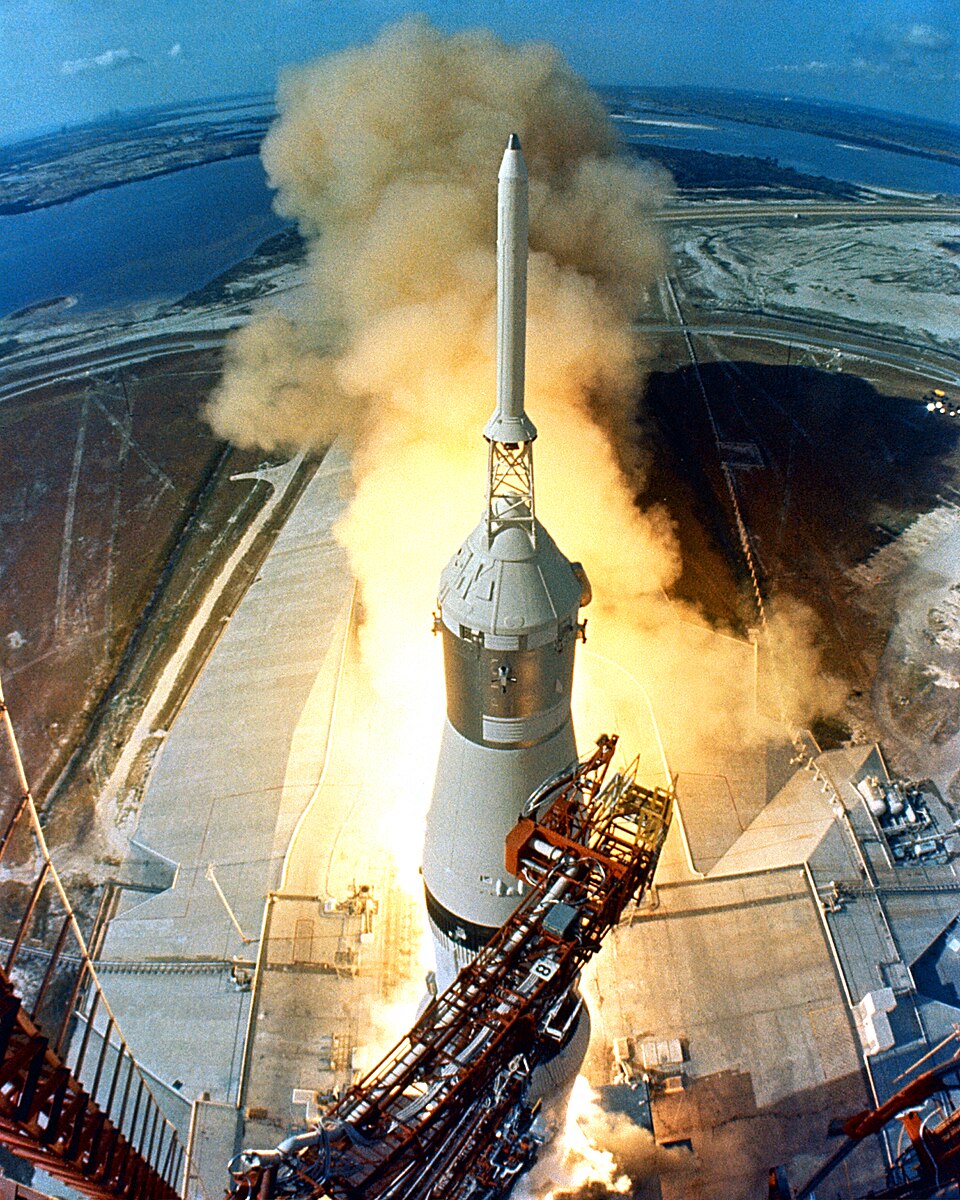
The Saturn V is one of the most famous rockets ever built and remains the most powerful rocket that has successfully flown. Standing 363 feet tall, it was taller than the Statue of Liberty and produced 7.5 million pounds of thrust at liftoff. NASA used the Saturn V to launch all of the Apollo missions to the Moon, including Apollo 11 in 1969, when Neil Armstrong and Buzz Aldrin became the first humans to walk on the lunar surface. A total of 13 Saturn V rockets were launched between 1967 and 1973, and none of them ever failed during a mission.
The Space Shuttle Era
NASA’s Space Shuttle flew from 1981 to 2011 and was the first reusable crewed spacecraft. Unlike earlier rockets that could only be used once, the shuttle’s orbiter glided back to Earth and landed on a runway like an airplane. The shuttle fleet — Columbia, Challenger, Discovery, Atlantis, and Endeavour — flew 135 missions over 30 years, carrying astronauts, satellites, and parts of the International Space Station into orbit. Tragically, two shuttles were lost in accidents: Challenger in 1986 and Columbia in 2003, reminding everyone of the dangers of space travel.
Other Important Rockets
Many other rockets played key roles in the history of space exploration. The Atlas rocket carried John Glenn, the first American to orbit Earth, in 1962. The Titan II rocket launched all ten Gemini missions in the mid-1960s, helping NASA practice the skills needed for Moon missions. The European Space Agency’s Ariane rockets have been launching satellites since 1979 and remain important today. Each of these rockets helped push the boundaries of what was possible in space.
The Legacy of Historic Rockets
The historic rockets of the past created a path that today’s spacecraft continue to follow. Engineers learned from every success and every failure, making each new rocket safer and more powerful than the last. The Saturn V proved that humans could reach the Moon, and the Space Shuttle showed that spacecraft could be reused. Today’s rockets, like SpaceX’s Falcon 9 and NASA’s Space Launch System, stand on the shoulders of these earlier achievements. Without the pioneering rockets of the past, none of our modern space exploration would be possible.
 OtterKnow Kids Encyclopedia