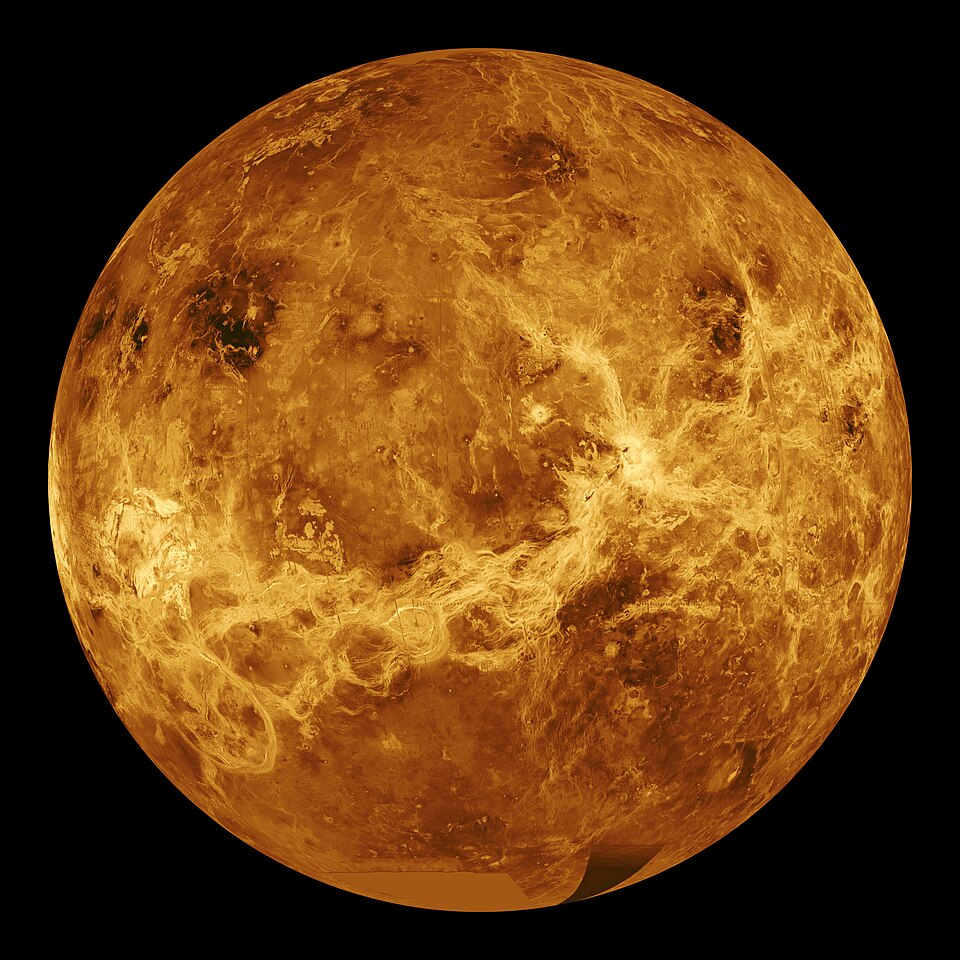
A Scorching Atmosphere
Venus has the hottest surface of any planet in our solar system, with temperatures reaching about 900 degrees Fahrenheit (475 degrees Celsius). The extreme heat is caused by a runaway greenhouse effect, where thick clouds of carbon dioxide trap heat from the Sun and prevent it from escaping back into space. The atmosphere of Venus is about 96.5 percent carbon dioxide, with clouds made of sulfuric acid droplets. The atmospheric pressure on the surface of Venus is about 90 times greater than Earth’s, which is similar to the pressure found 3,000 feet underwater in Earth’s oceans. This crushing pressure and extreme heat make Venus one of the most hostile environments in the solar system.
Backward Rotation
One of the strangest things about Venus is that it rotates in the opposite direction from most other planets. While Earth and most planets spin counterclockwise when viewed from above their north poles, Venus spins clockwise, which is called retrograde rotation. This means that on Venus, the Sun rises in the west and sets in the east. A single day on Venus, measured from one sunrise to the next, lasts about 117 Earth days. Venus also rotates very slowly, taking about 243 Earth days to complete one full spin, which means a day on Venus is actually longer than its year of 225 Earth days.
Surface and Geology
The surface of Venus is covered with volcanic plains, mountains, and thousands of volcanoes. The tallest mountain on Venus, Maxwell Montes, rises about 7 miles (11 kilometers) above the average surface level, making it taller than Mount Everest. Scientists believe that Venus may still have active volcanoes, based on evidence from recent spacecraft observations that detected changes in sulfur dioxide levels in the atmosphere. The surface of Venus appears to be relatively young, estimated at around 300 to 600 million years old, suggesting that massive volcanic events may have resurfaced the entire planet. Unlike Earth, Venus does not have tectonic plates, so its geology works very differently from our planet.
Exploring Venus
Venus has been visited by more spacecraft than any other planet. The Soviet Union’s Venera program was the first to successfully land spacecraft on Venus, with Venera 7 achieving the first successful landing on another planet in 1970. The Venera landers survived the extreme conditions for only short periods, but they managed to send back the first photographs ever taken from the surface of another planet. NASA’s Magellan spacecraft orbited Venus from 1990 to 1994 and used radar to map 98 percent of the planet’s surface through its thick clouds. More recently, the European Space Agency’s Venus Express orbited the planet from 2006 to 2014, studying its atmosphere in great detail.
Venus in the Sky
Venus is one of the easiest planets to spot because it is so bright, shining with a white or yellowish light that outshines every star. Because Venus orbits closer to the Sun than Earth does, it always appears near the Sun in the sky, visible either just after sunset or just before sunrise. When it appears in the evening, it is called the Evening Star, and when it appears in the morning, it is called the Morning Star. Ancient civilizations, including the Greeks, originally thought these were two different objects before realizing they were the same planet. Venus can sometimes be bright enough to cast faint shadows on Earth and can even be seen during the daytime if you know exactly where to look.
Comparing Venus and Earth
Venus and Earth are sometimes called sister planets because they formed from the same materials in the same part of the solar system about 4.5 billion years ago. Both planets have a similar size, mass, and density, and both have thick atmospheres and solid rocky surfaces. However, Venus took a very different path from Earth, developing a runaway greenhouse effect that boiled away any water it may have once had. Scientists study Venus to better understand how planets with similar starting conditions can end up so different. Learning about Venus helps researchers understand climate change and what could happen if greenhouse gases build up too much in a planet’s atmosphere.
Future Missions
Several space agencies have announced plans to send new missions to Venus in the coming years. NASA has approved two missions called VERITAS and DAVINCI, which are expected to launch in the late 2020s or early 2030s to study the planet’s surface and atmosphere. The European Space Agency is also planning a mission called EnVision to map the surface of Venus in high detail. These missions will help answer important questions about whether Venus ever had oceans and whether volcanoes are still erupting on its surface today. Scientists are especially excited to learn more about Venus because understanding its history could teach us important lessons about the future of our own planet.
 OtterKnow Kids Encyclopedia