Size and Distance
Uranus is the third-largest planet in our solar system, with a diameter of about 31,518 miles (50,724 kilometers). That means roughly 63 Earths could fit inside Uranus. The planet orbits the Sun at an average distance of about 1.8 billion miles (2.9 billion kilometers), making it very far from the warmth of our star. At that distance, sunlight takes about two and a half hours to reach Uranus. Because it is so far away, Uranus takes 84 Earth years to complete a single orbit around the Sun.
Atmosphere and Weather
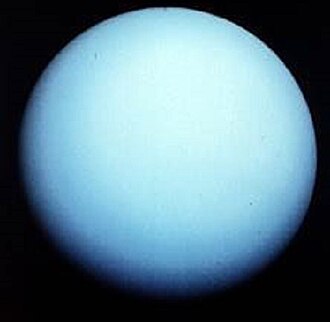
The atmosphere of Uranus is made mostly of hydrogen and helium, with a significant amount of methane gas mixed in. It is the methane in the upper atmosphere that gives Uranus its blue-green color by absorbing red light from the Sun and reflecting blue light back into space. Uranus is extremely cold, with temperatures in its upper atmosphere dropping to about minus 371 degrees Fahrenheit (minus 224 degrees Celsius), making it the coldest planetary atmosphere in the solar system. Despite its calm appearance, Uranus does experience powerful wind storms that can reach speeds of up to 560 miles per hour (900 kilometers per hour). Scientists have also observed seasonal changes in the atmosphere as different parts of the planet receive sunlight during its long orbit.
Rings of Uranus
Uranus has a system of 13 known rings, though they are much darker and thinner than the famous rings of Saturn. The rings were first discovered in 1977 by astronomers James Elliot, Edward Dunham, and Jessica Mink, who noticed starlight dimming as it passed behind the planet. The rings are made up of dark particles ranging in size from tiny dust grains to small boulders. Unlike Saturn’s bright, icy rings, the rings of Uranus are composed of very dark material that reflects very little light. The innermost rings are narrow and faint, while the outermost ring, called the epsilon ring, is the brightest and easiest to observe.
Moons of Uranus
Uranus has 27 known moons, and they are all named after characters from the works of William Shakespeare and Alexander Pope. The five largest moons are Miranda, Ariel, Umbriel, Titania, and Oberon. Titania is the biggest of these moons, with a diameter of about 981 miles (1,578 kilometers). Miranda is one of the most interesting moons because its surface has huge canyons and cliffs, including a cliff called Verona Rupes that is about 12 miles (20 kilometers) tall. Many of the smaller moons were discovered by the Voyager 2 spacecraft and by ground-based telescopes in more recent years.
Discovery and History
Uranus was the first planet to be discovered using a telescope. The British astronomer William Herschel spotted it on March 13, 1781, while surveying stars from his garden in Bath, England. At first, Herschel thought he had found a comet, but further observations confirmed it was a new planet. Herschel wanted to name the planet “Georgium Sidus” (George’s Star) after King George III, but the name Uranus, after the ancient Greek god of the sky, was eventually adopted instead. The discovery of Uranus nearly doubled the known size of the solar system at that time.
Exploration by Spacecraft
Only one spacecraft has ever visited Uranus. NASA’s Voyager 2 flew past the planet on January 24, 1986, coming within about 50,600 miles (81,500 kilometers) of the cloud tops. During its flyby, Voyager 2 discovered 10 new moons and two new rings that had not been seen from Earth. The spacecraft also measured the planet’s magnetic field and found that it is tilted at a strange 59-degree angle from the planet’s rotational axis. Scientists and space agencies have proposed future missions to study Uranus more closely, but as of now, no new missions have been approved for launch.
Fun Facts About Uranus
A day on Uranus lasts about 17 hours and 14 minutes, which is shorter than an Earth day. Because of its extreme tilt, each pole gets about 42 years of continuous sunlight followed by 42 years of darkness. Uranus is sometimes called an ice giant because its interior contains a thick layer of water, ammonia, and methane ices surrounding a small rocky core. The planet is so far away that it appears as just a tiny blue-green dot even through powerful telescopes. Despite being larger than Neptune, Uranus is actually less massive, making it the least dense of the giant planets after Saturn.
 OtterKnow Kids Encyclopedia