How Neptune Was Discovered
Neptune’s discovery in 1846 is one of the greatest stories in the history of science. Astronomers had noticed that Uranus was not moving exactly as predicted — something seemed to be pulling on it with gravity. Two mathematicians, Urbain Le Verrier in France and John Couch Adams in England, independently calculated where an unknown planet must be located to cause this effect. When astronomer Johann Galle pointed his telescope at the spot Le Verrier predicted, he found Neptune on his very first night of looking. This showed that mathematics could predict things we cannot yet see.
Size and Structure
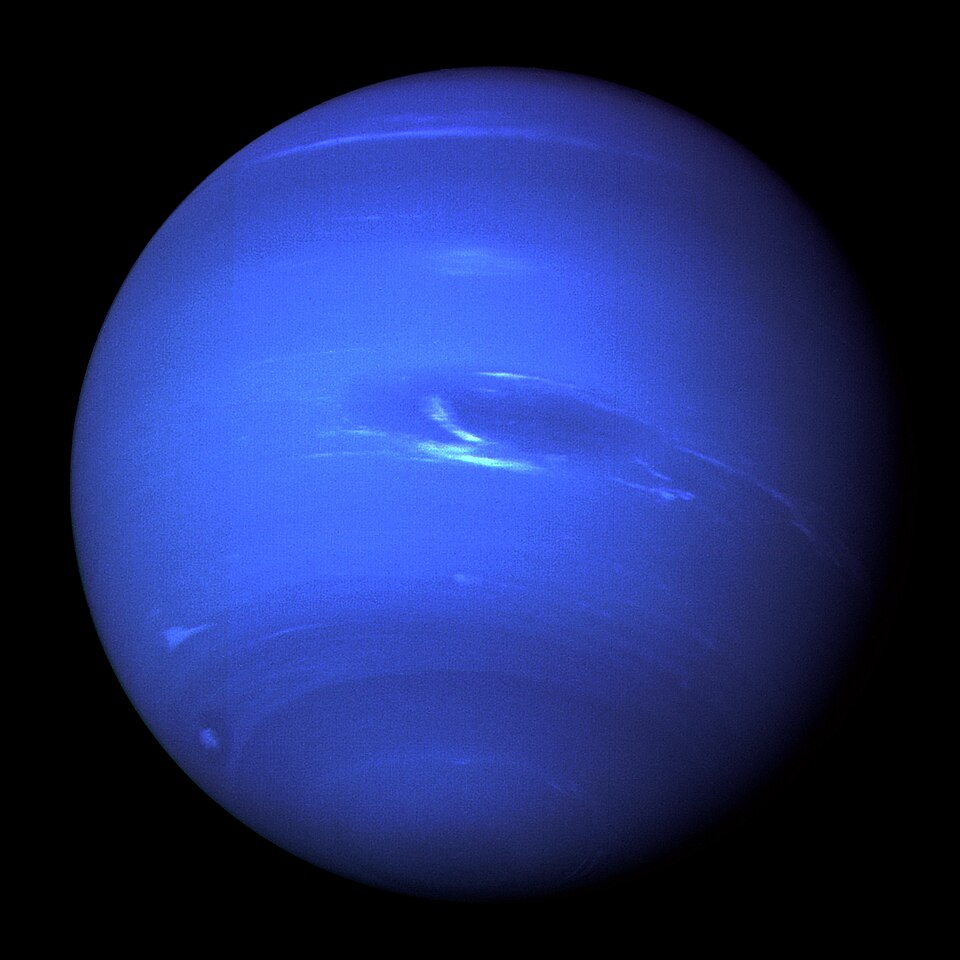
Neptune is the fourth-largest planet in our solar system, with a diameter of about 30,599 miles — nearly four times wider than Earth. Despite being slightly smaller than Uranus, Neptune is actually denser and more massive. Deep inside, Neptune has a rocky core roughly the size of Earth, surrounded by a thick layer of water, ammonia, and methane ices. Above the icy layer is a deep atmosphere of hydrogen, helium, and methane gas. The methane in Neptune’s atmosphere absorbs red light from the Sun and reflects blue light back, which is why Neptune appears as a deep blue color.
The Wildest Winds in the Solar System
Neptune has the fastest winds ever measured on any planet in the solar system. Wind speeds on Neptune can reach up to 1,200 miles per hour, which is faster than the speed of sound on Earth. When the Voyager 2 spacecraft flew past Neptune in 1989, it spotted a massive storm called the Great Dark Spot that was about the size of Earth. Unlike Jupiter’s Great Red Spot, Neptune’s storms seem to come and go over the years. Scientists are still trying to understand how a planet so far from the Sun, receiving very little solar energy, can produce such powerful storms.
Neptune’s Rings and Moons
Neptune has a system of faint rings made of dust and ice particles. The rings are much darker and harder to see than Saturn’s famous rings, and they were confirmed when Voyager 2 visited in 1989. Neptune has 16 known moons, and the largest by far is Triton. Triton is unusual because it orbits Neptune in the opposite direction from the planet’s rotation, which suggests it was captured from the Kuiper Belt long ago. Triton’s surface is one of the coldest places in the solar system, with temperatures around minus 391 degrees Fahrenheit (minus 235 degrees Celsius).
Triton: Neptune’s Biggest Moon
Triton deserves special attention because it is one of the most interesting moons in the solar system. It is the seventh-largest moon overall and the only large moon that orbits its planet backward, called a retrograde orbit. Voyager 2 discovered that Triton has geysers that shoot nitrogen gas and dark dust several miles above its surface. Triton has a thin atmosphere made mostly of nitrogen, similar to Earth’s atmosphere but much thinner. Scientists believe that Triton’s backward orbit will eventually cause it to spiral closer to Neptune, and millions of years from now it could break apart and form a spectacular ring system.
Exploring Neptune
Neptune has only been visited by one spacecraft in all of human history. NASA’s Voyager 2 flew past Neptune on August 25, 1989, coming within about 3,000 miles of the planet’s cloud tops. During this brief flyby, Voyager 2 discovered six new moons, confirmed Neptune’s rings, and captured detailed images of the planet and Triton. Since then, scientists have studied Neptune using the Hubble Space Telescope and the James Webb Space Telescope. There are proposals for future missions to Neptune and its moons, but no mission has been officially approved yet.
Why Neptune Matters
Neptune plays an important role in shaping the outer solar system. Its gravity influences the orbits of many objects in the Kuiper Belt, a region of icy bodies beyond Neptune’s orbit. Studying Neptune helps scientists understand ice giant planets, which appear to be one of the most common types of planets found orbiting other stars. Neptune’s extreme weather, despite receiving very little heat from the Sun, challenges our understanding of what drives planetary atmospheres. Learning more about Neptune and its moons could also help us understand how the solar system formed and how planets migrated to their current positions billions of years ago.
 OtterKnow Kids Encyclopedia