Size and Structure
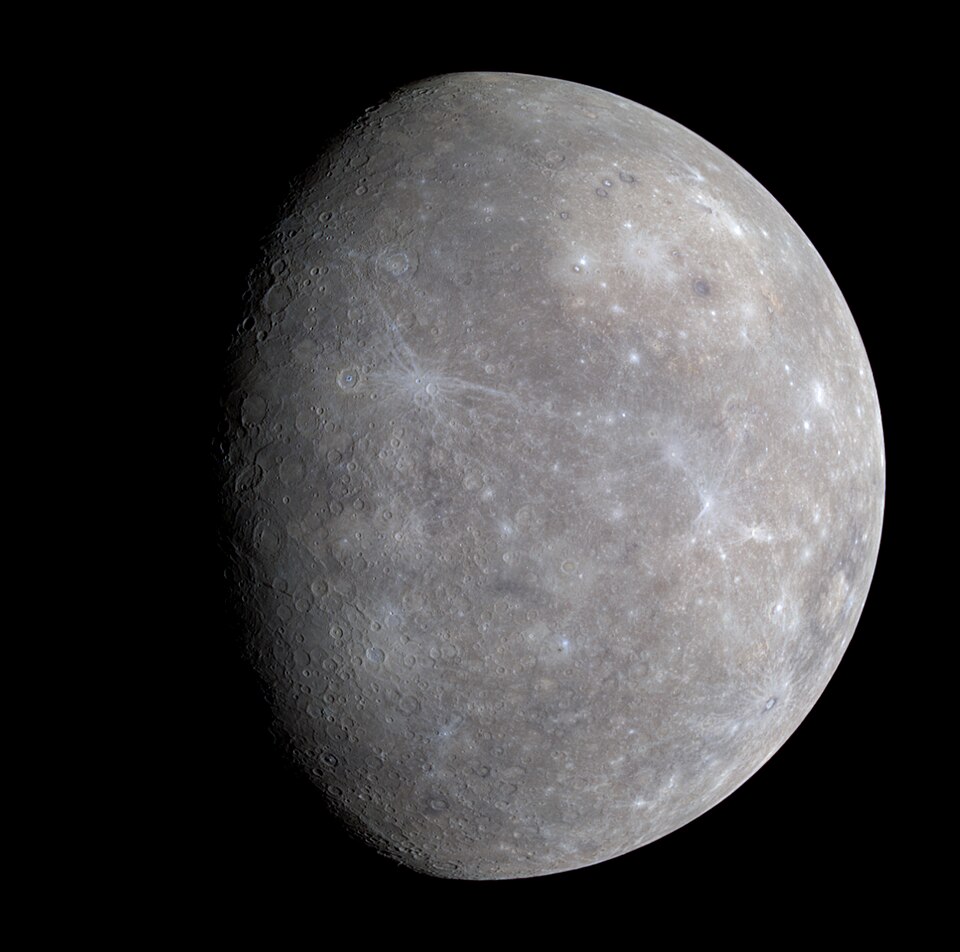
Mercury has a diameter of about 3,032 miles, making it only slightly larger than Earth’s Moon. Despite its small size, Mercury is surprisingly dense because it has a very large iron core. This iron core takes up about 85 percent of the planet’s radius, which is a much bigger proportion than any other planet in the solar system. The outer layer, called the mantle and crust, is relatively thin compared to the massive core beneath it. If you could weigh Mercury, it would be about 18 times heavier than our Moon.
A Day and a Year on Mercury
Mercury has a very unusual relationship between its day and its year. One full orbit around the Sun takes Mercury only about 88 Earth days, making it the fastest-orbiting planet. However, Mercury spins very slowly on its axis — one full rotation takes about 59 Earth days. Because of this odd combination, a single solar day on Mercury (from one sunrise to the next) lasts about 176 Earth days. That means a day on Mercury is actually longer than two of its years!
Extreme Temperatures
Mercury experiences some of the most extreme temperature swings in the solar system. During the daytime, temperatures on the sunlit side can soar to about 800 degrees Fahrenheit (430 degrees Celsius). At night, without a thick atmosphere to trap heat, temperatures can plunge to minus 290 degrees Fahrenheit (minus 180 degrees Celsius). This difference of nearly 1,100 degrees Fahrenheit is the largest temperature range of any planet. Mercury’s thin atmosphere, called an exosphere, is too weak to hold in warmth or protect the surface from the Sun’s radiation.
Surface Features
Mercury’s surface is covered with thousands of craters from billions of years of impacts by asteroids and comets. The largest crater on Mercury is called Caloris Basin, and it stretches about 960 miles across — large enough to fit the state of Texas inside it. Between the craters, there are smooth plains that were likely created by ancient volcanic eruptions. Mercury also has long, winding cliffs called scarps that can stretch for hundreds of miles. Scientists believe these scarps formed as Mercury’s interior cooled and the planet shrank slightly over billions of years.
Mercury’s Thin Atmosphere
Unlike Earth, Mercury does not have a real atmosphere that you could breathe or that could support weather. Instead, it has an incredibly thin exosphere made up of tiny amounts of oxygen, sodium, hydrogen, helium, and potassium. These particles come from the solar wind, meteorite impacts, and atoms escaping from the surface. The exosphere is so thin that the molecules in it almost never bump into each other. Because there is essentially no atmosphere, Mercury has no wind, no rain, and no clouds.
Exploring Mercury
Only two spacecraft have ever visited Mercury because it is very difficult to reach. The first was NASA’s Mariner 10, which flew by Mercury three times in 1974 and 1975 and mapped about 45 percent of its surface. NASA’s MESSENGER spacecraft orbited Mercury from 2011 to 2015 and provided detailed maps and data about the entire planet. MESSENGER discovered that Mercury has water ice hidden in permanently shadowed craters near its poles. A European-Japanese mission called BepiColombo launched in 2018 and is currently on its way to study Mercury in even greater detail.
Why Mercury Matters
Studying Mercury helps scientists understand how the rocky planets in our solar system formed and changed over time. Because Mercury is so close to the Sun, it gives us clues about how intense heat and solar radiation affect a planet. The discovery of water ice on Mercury was a big surprise and changed how scientists think about water in the inner solar system. Mercury’s giant iron core also raises questions about what happened early in the planet’s history — some scientists think a massive collision may have stripped away much of its outer layers. Every new discovery about Mercury teaches us something about how rocky planets form and change.
 OtterKnow Kids Encyclopedia