The Surface of Mars
Mars has a wide variety of surface features that scientists are eager to study. Olympus Mons is the tallest volcano in the solar system, standing about 72,000 feet high, which is nearly three times the height of Mount Everest. Valles Marineris is a massive canyon system that stretches over 2,500 miles across the planet, making it about ten times longer than the Grand Canyon. The surface is covered with rocks, dust, and craters from billions of years of meteorite impacts. Mars also has polar ice caps made of water ice and frozen carbon dioxide at its north and south poles.
The Thin Atmosphere
The atmosphere on Mars is very different from Earth’s and would be impossible for humans to breathe. It is made up of about 95 percent carbon dioxide, with only tiny amounts of nitrogen and oxygen. The atmosphere is also extremely thin, with less than one percent of the air pressure found on Earth’s surface. This thin atmosphere means Mars cannot hold onto heat very well, so temperatures can drop as low as minus 225 degrees Fahrenheit at the poles. Dust storms on Mars can grow so large that they sometimes cover the entire planet for weeks or even months.
Water on Mars
Scientists have found strong evidence that liquid water once flowed on the surface of Mars billions of years ago. Ancient river valleys, lake beds, and mineral deposits all suggest that Mars was once a warmer and wetter world. Today, most of the water on Mars is frozen in the polar ice caps or trapped underground as permafrost. In 2018, scientists using radar data from the Mars Express spacecraft detected what appears to be a lake of liquid water beneath the south polar ice cap. The question of whether Mars ever had enough water to support life is one of the biggest mysteries in planetary science.
Exploring Mars with Rovers
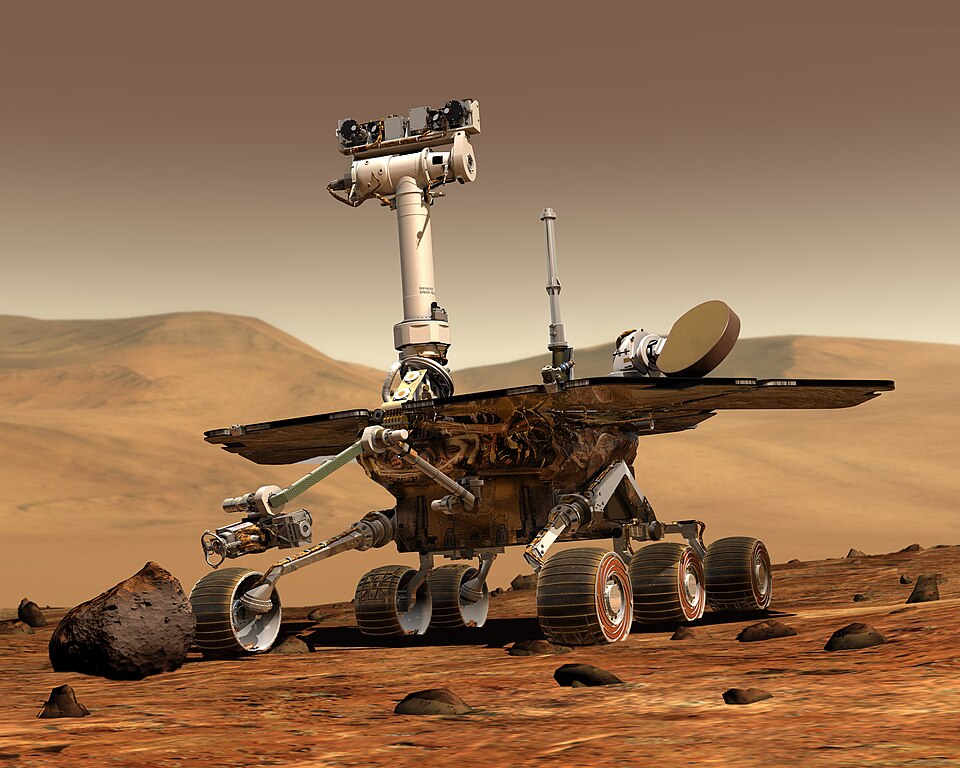
NASA has sent several robotic rovers to explore the surface of Mars up close. The Spirit and Opportunity rovers landed in 2004, and Opportunity kept working for over 14 years, far exceeding its planned 90-day mission. The Curiosity rover landed in 2012 and has been studying rocks and soil in Gale Crater to learn about Mars’s history. NASA’s Perseverance rover arrived in February 2021, carrying a small helicopter called Ingenuity that became the first aircraft to fly on another planet. Perseverance is collecting rock samples that a future mission may bring back to Earth for detailed study.
Mars has two small moons named Phobos and Deimos, which are named after the sons of the Greek god of war. Phobos is the larger of the two, measuring about 14 miles across, and it orbits very close to Mars. Deimos is even smaller, only about 8 miles across, and orbits farther from the planet. Both moons are irregularly shaped and look more like potatoes than round spheres. Scientists believe they may be captured asteroids that were pulled into orbit around Mars by its gravity long ago.
Could Humans Live on Mars?
Mars is the planet that scientists think humans are most likely to visit someday. Several space agencies and private companies, including NASA and SpaceX, are working on plans to send astronauts to Mars. However, living on Mars would be extremely challenging because of the thin atmosphere, freezing temperatures, and harmful radiation from the Sun. Astronauts would need to live in pressurized habitats and wear spacesuits whenever they went outside. A one-way trip to Mars takes about seven months, so future Mars explorers would need to bring enough supplies or find ways to use resources already on the planet.
Fun Facts About Mars
A day on Mars, called a sol, is very close to an Earth day at about 24 hours and 37 minutes. However, a year on Mars is much longer, lasting about 687 Earth days because Mars orbits farther from the Sun. Mars has the largest dust storms of any planet in the solar system, which can last for months and cover the entire surface. The gravity on Mars is only about 38 percent of Earth’s gravity, so a person who weighs 100 pounds on Earth would weigh only 38 pounds on Mars. Mars gets its name from the Roman god of war because its reddish color reminded ancient people of blood and battle.
 OtterKnow Kids Encyclopedia