Parts of a Comet
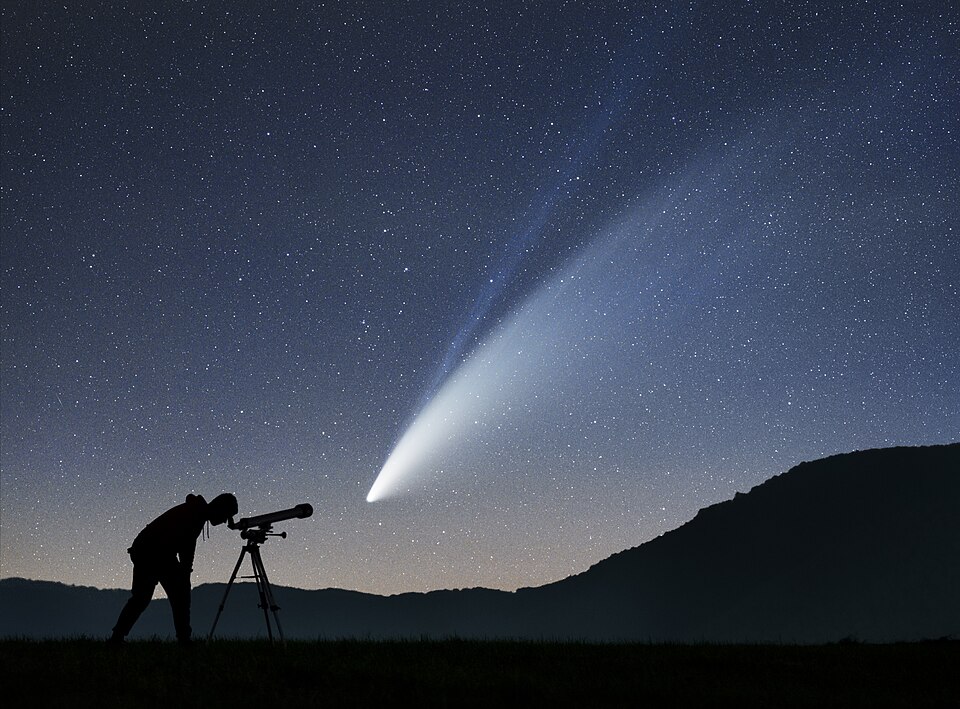
The solid center of a comet is called the nucleus, and it is usually only a few miles across. Even though the nucleus is small, the coma — the cloud of gas and dust around it — can stretch wider than Earth itself. Comets also have two tails that form when the Sun’s energy pushes material away from the coma. The dust tail is made of tiny particles and curves gently behind the comet as it moves. The ion tail is made of electrically charged gas and always points straight away from the Sun, no matter which direction the comet is traveling.
Where Comets Come From
Scientists believe comets come from two distant regions of the solar system. The Kuiper Belt is a ring of icy objects beyond the orbit of Neptune, stretching from about 30 to 50 times Earth’s distance from the Sun. Short-period comets, which take less than 200 years to orbit the Sun, usually come from the Kuiper Belt. The Oort Cloud is a vast shell of icy objects that surrounds the entire solar system, reaching almost halfway to the nearest star. Long-period comets, which can take thousands or even millions of years to complete one orbit, come from this incredibly distant region.
Famous Comets in History
Halley’s Comet is the most famous comet of all, and it returns to the inner solar system about every 75 to 79 years. People have been recording sightings of Halley’s Comet for more than 2,000 years, and it was even shown in the Bayeux Tapestry from 1066. Comet Hale-Bopp appeared in 1997 and was one of the brightest comets of the 20th century, visible to the naked eye for a record 18 months. Comet Shoemaker-Levy 9 made headlines in 1994 when it broke apart and crashed into Jupiter, giving scientists their first chance to watch a collision between two solar system objects.
How Scientists Study Comets
Space agencies have sent several missions to study comets up close. In 2004, the European Space Agency launched the Rosetta spacecraft, which traveled for ten years before reaching Comet 67P/Churyumov-Gerasimenko. Rosetta’s small lander, called Philae, became the first spacecraft to land on a comet’s surface in November 2014. NASA’s Stardust mission flew through the tail of Comet Wild 2 in 2004 and collected tiny particles of comet dust to bring back to Earth. These missions have taught scientists that comets contain organic molecules, which are some of the building blocks of life.
Comets and Earth
Throughout history, people were often afraid of comets because they did not understand what they were. Ancient civilizations thought comets were signs of bad luck or warnings from the gods. Today, scientists know that comets are natural objects, but they do study whether a comet could ever hit Earth. Some scientists believe that comets may have delivered water and organic materials to early Earth billions of years ago, helping life get started. Space agencies around the world track comets and other objects near Earth to make sure our planet stays safe.
Comets vs. Asteroids and Meteors
Comets and asteroids are both objects that orbit the Sun, but they are made of different materials. Asteroids are mostly rock and metal and are found mainly in the asteroid belt between Mars and Jupiter. Comets contain much more ice and develop tails when they get close to the Sun, while asteroids do not. When small pieces break off from comets and enter Earth’s atmosphere, they burn up and create streaks of light called meteors, or shooting stars. Some of the best meteor showers we see each year, like the Perseids in August, happen when Earth passes through the trail of debris left behind by a comet.
Why Comets Matter
Comets are like time capsules from the earliest days of the solar system. Because they have been frozen in the outer solar system for billions of years, they contain materials that have barely changed since the planets first formed. Studying comets helps scientists understand what the solar system was like when it was brand new. The water and chemicals found in comets give clues about how Earth got its oceans and how the ingredients for life may have arrived on our planet. Every time a new comet is discovered, it gives scientists another chance to learn about our solar system’s history.
 OtterKnow Kids Encyclopedia