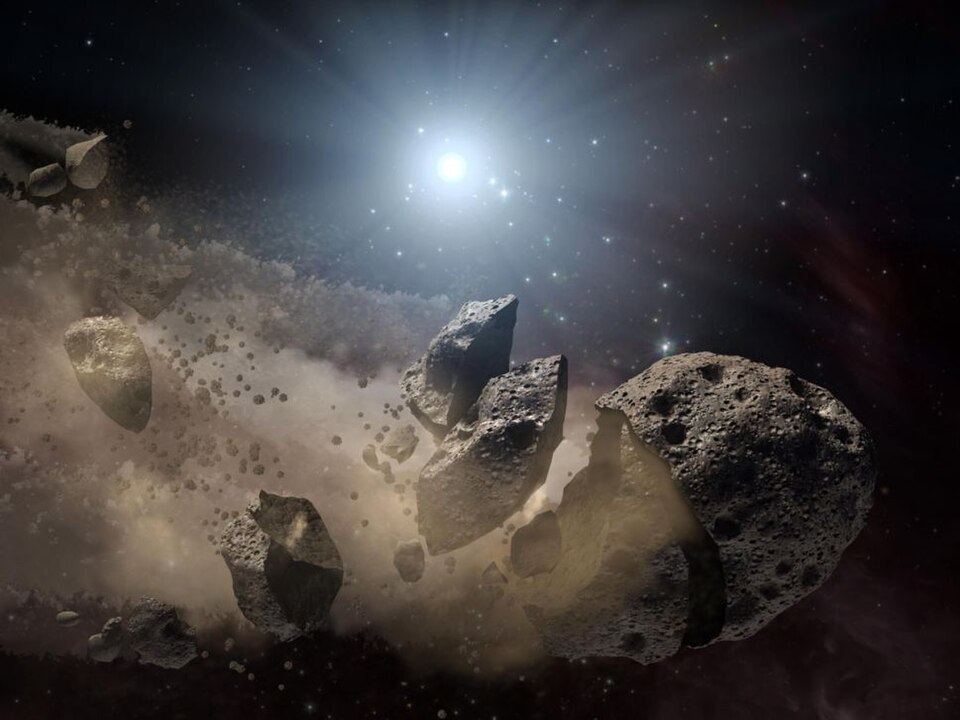
The Asteroid Belt
Most asteroids in our solar system are found in a region called the asteroid belt, which lies between the orbits of Mars and Jupiter. The asteroid belt contains millions of asteroids, but they are spread out over such a huge area that spacecraft can fly through without hitting any. The total mass of all the asteroids in the belt is less than the mass of Earth’s Moon. Jupiter’s powerful gravity prevented the material in the asteroid belt from ever coming together to form a planet. Despite what movies show, the asteroid belt is mostly empty space.
Famous Asteroids
The largest asteroid in the belt is Ceres, which is about 940 kilometers (584 miles) across and is so big that scientists also classify it as a dwarf planet. Vesta is the second largest asteroid and the brightest one visible from Earth, sometimes even visible to the naked eye. Another well-known asteroid is Bennu, which NASA’s OSIRIS-REx spacecraft visited and collected a sample from in 2020. The spacecraft returned Bennu’s sample to Earth in September 2023, giving scientists material from a 4.5-billion-year-old asteroid to study. Ida is famous for being the first asteroid discovered to have its own tiny moon, called Dactyl.
Near-Earth Asteroids
Some asteroids have orbits that bring them close to Earth, and these are called near-Earth asteroids, or NEAs. Scientists have found more than 34,000 near-Earth asteroids as of 2024. Most of these pass by at a safe distance, millions of kilometers away. NASA and other space agencies track these asteroids carefully to make sure none are on a collision course with our planet. In 2022, NASA’s DART mission successfully crashed a spacecraft into the asteroid Dimorphos to test whether we could change an asteroid’s path if one ever threatened Earth.
Asteroids and Dinosaurs
About 66 million years ago, a massive asteroid roughly 10 kilometers (6 miles) wide struck what is now the Yucatan Peninsula in Mexico. The impact created the Chicxulub crater, which is about 180 kilometers (112 miles) across and mostly buried underground and under the seafloor. The collision sent dust and debris high into the atmosphere, blocking sunlight and changing the climate for years. This event is believed to have caused the extinction of about 75 percent of all species on Earth, including most dinosaurs. The only dinosaurs that survived were small feathered ones that eventually evolved into the birds we see today.
How Scientists Study Asteroids
Scientists study asteroids using telescopes on Earth and in space, as well as by sending spacecraft to visit them up close. Radar observations from ground-based telescopes can reveal an asteroid’s size, shape, and rotation. Several space missions have orbited or landed on asteroids, including Japan’s Hayabusa2, which brought back samples from asteroid Ryugu in 2020. By studying asteroid samples, scientists learn about the materials that existed when the solar system was young. Some asteroids even contain water and organic molecules, which could help explain how life’s building blocks arrived on Earth.
Types of Asteroids
Scientists group asteroids into three main types based on what they are made of. C-type (carbonaceous) asteroids are the most common, making up about 75 percent of known asteroids, and they are dark and rich in carbon. S-type (siliceous) asteroids are made mostly of silicate rocks and nickel-iron and account for about 17 percent. M-type (metallic) asteroids are the rarest and appear to be made mostly of nickel and iron. Knowing what asteroids are made of helps scientists understand the different materials that were present in the early solar system.
Asteroids vs. Comets and Meteoroids
Asteroids are sometimes confused with comets and meteoroids, but they are different objects. Comets are made of ice, dust, and rock, and they develop glowing tails when they get close to the Sun, while asteroids are mostly rock and metal without tails. Meteoroids are much smaller pieces of rock or debris floating in space, often broken off from asteroids or comets. When a meteoroid enters Earth’s atmosphere and burns up, it creates a bright streak of light called a meteor, or shooting star. If a piece survives and lands on the ground, it is called a meteorite.
 OtterKnow Kids Encyclopedia