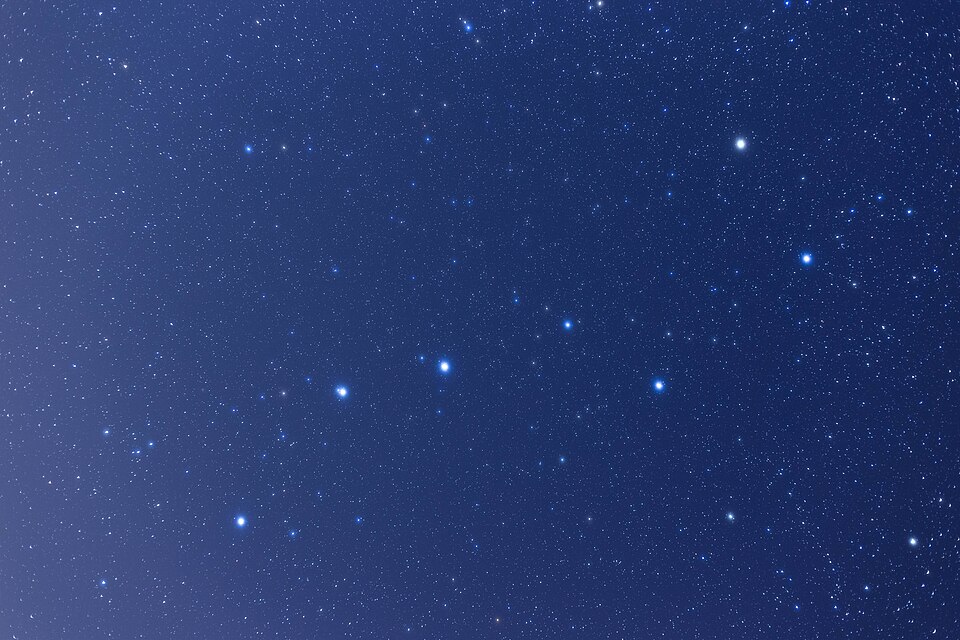
The Big Dipper
The Big Dipper is the most famous part of Ursa Major, but it is actually only a section of the larger constellation. It is made up of seven bright stars that form a shape like a ladle or a large cup with a long handle. The four stars of the “cup” are Dubhe, Merak, Phecda, and Megrez, while the three handle stars are Alioth, Mizar, and Alkaid. Alioth is the brightest star in Ursa Major and one of the brightest stars in the northern sky. The Big Dipper is called different things in different cultures, including “the Plough” in the United Kingdom and “the Great Wagon” in parts of Europe.
The Little Dipper and Polaris
The Little Dipper is the most recognizable part of Ursa Minor and also has seven main stars shaped like a smaller cup with a handle. The most important star in the Little Dipper is Polaris, which sits at the very tip of the handle. Polaris is special because it stays almost directly above Earth’s North Pole, so it barely moves while all the other stars appear to rotate around it during the night. For centuries, travelers, sailors, and explorers have used Polaris to find north and navigate in the dark. Polaris is not the brightest star in the sky, but it is easy to find once you know where to look.
Finding North with the Pointer Stars
There is a simple trick for finding Polaris using the Big Dipper. The two stars at the front edge of the Big Dipper’s cup, Dubhe and Merak, are called the “pointer stars.” If you draw an imaginary line through these two stars and extend it about five times the distance between them, you will arrive at Polaris. This trick works any time of year as long as the Big Dipper is above the horizon. Once you find Polaris, you are looking due north, which makes it easy to figure out east, west, and south as well.
Myths and Stories
Many cultures around the world created stories about these constellations. In Greek mythology, Ursa Major represents Callisto, a woman who was turned into a bear by the goddess Hera, and Ursa Minor represents her son Arcas. Native American groups including the Iroquois also saw a bear in these stars, and some of their stories describe hunters chasing the bear across the sky through the seasons. In Hindu astronomy, the seven stars of the Big Dipper are called the Saptarishi, meaning “seven sages” or wise men. These different stories show how people everywhere have looked up at the same stars and imagined their own meanings.
Circumpolar Constellations
Ursa Major and Ursa Minor are called circumpolar constellations because they never set below the horizon for observers in most of the Northern Hemisphere. Instead of rising and setting like many other constellations, they appear to circle around Polaris throughout the night. This happens because they are located close to the north celestial pole, the point in the sky directly above Earth’s North Pole. If you watch the Big Dipper over several hours, you will see it slowly rotate like the hand of a clock around Polaris. This is why these constellations can be seen on any clear night of the year from places like the United States, Canada, and Europe.
Interesting Stars in the Bears
Several stars in these constellations have fascinating features that astronomers have studied closely. Mizar, the middle star of the Big Dipper’s handle, has a faint companion star called Alcor right next to it, and people with sharp eyes can see both stars without a telescope. Through a telescope, Mizar itself turns out to be a system of four stars orbiting each other. Polaris is also not a single star but a system of three stars, with the main star being a supergiant about 2,500 times brighter than our Sun. Five of the Big Dipper’s seven stars are actually moving through space together as a group called the Ursa Major Moving Group, traveling in the same direction at the same speed.
Viewing Tips
Ursa Major and Ursa Minor are easy to observe because they are visible all year round from most places in North America and Europe. The best time to see Ursa Major high in the sky is during spring evenings, when the Big Dipper appears almost directly overhead. Start by finding the Big Dipper, then use the pointer stars to locate Polaris and the Little Dipper. The Little Dipper’s stars are fainter than the Big Dipper’s, so you may need darker skies away from city lights to see all seven stars. Binoculars can help you spot the double star Mizar and Alcor in the Big Dipper’s handle, which is a fun challenge for beginning stargazers.
 OtterKnow Kids Encyclopedia