The Shape and Size of Our Galaxy
The Milky Way is a barred spiral galaxy, which means it has a bar-shaped center with curved arms spiraling outward. It measures about 100,000 light-years across, which means that light traveling at 186,000 miles per second would take 100,000 years to cross from one side to the other. Our solar system sits on one of the spiral arms, called the Orion Arm, about 26,000 light-years from the galaxy’s center. The entire Milky Way is slowly rotating, and our solar system takes about 225 to 250 million years to complete one orbit around the center. Scientists sometimes call this long trip a “galactic year.”
How to See the Milky Way
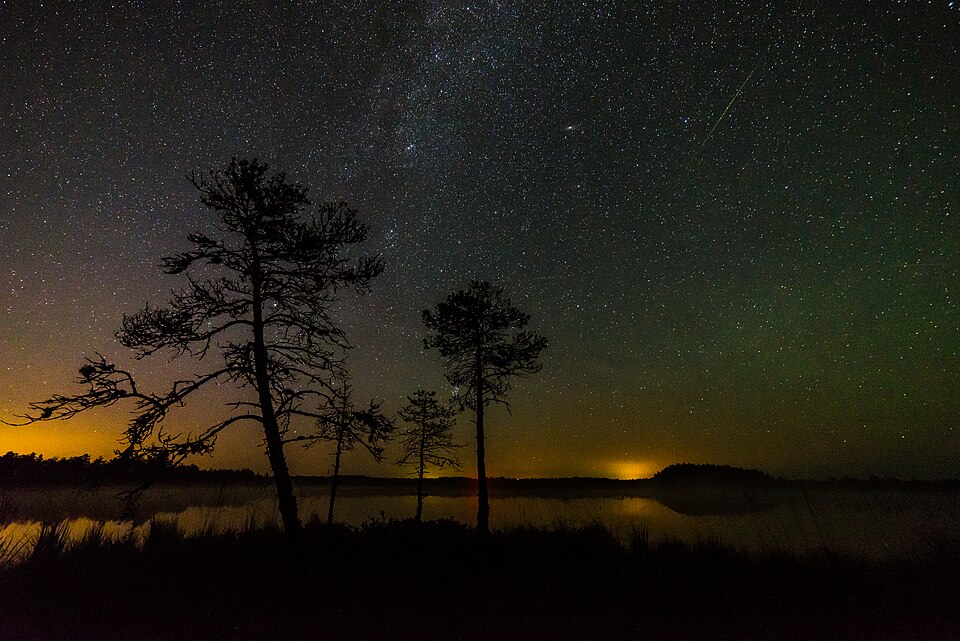
To see the Milky Way with your own eyes, you need to be in a dark location far from city lights. Light pollution from streetlights, buildings, and signs washes out the faint glow of the Milky Way, making it invisible from most cities. The best time to see the Milky Way in the Northern Hemisphere is during the summer months, from June through September, when the brightest part of the galaxy is overhead. On a clear, moonless night in a dark area, the Milky Way appears as a pale, cloudy band stretching across the entire sky. You do not need a telescope to see it, but binoculars will reveal that the band is actually made up of millions of individual stars.
Light Pollution and Dark Skies
Light pollution is one of the biggest challenges for anyone who wants to observe the Milky Way. More than 80 percent of people in North America live under light-polluted skies and cannot see the Milky Way from their homes. Scientists measure light pollution using a scale called the Bortle scale, which ranks sky darkness from 1 (the darkest) to 9 (the brightest city skies). To see the Milky Way clearly, you generally need a Bortle 4 or darker sky. Many national and state parks have been designated as Dark Sky Parks to protect the nighttime environment and give people places to enjoy the stars.
What Lives in the Milky Way
The Milky Way is home to an incredible variety of objects besides stars. Giant clouds of gas and dust called nebulae float between the stars, and new stars are born inside these clouds. Some stars have planets orbiting them, just like our Sun has Earth and the other planets of our solar system. Scientists have discovered thousands of exoplanets in the Milky Way so far, and they estimate there could be billions more. At the very center of the Milky Way sits a supermassive black hole called Sagittarius A* that has the mass of about 4 million suns.
The Milky Way in Culture and History
People have gazed at the Milky Way for thousands of years and given it many different names. The ancient Greeks called it “galaxias kyklos,” meaning “milky circle,” which is where the word “galaxy” comes from. In many Indigenous Australian cultures, the dark patches in the Milky Way formed important constellations, like the Emu in the Sky. The Maori people of New Zealand called it Te Ikaroa, meaning “the long fish.” In Hindu tradition, it was known as the “pathway of the gods.” Before modern science, many cultures understood that this band of light was something special, even if they did not yet know it was made of billions of distant stars.
Studying the Milky Way with Technology
Because we live inside the Milky Way, it is actually quite difficult to study its shape. Scientists use radio telescopes, infrared cameras, and space telescopes like the Gaia spacecraft to map our galaxy. The Gaia mission, launched by the European Space Agency in 2013, has measured the positions and movements of nearly 2 billion stars in the Milky Way. Radio telescopes can peer through the dust that blocks visible light and reveal structures hidden deep within the galaxy. By combining data from many different instruments, scientists have created detailed maps showing the Milky Way’s spiral arms, star-forming regions, and the motions of stars throughout the galaxy.
The Milky Way’s Future
The Milky Way is not staying the same. It is constantly changing as new stars are born and old stars die. Our galaxy is also on a collision course with the nearby Andromeda Galaxy, which is heading toward us at about 70 miles per second. In about 4 to 5 billion years, the two galaxies will merge together to form a new, larger galaxy that some scientists have nicknamed “Milkomeda.” Even though this sounds dramatic, the stars in both galaxies are so far apart that very few of them would actually crash into each other. Our Sun will still be shining when the collision begins, but Earth will likely be too hot to support life by then because the Sun will have grown much brighter.
 OtterKnow Kids Encyclopedia