The Stars of Orion
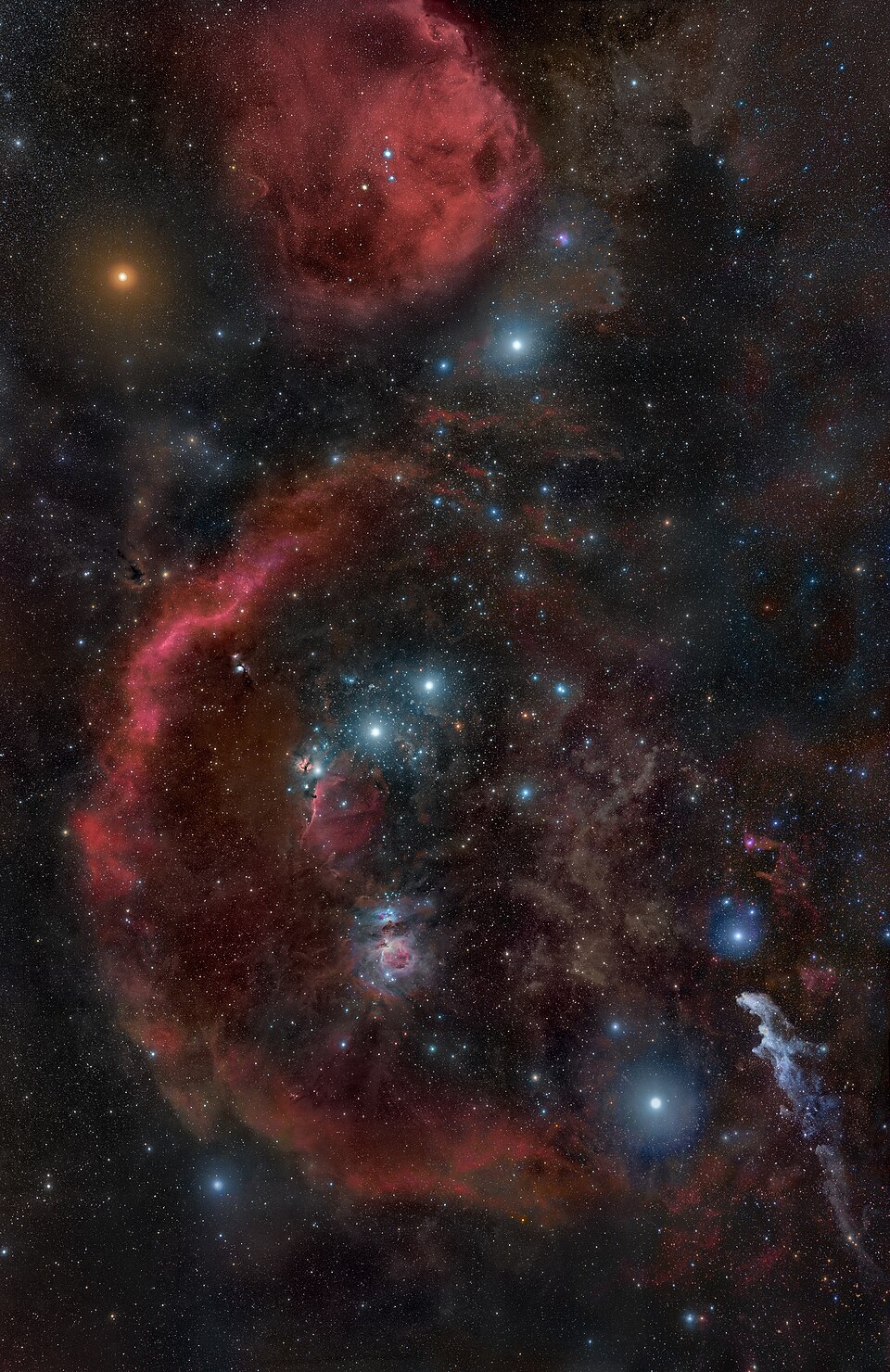
Orion contains some of the brightest stars in the entire night sky. Betelgeuse, a red supergiant star, marks Orion’s right shoulder and is one of the largest stars ever discovered — it is about 700 times the diameter of our Sun. Rigel, a blue supergiant, marks Orion’s left foot and shines about 120,000 times brighter than the Sun. The three stars of Orion’s Belt — Alnitak, Alnilam, and Mintaka — are roughly equally spaced and make the constellation easy to find. Bellatrix and Saiph mark the other shoulder and foot, completing the hunter’s outline.
Orion’s Belt
Orion’s Belt is probably the most recognized pattern of stars in the sky. The three stars sit in an almost perfectly straight line and are roughly the same brightness, which is why they stand out so clearly. Ancient Egyptians noticed that the three Great Pyramids of Giza are arranged in a pattern that resembles Orion’s Belt. Astronomers use Orion’s Belt as a guide to find other stars — if you follow the belt downward to the left, you will find Sirius, the brightest star in the night sky. Following the belt upward to the right leads you to Aldebaran, a bright orange star in the constellation Taurus.
The Orion Nebula
Hanging below Orion’s Belt is a fuzzy patch of light called the Orion Nebula, also known as M42. This nebula is a giant cloud of gas and dust where new stars are being born right now. It is about 1,344 light-years away from Earth and is one of the closest star-forming regions to our solar system. The Orion Nebula is so bright that you can see it with your naked eye on a clear, dark night. Through a telescope, it reveals beautiful swirls of glowing gas in shades of pink, purple, and blue.
Myths and Legends
Many cultures around the world have created stories about the stars of Orion. In Greek mythology, Orion was a mighty hunter who boasted he could defeat any animal on Earth. The ancient Egyptians associated Orion with Osiris, the god of the afterlife. Aboriginal Australians saw the stars of Orion as a canoe, while some Native American tribes saw the belt stars as three hunters chasing a bear across the sky. In Hindu mythology, the constellation was known as Mriga, meaning deer. These different stories show how people everywhere have looked at the same stars and imagined their own tales.
How to Find Orion
Finding Orion is a great way to start learning the night sky. On a clear winter evening in the Northern Hemisphere, face south and look for three bright stars in a short, straight line — that is Orion’s Belt. Once you find the belt, look above it for two bright stars forming the shoulders, with reddish Betelgeuse on the left side. Below the belt, two more bright stars form the feet, with blue-white Rigel on the right side. In the Southern Hemisphere, Orion appears upside down, so the belt stars are near the top and the hunter looks like he is standing on his head.
Betelgeuse: A Star to Watch
Betelgeuse has been getting a lot of attention from scientists because it is expected to explode as a supernova sometime in the next 100,000 years. In late 2019, Betelgeuse dimmed noticeably, and some people wondered if the explosion was about to happen. Scientists later discovered that the dimming was caused by a cloud of dust that the star had ejected, temporarily blocking some of its light. When Betelgeuse does finally explode, it will briefly shine as bright as the full moon and will be visible even during the daytime. Do not worry though — at about 650 light-years away, it is far too distant to harm Earth.
Orion in Modern Astronomy
Orion remains one of the most studied regions of the sky in modern astronomy. The Orion Nebula serves as a natural laboratory for scientists studying how stars and planetary systems form. NASA’s Hubble Space Telescope and James Webb Space Telescope have captured highly detailed images of the nebula, revealing baby stars surrounded by disks of dust that may one day form planets. The constellation also contains the Horsehead Nebula, a dark cloud shaped like a horse’s head that is one of the most photographed objects in space. Orion continues to inspire both professional astronomers and amateur stargazers around the world.
 OtterKnow Kids Encyclopedia