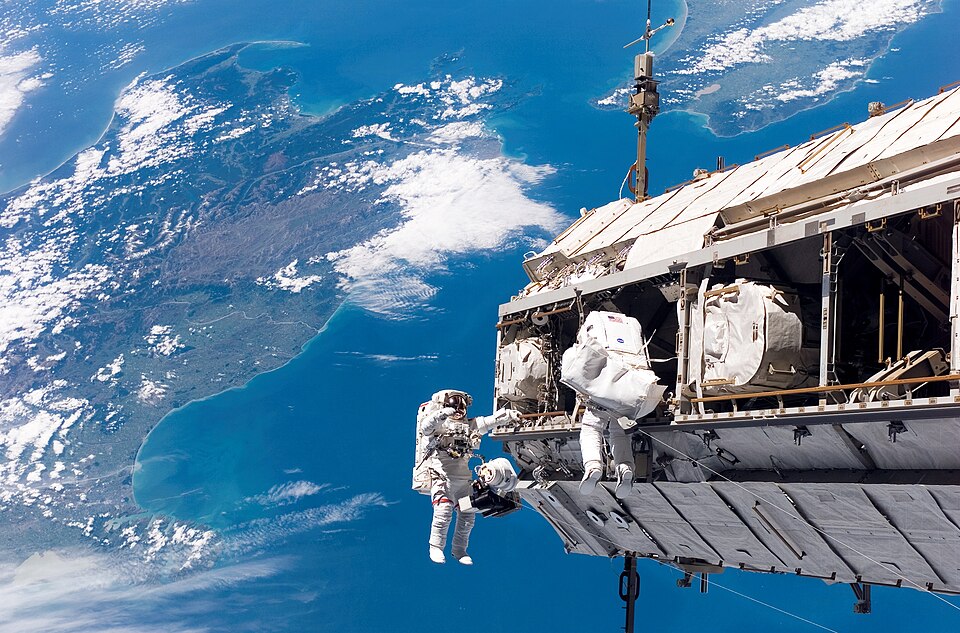
The First Spacewalks
The first spacewalk in history was performed by Soviet cosmonaut Alexei Leonov on March 18, 1965. Leonov floated outside his Voskhod 2 spacecraft for about 12 minutes, connected by a tether. His suit inflated so much in the vacuum of space that he had trouble getting back through the airlock and had to release some air pressure to squeeze inside. Just a few months later, American astronaut Ed White performed the first US spacewalk on June 3, 1965, during the Gemini 4 mission. White enjoyed the experience so much that mission control had to order him to come back inside the capsule.
How Astronauts Prepare
Preparing for a spacewalk is a long and detailed process that starts months before the actual event. Astronauts practice underwater in a giant pool at NASA’s Johnson Space Center called the Neutral Buoyancy Laboratory, which holds 6.2 million gallons of water. The pool contains a full-size model of parts of the International Space Station, and floating underwater feels similar to floating in space. For every hour of spacewalk time, astronauts typically train for about seven hours in the pool. They also review checklists, practice with their tools, and study detailed diagrams of whatever equipment they will be working on.
What Happens on Spacewalk Day
On the day of a spacewalk, astronauts begin preparing several hours before they open the hatch. They breathe pure oxygen for a period of time to remove nitrogen from their blood, which prevents a painful condition called the bends that deep-sea divers can also get. Getting into the spacesuit takes about 45 minutes and requires help from other crew members. Once outside, astronauts clip safety tethers to the station so they cannot float away. A typical spacewalk on the International Space Station lasts about six and a half hours, though some have lasted more than eight hours.
Famous Spacewalks in History
Some spacewalks have become famous because of the incredible work astronauts accomplished during them. In 1984, astronaut Bruce McCandless became the first person to fly freely in space using the Manned Maneuvering Unit (MMU), a jet-powered backpack, with no tether connecting him to the shuttle. During five spacewalks in 1993, astronauts repaired the Hubble Space Telescope’s faulty mirror, saving the billion-dollar observatory. Italian astronaut Luca Parmitano faced a dangerous situation in 2013 when water began leaking into his helmet during a spacewalk, and he had to carefully make his way back to the airlock with water covering his eyes and nose. These events show both the amazing achievements and real dangers of working in space.
Dangers of Spacewalking
Spacewalking is one of the riskiest activities astronauts perform. Tiny pieces of space debris travel at speeds up to 17,500 miles per hour and could puncture a spacesuit if they struck it. Astronauts must also watch out for sharp edges on the space station that could tear their gloves, which has happened several times. If an astronaut became separated from the station, they would need to use their SAFER jetpack to fly back before their oxygen ran out. The extreme temperature changes between sunlight and shadow, which happen every 45 minutes as the station orbits Earth, also put stress on both the astronaut and their equipment.
Spacewalks on the International Space Station
The International Space Station (ISS) has been the main location for spacewalks since its construction began in 1998. More than 260 spacewalks have been conducted at the ISS to build, maintain, and upgrade the station. Astronauts have installed massive solar panels, replaced batteries, and repaired cooling systems during these excursions. The station’s robotic arm, called Canadarm2, often helps by carrying astronauts to hard-to-reach work sites. Spacewalks at the ISS are supported by a team of hundreds of people on the ground at Mission Control in Houston, Texas, who monitor every moment and guide the astronauts through each task.
The Future of Spacewalks
As space agencies plan missions to the Moon and Mars, spacewalks will become even more important and challenging. NASA’s Artemis program will send astronauts to walk on the lunar surface, requiring spacewalks in a completely different environment than floating beside a space station. Walking on the Moon means dealing with sharp lunar dust that can damage equipment and irritate lungs if brought inside. Future Mars explorers will need to perform spacewalks in a thin atmosphere with dust storms and temperatures that average around minus 80 degrees Fahrenheit. New spacesuit designs and robotic assistants are being developed to make these future spacewalks safer and more productive than ever before.
 OtterKnow Kids Encyclopedia