Basic Training
Astronaut candidates spend about two years in basic training before they are eligible for a space mission. During this time, they take classes in subjects like Earth science, space station systems, robotics, and rocket science. They also learn to speak Russian because American and Russian astronauts work together on the International Space Station. Physical fitness is a big part of training too, with candidates swimming, running, and doing strength exercises regularly. At the end of basic training, candidates who pass all their tests officially earn the title of astronaut.
Underwater Training
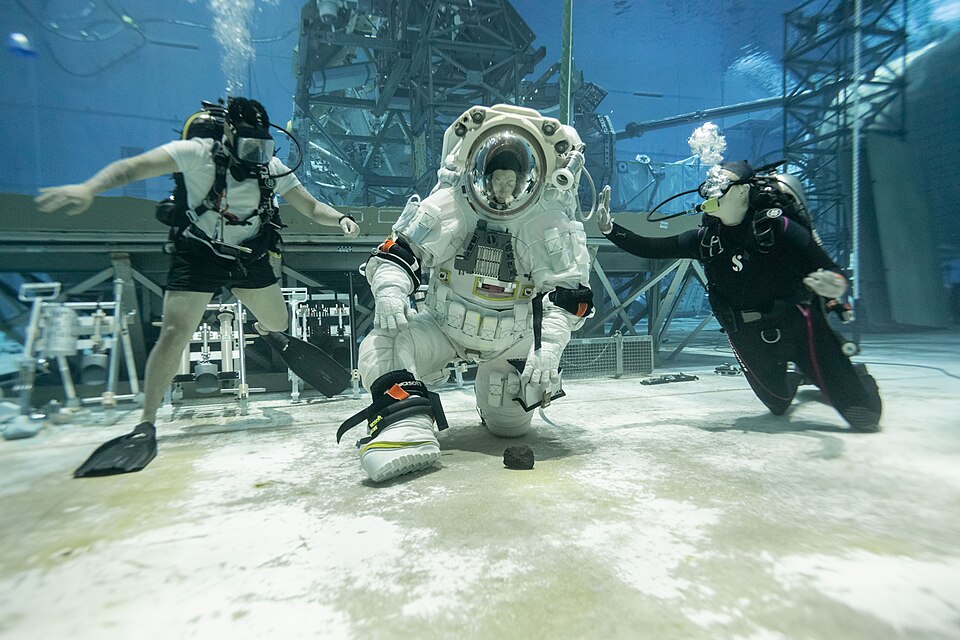
One of the most important parts of astronaut training happens underwater in a giant pool called the Neutral Buoyancy Laboratory, or NBL. This pool is 202 feet long, 102 feet wide, and 40 feet deep, making it one of the largest indoor pools in the world. Floating underwater feels similar to floating in the microgravity of space, so astronauts practice spacewalks here before doing them for real. A single underwater training session for a spacewalk can last up to six hours, and astronauts may train underwater dozens of times before their mission. Divers are always nearby to help with safety and to hand astronauts the tools they need.
Survival Training
Astronauts must be prepared for emergencies, including the possibility of landing far from the planned landing site. They take wilderness survival courses where they learn to find food, build shelters, and signal for rescue in forests, deserts, and oceans. Water survival training teaches astronauts how to escape from a capsule that has landed in the ocean and how to stay afloat in rough seas. In the past, astronauts trained in remote areas of Russia during winter to prepare for cold-weather survival after landing. These skills give astronauts confidence that they can handle almost any emergency situation.
Flying and Spacecraft Training
Astronaut candidates who are not already pilots learn to fly T-38 jet aircraft, which are fast training jets used by NASA. Even astronauts who are scientists rather than pilots must complete flight training because it teaches quick decision-making under pressure. Astronauts also spend hundreds of hours in spacecraft simulators, which are exact replicas of the vehicles they will fly. These simulators can recreate every part of a mission, from launch to docking with the space station to landing back on Earth. Trainers sometimes throw in surprise problems and emergencies so astronauts learn to stay calm and solve issues quickly.
Learning to Live in Space
Living in space is very different from living on Earth, and astronauts must learn how to do everyday tasks in microgravity. They practice eating food from special pouches, sleeping in bags strapped to the wall, and using a space toilet that works with suction instead of gravity. Astronauts also learn to operate the scientific experiments they will conduct on the International Space Station. They train with the station’s robotic arm, called Canadarm2, which is used to move equipment and even catch visiting cargo spacecraft. Every detail of daily life in space is practiced on the ground first so nothing is a surprise.
Physical and Mental Preparation
Space is tough on the human body, so astronauts must be in excellent physical shape before, during, and after their missions. They exercise about two hours every day during training and continue exercising in space to prevent muscle and bone loss caused by microgravity. Astronauts also work with psychologists to prepare for the mental challenges of living in a small space with a few other people for months at a time. Isolation, being far from family, and the high-pressure work environment can all be stressful. Learning to communicate well, manage stress, and work as a team is just as important as any technical skill.
Training for Future Missions
As space exploration moves beyond the International Space Station, astronaut training is evolving too. NASA’s Artemis program is training astronauts for missions back to the Moon, which requires learning to work on the lunar surface in bulky spacesuits. Future Mars missions will require astronauts to train for journeys lasting two to three years, far longer than any current mission. Scientists are studying how to grow food in space and how to keep astronauts healthy during these extremely long trips. The next generation of astronauts will need to be explorers, scientists, engineers, and problem-solvers all rolled into one.
 OtterKnow Kids Encyclopedia