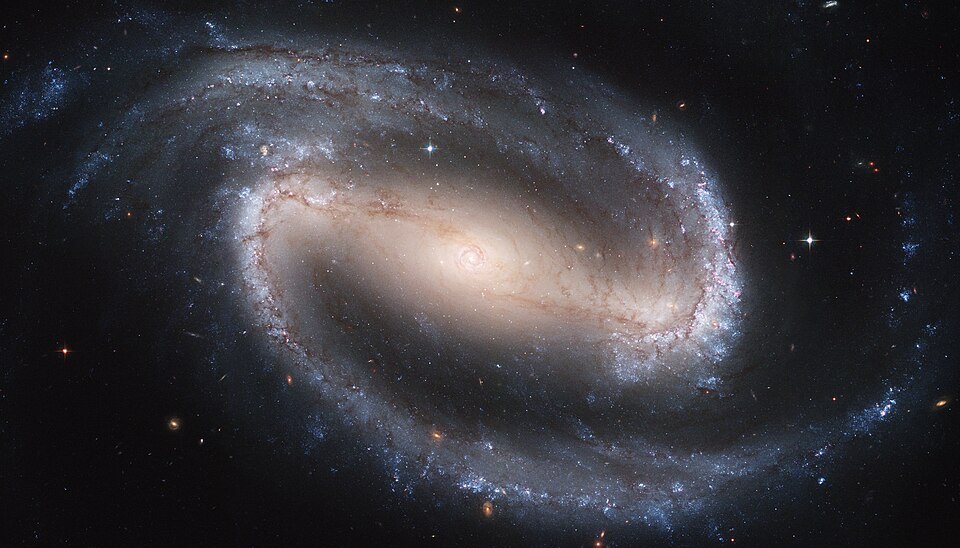
The Milky Way: Our Home Galaxy
The Milky Way is a barred spiral galaxy that contains between 100 billion and 400 billion stars, including our Sun. It stretches about 100,000 light-years across, which means that even traveling at the speed of light, it would take 100,000 years to cross from one side to the other. Our solar system sits about 26,000 light-years from the center of the Milky Way, on one of its spiral arms called the Orion Arm. The entire solar system orbits around the center of the galaxy at about 515,000 miles per hour, but the galaxy is so enormous that one full orbit takes about 225 to 250 million years. On a clear, dark night, you can see the Milky Way as a pale band of light stretching across the sky, which is actually billions of distant stars blurred together.
Types of Galaxies
Scientists group galaxies into several main types based on their shapes. Spiral galaxies, like the Milky Way, have a bright center with sweeping arms that curve outward, giving them a pinwheel-like appearance. Elliptical galaxies are shaped like smooth, rounded balls or ovals and can range from nearly spherical to very stretched out. Irregular galaxies have no particular shape and often look messy or lumpy, sometimes because they have been pulled apart by the gravity of a nearby galaxy. The astronomer Edwin Hubble created the first system for classifying galaxies in 1926, and scientists still use an updated version of his system today.
What Holds Galaxies Together
Gravity is the force that keeps all the stars, gas, and dust in a galaxy from flying apart. However, when scientists measured how fast stars move inside galaxies, they found that visible matter alone does not have enough gravity to hold galaxies together. This mystery led to the discovery of dark matter, an invisible substance that makes up about 85 percent of all matter in the universe. Dark matter does not give off light or heat, so we cannot see it directly, but we can detect its gravitational pull on stars and galaxies. At the center of most large galaxies, including the Milky Way, there is a supermassive black hole with a mass millions or even billions of times greater than our Sun.
Scientists believe that galaxies began forming a few hundred million years after the Big Bang, about 13.8 billion years ago. Small clumps of matter pulled together through gravity, eventually growing into the first tiny galaxies. Over billions of years, these small galaxies merged with each other to form larger ones, and this process of galaxy mergers continues today. When galaxies collide, they do not crash like cars because the stars inside them are so spread out that most pass right by each other. However, the gravity from a collision reshapes both galaxies, sometimes turning spiral galaxies into elliptical ones over millions of years.
Galaxy Clusters and Superclusters
Galaxies are not spread evenly across space but instead gather in groups held together by gravity. Small groups may contain just a handful of galaxies, while large galaxy clusters can hold hundreds or even thousands of galaxies. The Milky Way belongs to a small group called the Local Group, which contains about 80 galaxies, including the Andromeda Galaxy and the Triangulum Galaxy. Galaxy clusters are organized into even larger structures called superclusters, which are some of the biggest structures in the known universe. Our Local Group is part of the Laniakea Supercluster, which stretches across about 500 million light-years and contains roughly 100,000 galaxies.
Famous Galaxies You Can See
Several galaxies are visible from Earth without a telescope, and many more can be seen with binoculars or a small telescope. The Andromeda Galaxy is the nearest large spiral galaxy to the Milky Way, located about 2.5 million light-years away, and can be seen as a faint fuzzy patch on clear autumn nights in the Northern Hemisphere. The Large and Small Magellanic Clouds are two irregular dwarf galaxies visible from the Southern Hemisphere that orbit the Milky Way like satellites. The Whirlpool Galaxy, about 23 million light-years away, is a favorite target for telescope users because its spiral arms are especially clear and beautiful. In about 4.5 billion years, the Milky Way and Andromeda are expected to collide and eventually merge into a single larger galaxy.
Studying Galaxies
Astronomers use many different tools and techniques to study galaxies across the universe. Powerful telescopes like the Hubble Space Telescope and the James Webb Space Telescope capture detailed images of galaxies billions of light-years away, showing us what the universe looked like in its early days. Radio telescopes detect invisible radio waves from galaxies, revealing hidden gas clouds and energetic jets shooting from black holes. By studying the light from distant galaxies, scientists can figure out what elements they contain, how fast they are moving, and how far away they are. The James Webb Space Telescope, launched in 2021, has discovered some of the oldest and most distant galaxies ever observed, formed less than 400 million years after the Big Bang.
 OtterKnow Kids Encyclopedia