Stars and Stripes
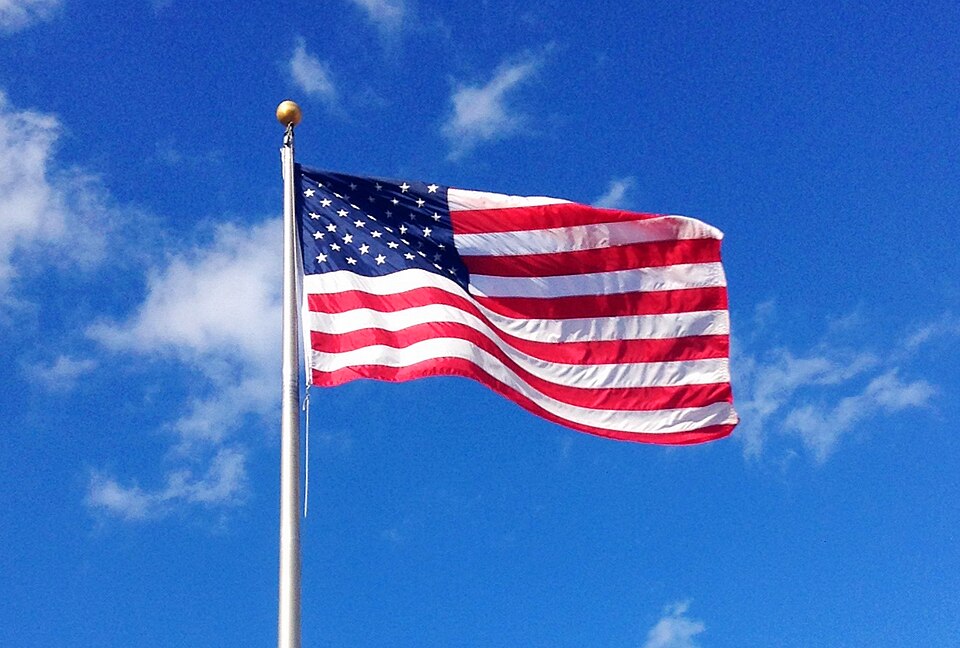
The current American flag has 50 white stars on a blue background in the upper left corner, representing the 50 states in the Union today. The flag also has 13 alternating red and white stripes, which stand for the original 13 colonies that declared independence from Great Britain in 1776. There are seven red stripes and six white stripes on the flag. The colors have symbolic meaning: red stands for hardiness and valor, white represents purity and innocence, and blue symbolizes vigilance, perseverance, and justice. These meanings were described by Charles Thomson, the Secretary of the Continental Congress, when he designed the Great Seal of the United States in 1782.
The First American Flag
The Continental Congress passed the Flag Resolution on June 14, 1777, establishing the first official American flag with 13 stars and 13 stripes. A popular legend says that Betsy Ross, a seamstress from Philadelphia, sewed the first flag at the request of George Washington, but historians are not certain this story is true. The original design arranged the 13 stars in a circle on the blue field, though some early versions placed them in rows. The first flags were sewn by hand, and different flagmakers created slightly different versions because the resolution did not specify the exact arrangement of the stars. What we do know is that the flag was first flown in battle at the Battle of Brandywine in September 1777.
How the Flag Has Changed
The American flag has been redesigned 27 times since 1777, more than any other national flag in the world. Each time a new state joined the Union, a new star was added to the flag. In 1795, two stars and two stripes were added when Vermont and Kentucky became states, creating a 15-star, 15-stripe flag. Congress realized that adding a stripe for every new state would make the flag too large, so in 1818 they passed a law returning the flag to 13 stripes and adding only stars for new states. The most recent change came on July 4, 1960, when the 50th star was added after Hawaii became a state in 1959.
The Star-Spangled Banner
During the War of 1812, British forces attacked Fort McHenry in Baltimore, Maryland, on the night of September 13, 1814. A lawyer named Francis Scott Key watched the battle from a ship in the harbor and was overjoyed to see the American flag still flying over the fort the next morning. He was so inspired that he wrote a poem called “Defence of Fort M’Henry,” which was later set to music and became known as “The Star-Spangled Banner.” In 1931, Congress officially made “The Star-Spangled Banner” the national anthem of the United States. The original flag that flew over Fort McHenry measured 30 by 42 feet and is now preserved at the Smithsonian’s National Museum of American History in Washington, D.C.
Flag Etiquette and the Flag Code
The United States Flag Code is a set of rules that explains how the American flag should be displayed and treated with respect. According to the code, the flag should be raised briskly and lowered slowly and ceremoniously, and it should never touch the ground. When the flag becomes worn or faded, it should be retired in a dignified way, usually by burning it in a special ceremony. The flag is flown at half-staff as a sign of mourning when a president or other important figure passes away. On Flag Day, celebrated every June 14, Americans honor the flag and remember the day Congress adopted its design.
The Pledge of Allegiance
The Pledge of Allegiance is a promise of loyalty to the United States that is often recited while facing the American flag. It was originally written in 1892 by Francis Bellamy, a minister and author, to celebrate the 400th anniversary of Columbus’s arrival in the Americas. The pledge has been changed four times since it was first written, with the words “under God” added by Congress in 1954 during the Cold War. Students in many American schools recite the Pledge of Allegiance each morning with their right hand over their heart. While the pledge is a tradition, the Supreme Court ruled in 1943 that students cannot be forced to say it, protecting their right to free speech.
The Flag in American Life
The American flag plays a central role in many national traditions and celebrations, including Independence Day on July 4th, Memorial Day, and Veterans Day. Astronauts planted an American flag on the moon during the Apollo 11 mission on July 20, 1969, making it one of the most famous flag displays in history. The flag is also carried by American athletes during the opening ceremony of the Olympic Games. After the September 11, 2001 attacks, millions of Americans displayed flags on their homes, cars, and clothing as a sign of unity and resilience. The flag continues to be a powerful symbol of freedom, democracy, and the shared identity of the American people.
 OtterKnow Kids Encyclopedia