The Discovery
James Marshall was a carpenter building a sawmill along the American River for John Sutter, a wealthy landowner. While inspecting the mill’s water channel one morning, Marshall noticed gold flakes glinting in the riverbed. He and Sutter tried to keep the discovery secret, but rumors spread quickly. By May 1848, a San Francisco merchant named Sam Brannan paraded through the streets holding up a bottle of gold dust, shouting about the discovery. That was the end of any secrecy — the rush was on.
The Journey West
The gold seekers, known as Forty-Niners because the biggest wave arrived in 1849, faced dangerous journeys to reach California. Some traveled overland by wagon on trails that took four to six months, crossing deserts, mountains, and rivers. Others sailed around the southern tip of South America, a voyage of about 18,000 miles that could take five to eight months. A third route involved sailing to Panama, crossing the narrow isthmus on foot through tropical jungle, and then catching another ship north to San Francisco. Each route carried risks of disease, accidents, and harsh weather.
Life in the Gold Fields
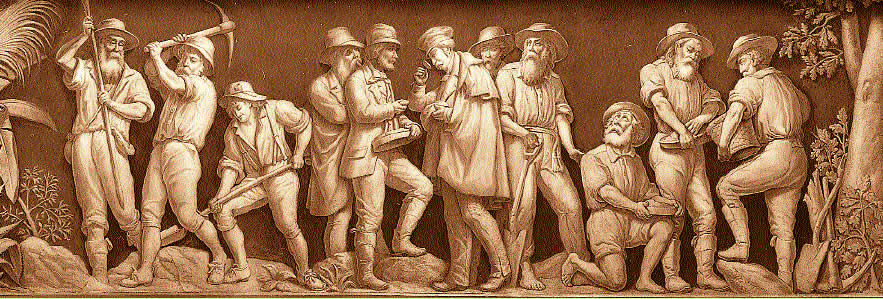
Mining for gold was backbreaking work. Early miners used simple tools — pans, picks, and shovels — to sift through river gravel for gold flakes and nuggets. This method, called placer mining, worked well at first. But as the easy surface gold ran out, miners turned to more advanced techniques. Hydraulic mining used high-pressure water hoses to blast away hillsides, and hard rock mining involved digging tunnels deep underground. Mining camps were rough places with tents and wooden shacks. Food and supplies were extremely expensive — eggs could cost the equivalent of $25 each in today’s money, and a simple pair of boots might cost $100 or more.
Impact on California
The Gold Rush had enormous consequences. California’s non-Native population exploded from about 14,000 in 1848 to over 300,000 by 1855. San Francisco grew from a small settlement of roughly 200 people into a bustling city of 36,000 by 1852. On September 9, 1850, California was admitted as the 31st state of the United States, just two years after the gold discovery. The Gold Rush also attracted people from China, Mexico, Chile, Australia, and Europe, making California one of the most diverse places in the country.
Effects on Native Americans
The Gold Rush had devastating effects on California’s Native American peoples. Before 1848, an estimated 150,000 Native Americans lived in California. Miners invaded their lands, polluted their rivers, and destroyed the environments they depended on for food. Many Native people were forced off their homelands, and violence against Native communities was widespread. By 1870, the Native population had dropped to about 30,000. The Gold Rush is remembered as one of the most destructive periods in the history of California’s indigenous peoples.
Land Speculation and Rising Prices
The Gold Rush created a second kind of fortune-seeking that had nothing to do with mining: land speculation. Speculators bought cheap land in and around San Francisco, then sold it for enormous profits as the city exploded in size. A lot that could be bought for a few hundred dollars in 1847 might sell for tens of thousands just a few years later. The people who got rich from this were not miners — they were simply people who happened to own land in a place that suddenly became very valuable.
A young printer and journalist named Henry George arrived in San Francisco in 1857, just after the Gold Rush. He watched the city grow into a booming metropolis and was troubled by what he saw: land prices kept rising, wealthy landowners grew richer, but many working people stayed poor. His observations about land and wealth in Gold Rush California would eventually inspire him to write one of the most influential books of the 1800s.
Legacy
Although very few miners actually struck it rich, the Gold Rush left a lasting mark on the nation. It accelerated westward expansion, helped build San Francisco into a major city, and connected California to the rest of the country through new roads, shipping routes, and eventually the transcontinental railroad completed in 1869. The Gold Rush also shaped California’s identity as a land of opportunity and diversity — a reputation that continues to this day.
 OtterKnow Kids Encyclopedia