Life Before Desegregation
Ruby Nell Bridges was born on September 8, 1954, in Tylertown, Mississippi. Her family later moved to New Orleans, Louisiana, looking for better opportunities. At that time, laws in many Southern states kept Black children and white children in separate schools, a system called segregation. Black schools often received less money, fewer supplies, and older textbooks than white schools. Ruby attended a kindergarten for Black children before she was chosen to help integrate the New Orleans school system.
The Supreme Court and Brown v. Board of Education
In 1954, the same year Ruby was born, the U.S. Supreme Court made a historic decision in the case called Brown v. Board of Education. The Court ruled that separating children in public schools based on race was unconstitutional, meaning it went against the rights guaranteed by the Constitution. Before this ruling, many states had laws requiring Black and white students to attend different schools. The decision declared that “separate but equal” schools were not truly equal. However, many Southern states resisted the ruling and took years to actually integrate their schools.
Ruby’s First Day at William Frantz Elementary
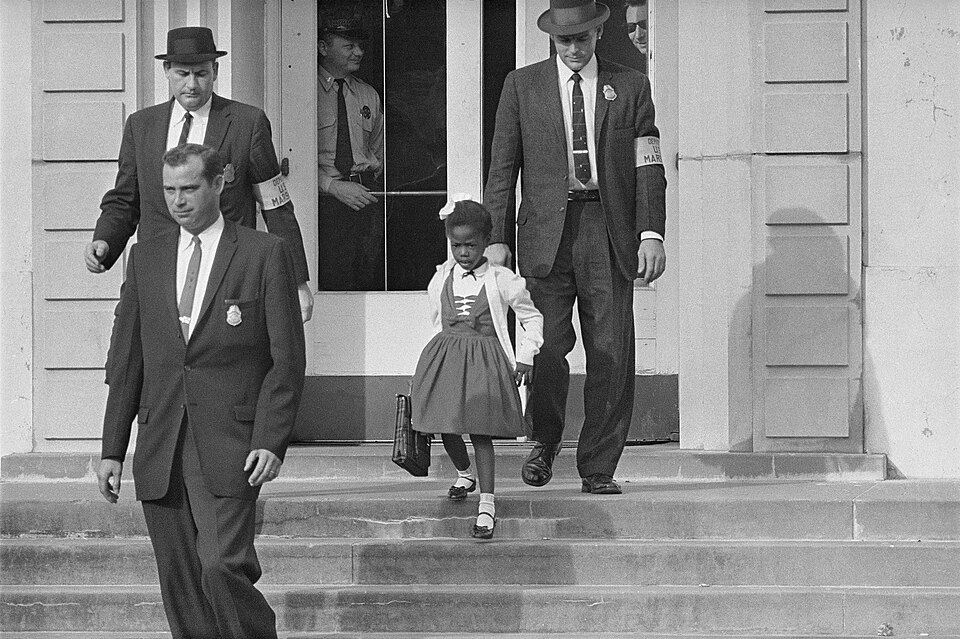
When Ruby arrived at William Frantz Elementary School, she was met by angry crowds of white protesters who shouted at her and held up signs. Federal marshals had to walk with her to keep her safe because local police could not be trusted to protect her. One marshal later said that Ruby never cried or showed fear as she walked through the hostile crowd. Inside the school, almost all the white parents pulled their children out of class in protest. Ruby spent her first day in the principal’s office because the chaos made it impossible to start class right away.
A Classroom of One
For most of her first year at William Frantz, Ruby was the only student in her classroom. Her teacher, Barbara Henry, who had come from Boston, Massachusetts, was the only teacher willing to teach her. Mrs. Henry treated Ruby like any other student, and the two formed a close bond that lasted for decades. They went through the entire first-grade curriculum together, just teacher and student. Other teachers in the school refused to teach if a Black child was in their classroom.
The Impact on Ruby’s Family
Ruby’s decision to attend William Frantz Elementary affected her entire family. Her father lost his job at a gas station because his employer did not support integration. Local grocery stores refused to sell food to her mother, and her grandparents in Mississippi were forced off the land they had farmed for years. Some neighbors and community members, both Black and white, supported the family by bringing them groceries and offering help. Despite these hardships, Ruby’s parents believed that getting a good education was worth the sacrifice.
The Bigger Fight for School Desegregation
Ruby Bridges was not the only child involved in school desegregation. Across the South, other brave students faced similar challenges as they integrated all-white schools. In 1957, the Little Rock Nine, a group of nine Black teenagers, integrated Central High School in Arkansas with the help of federal troops. It took many years, court orders, and federal enforcement before most Southern schools were fully integrated. The Civil Rights Act of 1964 and continued legal action helped push schools across the country to end segregation.
Ruby’s Legacy Today
Ruby Bridges grew up and became an activist dedicated to promoting tolerance and equality. In 1999, she founded the Ruby Bridges Foundation to help schools teach children about respect and the value of diversity. The famous artist Norman Rockwell painted her story in a 1964 painting called “The Problem We All Live With,” which showed Ruby walking to school surrounded by marshals. Ruby has written several books about her experience, including “Through My Eyes,” which shares her story in her own words. Her courage at age six continues to inspire children and adults around the world to stand up for what is right.
 OtterKnow Kids Encyclopedia