The Nile River
The Nile River was the lifeline of ancient Egypt. Stretching about 6,650 kilometers (over 4,100 miles), it is one of the longest rivers in the world. Every year, the Nile flooded its banks and left behind a layer of dark, rich soil that was perfect for farming. The Egyptians grew crops like wheat, barley, and flax in this fertile land. Without the Nile, farming in the hot desert would have been nearly impossible. The river was also used for transportation, trade, and fishing, connecting cities and villages throughout the kingdom.
Pharaohs and Government
Egypt was ruled by kings called pharaohs, who held enormous power. The pharaoh was not only the political leader but was also considered a living god. Egyptians believed the pharaoh kept order and protected the land. Some of the most famous pharaohs include Khufu, who ordered the building of the Great Pyramid, Hatshepsut, one of the few women to rule as pharaoh, and Tutankhamun, whose treasure-filled tomb was discovered in 1922. The pharaoh was supported by priests, scribes, and government officials who helped run the kingdom.
Pyramids and Monuments
The ancient Egyptians are famous for their incredible buildings. The Great Pyramid of Giza, built for Pharaoh Khufu around 2560 BCE, originally stood about 146 meters (481 feet) tall and was made from roughly 2.3 million stone blocks. It was the tallest structure in the world for more than 3,800 years. The Egyptians also built the Great Sphinx, a massive stone statue with the body of a lion and the head of a human. Temples, tombs, and obelisks were built to honor the gods and preserve the pharaohs for the afterlife.
Hieroglyphics and Writing
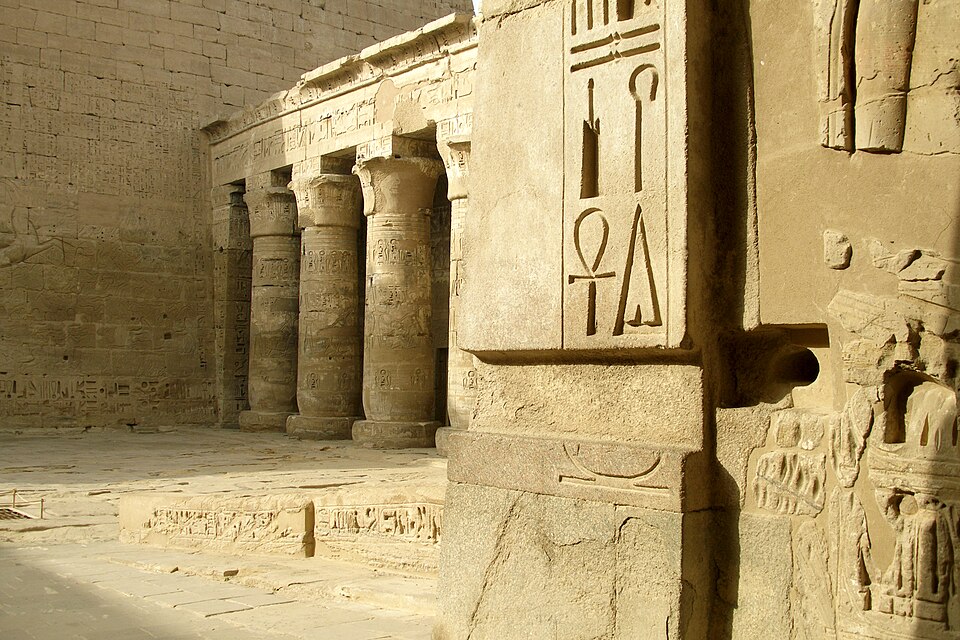
The Egyptians developed one of the earliest writing systems in the world, called hieroglyphics. This system used about 700 different symbols, including pictures of animals, people, and objects. Some symbols represented whole words, while others stood for sounds, similar to letters in our alphabet. Scribes, the specially trained writers, carved hieroglyphics into temple walls and wrote on papyrus, a paper-like material made from reeds that grew along the Nile. For thousands of years, nobody could read hieroglyphics until a French scholar named Jean-Francois Champollion decoded them in 1822 using the Rosetta Stone.
Daily Life and Culture
Most ancient Egyptians were farmers who worked the land near the Nile. Families lived in mud-brick houses and ate bread, vegetables, fish, and fruit. Children played with toys like dolls, spinning tops, and a board game called Senet that was popular for thousands of years. The Egyptians worshipped many gods and goddesses, including Ra the sun god, Isis the goddess of magic, and Anubis the god of the afterlife. They believed in life after death and developed mummification to preserve the bodies of the dead for the next world.
Legacy of Ancient Egypt
Ancient Egypt’s achievements still amaze people today. The Egyptians made important advances in mathematics, medicine, and astronomy. They created a 365-day calendar that became the basis for the calendar we use now. Their art, architecture, and writing have inspired people for thousands of years. The pyramids at Giza remain one of the Seven Wonders of the Ancient World and attract millions of visitors each year. By studying the artifacts and writings they left behind, we continue to learn more about how the ancient Egyptians lived, worked, and understood the world.
 OtterKnow Kids Encyclopedia