What It Looks Like
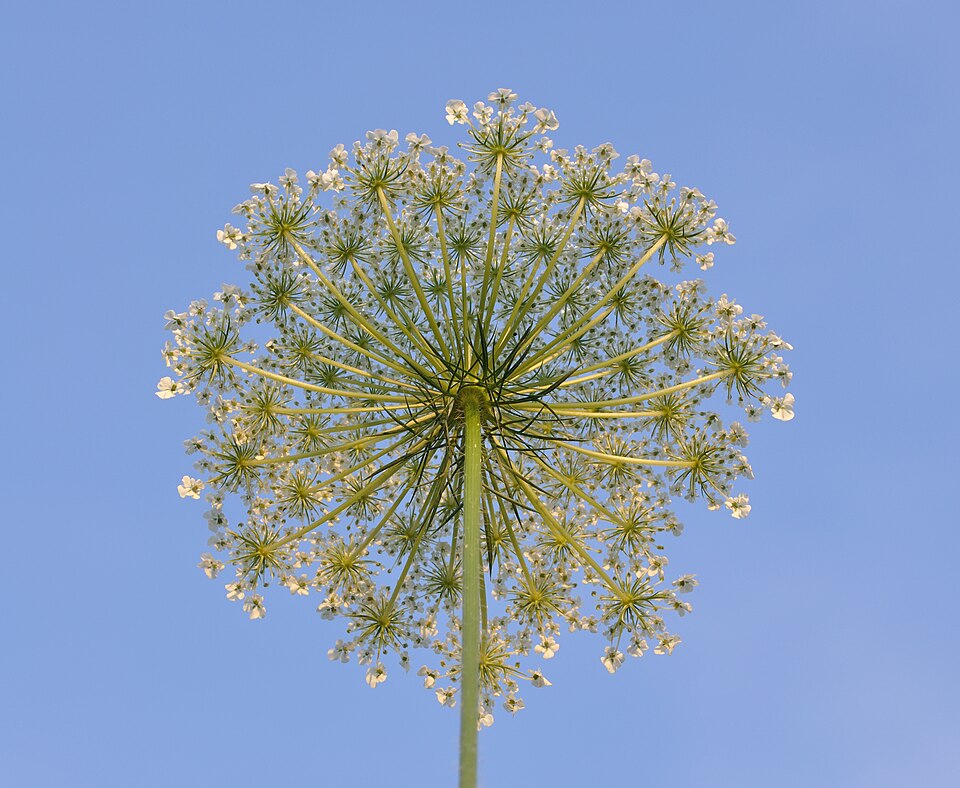
The flower head of Queen Anne’s lace is a flat or slightly rounded cluster called an umbel, made up of hundreds of tiny white flowers arranged in a pattern that looks like an intricate piece of lacework. If you look closely at the very center of the flower cluster, you will often find a single tiny dark purple or maroon flower, which legend says represents a drop of blood from Queen Anne of England when she pricked her finger while making lace. The plant grows two to four feet tall on hairy stems with finely divided, feathery leaves that look like carrot tops. As the seeds develop, the entire flower head curls inward, forming a cup shape that looks like a tiny bird’s nest.
Where It Grows
Queen Anne’s lace is a biennial plant, meaning it takes two years to complete its life cycle. In the first year, it grows only a flat rosette of feathery leaves close to the ground and develops its taproot. In the second year, the plant sends up its tall flowering stalk, blooms, produces seeds, and then dies. It thrives in dry to moderately moist soils in full sun and is extremely common along roadsides, in abandoned fields, and at the edges of farmland. Because it is so widespread and produces thousands of seeds per plant, Queen Anne’s lace is considered an invasive weed in many parts of North America.
Pollinators and Wildlife
The flat, open design of Queen Anne’s lace flower clusters makes them perfect landing platforms for a wide variety of small pollinators, including flies, tiny beetles, wasps, and small bees. These insects are attracted to the nectar produced by the tiny flowers and can be seen crawling across the flower heads on warm summer days. Some species of caterpillars, including the black swallowtail butterfly larva, feed on the leaves of Queen Anne’s lace and related plants in the carrot family. The seeds provide food for birds during fall and winter.
Uses and History
As the wild ancestor of the cultivated carrot, Queen Anne’s lace played a role in agricultural history long before the orange carrots we know today were developed by Dutch farmers in the 1600s. The first cultivated carrots were actually purple or yellow, and they were grown from wild carrot varieties closely related to Queen Anne’s lace. The plant’s name comes from a legend about Queen Anne of England, who challenged her ladies-in-waiting to create lace as beautiful as the flower, and pricked her finger with the needle, leaving a single drop of blood at the center. It is very important to know that Queen Anne’s lace has a dangerous look-alike called poison hemlock, which is extremely toxic and can be fatal if eaten.
Interesting Facts
You can demonstrate how plants drink water by placing a cut Queen Anne’s lace stem in a glass of water tinted with food coloring, and within hours the white flowers will turn the color of the dye. The dark purple central flower may serve as a “bull’s-eye” that helps attract pollinating insects to the center of the flower cluster, though scientists are still debating its exact purpose. When Queen Anne’s lace curls up into its bird’s nest shape, it creates a protective chamber around the developing seeds, sheltering them from rain and wind until they are ready to be released. The plant produces a natural compound that some researchers believe may act as an insect repellent, which could explain why the flowers attract pollinators but discourage leaf-eating pests.
 OtterKnow Kids Encyclopedia