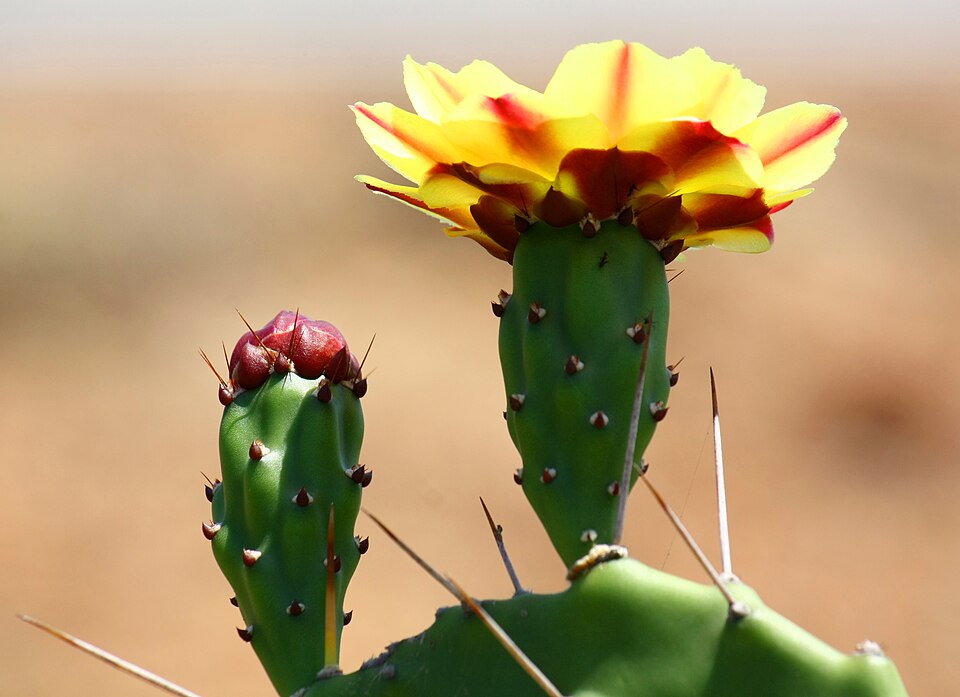
Spines and Sneaky Glochids
Prickly pear cacti have two types of defenses that protect them from hungry animals. The large, visible spines are easy to spot and avoid, growing from small bumps on the pads called areoles. But the prickly pear’s secret weapon is its glochids, tiny hair-like barbed spines that are almost invisible to the naked eye. Glochids detach at the slightest touch and embed themselves in skin, where their microscopic barbs make them incredibly difficult and painful to remove. Anyone who has accidentally brushed against a prickly pear knows that the glochids are far more annoying than the big spines. Even the fruit is covered with glochids, which is why people must carefully peel it before eating.
A Cactus You Can Eat
Prickly pear cacti have been an important food source in Mexico and the American Southwest for thousands of years. The flat pads, called nopales, are harvested, de-spined, and sliced into strips that are grilled, boiled, or added to salads, tacos, and scrambled eggs. Nopales have a mild, slightly tangy flavor similar to green beans and are packed with vitamins and fiber. The colorful fruit, known as tunas, tastes sweet and juicy, somewhat like a mix of watermelon and bubblegum. In Mexican markets, you can find nopales and tunas sold fresh alongside other produce, and they remain a beloved staple of Mexican cuisine to this day.
The Cochineal Connection
One of the most surprising stories about prickly pear cacti involves a tiny insect called the cochineal that lives on their pads. Cochineal insects feed on cactus sap and produce a brilliant red-purple dye called carmine when their bodies are crushed. For centuries, this dye was one of the most valuable exports from the Americas, used to color royal robes, military uniforms, and works of art. The Aztec and Maya peoples harvested cochineal long before European contact, and Spanish conquistadors shipped tons of the dried insects back to Europe. Even today, carmine from cochineal insects is used as a natural red food coloring in products like yogurt, candy, and cosmetics.
Prickly Pears Around the World
Prickly pear cacti have been introduced to every continent except Antarctica, and in some places they have become serious invasive pests. In Australia, prickly pears brought from the Americas in the 1800s spread so aggressively that they covered over 60 million acres of farmland. The problem was finally controlled by releasing a South American moth called Cactoblastis whose caterpillars eat prickly pear pads from the inside out. On the island of Malta, prickly pear fences have been used for centuries to mark property boundaries. The prickly pear even appears on the national flag and coat of arms of Mexico, where an eagle perched on a prickly pear cactus is the country’s founding symbol.
 OtterKnow Kids Encyclopedia