What They Look Like
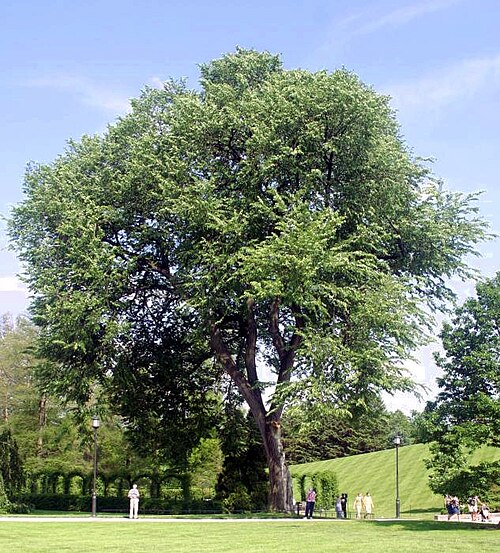
The American elm is famous for its vase-like shape, with a single trunk that splits into arching branches that spread outward and upward like the ribs of an umbrella. A mature elm can reach 80 to 100 feet tall and spread its canopy just as wide, creating a cathedral-like tunnel of shade when planted along a street. Elm leaves are oval with pointed tips and have a distinctive lopsided base where one side of the leaf is slightly larger than the other. In spring, elms produce small clusters of flowers before their leaves appear, followed by flat, papery seeds called samaras that are surrounded by a thin wing to catch the wind. The bark of older elms develops deep, interlocking ridges that give the trunk a rough, textured appearance.
The Dutch Elm Disease Story
In the early 1900s, a fungal disease called Dutch elm disease began spreading through Europe, carried by tiny bark beetles that tunneled under the bark. The fungus blocks the tree’s water-carrying vessels, causing branches to wilt and the tree to die, sometimes within a single season. The disease reached North America in the 1930s, likely carried on imported logs, and by the 1970s it had killed tens of millions of American elms across the continent. Entire streets that were once shaded by rows of towering elms became bare and sunlit. The loss of so many elms changed the character of countless neighborhoods and inspired a major effort to breed disease-resistant varieties.
How People Use Them
Elm wood is tough, flexible, and resistant to splitting, which made it ideal for building things that needed to withstand heavy use. Wheelwrights used elm to make wheel hubs because the interlocking grain held together even under great stress. Elm wood was also popular for making chairs, coffins, boat keels, and the seats of Windsor chairs. In England, hollowed-out elm logs were used as water pipes before metal plumbing became available. Today, new disease-resistant elm varieties are being planted in cities around the world, and scientists continue working to restore this beloved tree to its former place along America’s streets.
Fun Facts
Before Dutch elm disease, some American cities had elm-lined streets so thick with foliage that you could walk for blocks in complete shade on the hottest summer day. Elm seeds are among the first to ripen in spring, giving squirrels and birds an early food source when other seeds are not yet available. The Liberty Tree in Boston, a famous American elm, became a rallying point during the American Revolution and was a symbol of colonial resistance. Some elm trees have survived Dutch elm disease and are now being studied to understand what makes them resistant. The city of Winnipeg, Canada, has one of the largest remaining populations of American elms thanks to an aggressive disease prevention program that has been running for decades.
 OtterKnow Kids Encyclopedia