History and Founding
Leland Stanford Sr. was a railroad tycoon who served as governor of California from 1862 to 1863 and later as a U.S. senator. He and his wife, Jane Lathrop Stanford, founded the university in memory of their only child, Leland Stanford Jr., who died of typhoid fever in 1884 at the age of 15. The Stanfords dedicated their vast Palo Alto Stock Farm — the land where the campus sits today — to creating a university that would, in Leland’s words, benefit the children of California. Stanford University officially opened on October 1, 1891, with 555 students. The 1906 San Francisco earthquake heavily damaged the young campus, destroying several buildings, but the university rebuilt and continued to grow throughout the 20th century.
The Campus
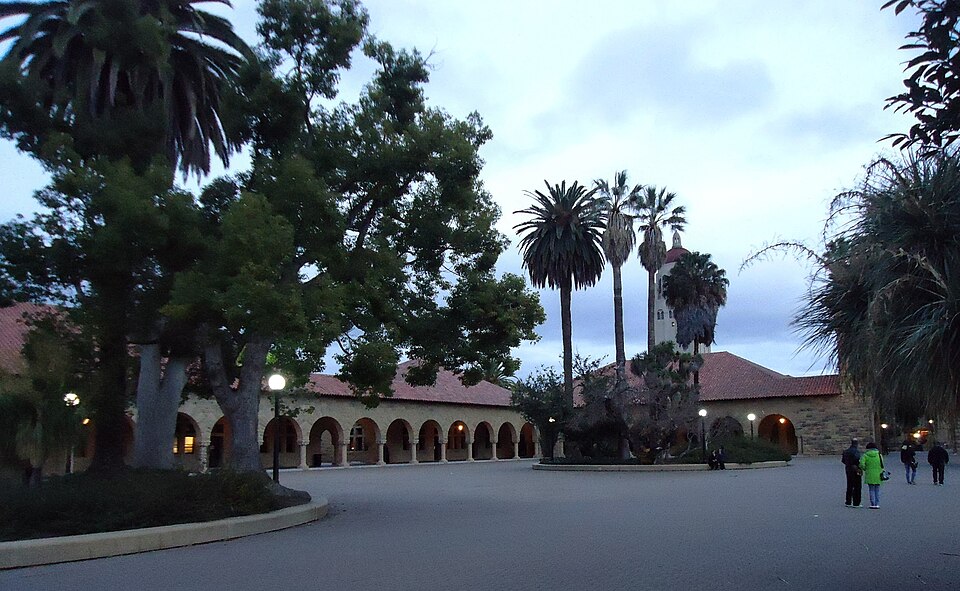
Stanford’s campus is famous for its Romanesque architecture, featuring sandstone buildings with red tile roofs connected by long arcaded walkways called colonnades. The Main Quad, at the center of campus, is anchored by Memorial Church, whose facade is decorated with a large religious mosaic containing thousands of hand-cut pieces of glass and stone. Hoover Tower, standing 285 feet tall, was built in 1941 to house a library and offers panoramic views of the entire Bay Area from its observation deck. The campus also features the Cantor Arts Center, the Anderson Collection of modern art, the Papua New Guinea Sculpture Garden, and the Stanford Dish — a popular 3.5-mile hiking trail that loops around a large radio telescope in the foothills behind campus.
Research and Innovation
Stanford is one of the top research universities in the world, with major contributions in fields ranging from computer science and engineering to medicine and the humanities. Stanford Research Park, established in 1951, was one of the first university-affiliated technology parks and helped spark the growth of Silicon Valley. The Stanford Linear Accelerator Center (SLAC), now called the SLAC National Accelerator Laboratory, is a Department of Energy facility on campus that has been the site of major physics discoveries, including work that earned multiple Nobel Prizes. The Stanford School of Medicine and Stanford Health Care are leading institutions in medical research and patient care. Overall, Stanford affiliates have won more than 30 Nobel Prizes.
Stanford and Silicon Valley
Perhaps more than any other university, Stanford has shaped the technology industry. Hewlett-Packard, often considered the founding company of Silicon Valley, was started in 1939 by Stanford graduates William Hewlett and David Packard with encouragement from their professor, Frederick Terman. Since then, Stanford students, faculty, and alumni have founded or co-founded some of the world’s most influential companies, including Google, Cisco Systems, Yahoo, Netflix, and many others. The university’s location in Palo Alto, surrounded by venture capital firms on nearby Sand Hill Road, creates an environment where academic research frequently leads to real-world products and companies.
Athletics and Student Life
Stanford’s athletic teams compete in the Pac-12 Conference under the name the Stanford Cardinal — referring to the color cardinal red, not the bird. Stanford has won over 130 NCAA team championships, more than any other university in the country. The campus has a strong tradition of cycling, with about 13,000 bicycles used by students and staff to get around the sprawling grounds. Student life includes over 600 organizations, from a cappella groups and debate teams to community service clubs and cultural organizations.
Fun Facts
- Stanford’s campus is so large that it has its own zip code: 94305.
- The university was originally tuition-free when it opened in 1891, a policy that lasted until 1920.
- Google’s search engine was developed as a research project by Stanford PhD students Larry Page and Sergey Brin in 1998.
- The Stanford Dish trail attracts over 800,000 hikers per year and offers views across the entire Bay Area.
- More than 30 Stanford affiliates have received Nobel Prizes across physics, chemistry, economics, and medicine.
 OtterKnow Kids Encyclopedia