The Route
Caltrain’s route stretches from the 4th and King Street station in San Francisco southward to the Tamien station in San Jose. Along the way, trains stop at cities and towns including South San Francisco, San Bruno, Millbrae, Burlingame, San Mateo, Redwood City, Palo Alto, Mountain View, Sunnyvale, and Santa Clara. The system operates 104 weekday trains — 52 in each direction — with local service running every 30 minutes and more frequent service during peak commute hours. Express trains can travel from San Francisco to San Jose in under an hour.
Electrification
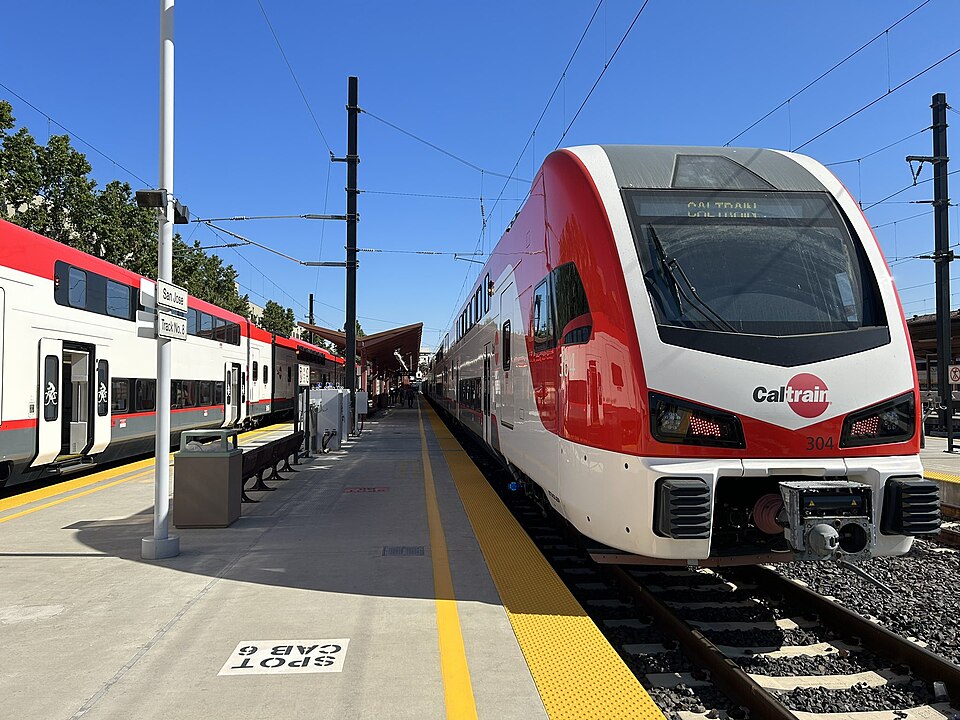
Caltrain’s electrification was one of the most significant rail modernization projects in recent American history. For decades, the railroad relied on diesel locomotives, which were noisy and produced significant air pollution. The Caltrain Modernization Program replaced those diesel trains with sleek, electric multiple-unit trains built by the Swiss company Stadler. Electric service began on August 11, 2024, and the last diesel trains were retired on September 21, 2024. The new trains draw power from overhead wires called a catenary system, running on 100 percent renewable energy. This change eliminates approximately 250,000 metric tons of carbon dioxide emissions, equivalent to removing 55,000 cars from the road each year.
History: From Southern Pacific to Caltrain
The railroad corridor that Caltrain uses today has one of the longest histories of any rail line in the American West. The San Francisco and San Jose Railroad began construction in 1860 and completed the route in 1863, making it one of California’s earliest railroads. In 1870, the powerful Southern Pacific Railroad purchased the line and operated passenger service along the peninsula for over a century. By the 1970s, however, ridership had declined and Southern Pacific petitioned to discontinue the service in 1977 due to operating losses. State subsidies through Caltrans kept the trains running, and in 1985 the service was rebranded as “Caltrain.” In 1991, the newly formed Peninsula Corridor Joint Powers Board purchased the 51-mile right-of-way from Southern Pacific for $202 million and took full control of operations the following year.
Stations and Connections
Caltrain connects with several other transit systems across the Bay Area. At Millbrae, riders can transfer to BART (Bay Area Rapid Transit) for service to Oakland, Berkeley, and San Francisco International Airport. At San Jose Diridon station, Caltrain connects with Amtrak long-distance trains, the VTA light rail system, and the Altamont Corridor Express. Many stations also have bus connections and bicycle parking. Caltrain is known for being one of the most bike-friendly railroads in the country, with dedicated bicycle storage cars on every train.
The New Electric Trains
The new Stadler KISS electric trains represent a major upgrade in passenger comfort and performance. Each trainset has seven cars and can carry more passengers than the old diesel consists. The trains feature free Wi-Fi, power outlets at every forward-facing seat, digital displays showing real-time trip information, improved climate control, baby-changing tables, security cameras, and expanded storage space under cantilevered seats. The electric motors accelerate faster than diesel locomotives, which means shorter travel times and the ability to run more frequent service throughout the day.
Fun Facts
- Caltrain’s railroad corridor has been in continuous use since 1863 — over 160 years of train service between San Francisco and San Jose.
- The electrification project eliminates the equivalent of 55,000 cars’ worth of carbon emissions every year.
- Caltrain was one of the last major commuter railroads in the United States still running on diesel power before its 2024 electrification.
- The Peninsula Corridor Joint Powers Board bought the entire 51-mile railroad right-of-way from Southern Pacific for $202 million in 1991.
- You can bring your bicycle aboard every Caltrain trip — dedicated bike cars make it one of the most bike-friendly train systems in the country.
 OtterKnow Kids Encyclopedia