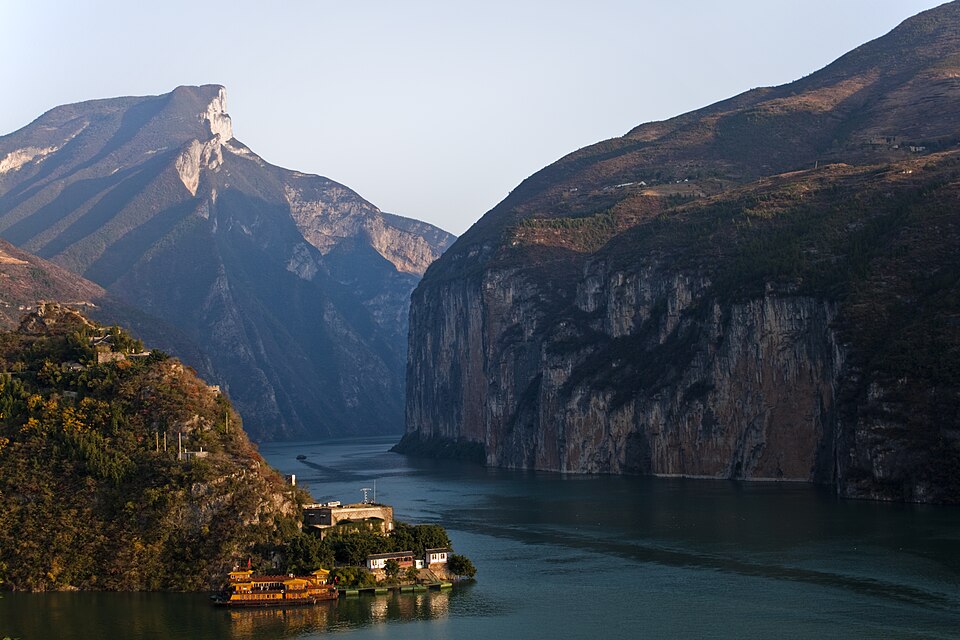
The Three Gorges
One of the most spectacular stretches of the Yangtze is the Three Gorges, a series of three dramatic canyons called Qutang, Wu, and Xiling. In these sections, the river squeezes between towering cliffs that rise hundreds of meters above the water. The gorges have inspired Chinese poets and painters for centuries with their misty peaks and sheer rock walls. Today, many tourists take boat cruises through the Three Gorges to experience this breathtaking scenery, though the water level is much higher than it once was due to the dam downstream.
The Three Gorges Dam
The Three Gorges Dam, completed in 2006, is the world’s largest hydroelectric power plant. It generates enormous amounts of clean electricity for China’s growing cities and factories. Building the dam required creating a reservoir 660 kilometers long, and more than 1.3 million people had to be relocated from towns and villages that were flooded. The dam helps control dangerous floods downstream, but it has also changed the river’s ecosystem and submerged ancient historical sites beneath the rising water.
A Dividing Line Across China
The Yangtze has long served as a natural boundary that divides China into north and south. The differences between these two regions are striking and go far beyond geography. People north of the Yangtze traditionally eat wheat-based foods like noodles and dumplings, while people to the south prefer rice. The climate is colder and drier in the north and warmer and wetter in the south. Even the languages and dialects spoken on each side of the river differ noticeably, showing how the Yangtze has shaped Chinese culture for millennia.
Endangered Wildlife
The Yangtze is home to some of the most endangered animals on Earth. The Yangtze finless porpoise, a small freshwater mammal with a permanent smile-like expression, is critically endangered with only about 1,000 individuals remaining. Sadly, the baiji, or Yangtze River dolphin, was declared functionally extinct in 2006 after scientists could no longer find any in the wild, making it the first large mammal driven to extinction primarily by human development in over 50 years. The Yangtze giant softshell turtle is also among the rarest animals in the world, with only a handful of known individuals left.
The Upper Yangtze
In its upper reaches, the Yangtze is known as the Jinsha River, or “River of Golden Sand.” This section flows through deep gorges in the mountains of southwestern China, running alongside two other great rivers, the Mekong and the Salween. Together, these three rivers form the Three Parallel Rivers area, a UNESCO World Heritage Site recognized for its extraordinary biodiversity and dramatic landscapes. The upper Yangtze drops steeply in elevation, making it a powerful source of hydroelectric energy even before it reaches the Three Gorges Dam.
The Yangtze’s Importance Today
The Yangtze is vital to China’s economy, serving as one of the busiest waterways in the world for shipping and trade. Cargo ships carry goods between inland cities and the port of Shanghai, one of the largest ports on Earth. The river also provides water for drinking, farming, and industry across a vast area of China. In recent years, the Chinese government has launched major efforts to clean up pollution in the Yangtze and protect its remaining wildlife, including a ten-year fishing ban that began in 2021.
Fun Facts
- The Yangtze begins at an elevation of over 5,000 meters on the Tibetan Plateau and drops to sea level by the time it reaches the ocean, a difference greater than the height of most mountains.
- The Three Gorges Dam’s reservoir is so massive that scientists believe the weight of the water slightly slows Earth’s rotation.
- Shanghai, one of the world’s largest cities with over 24 million people, sits at the mouth of the Yangtze River.
- The Chinese sturgeon, sometimes called a “living fossil,” has swum in the Yangtze for more than 140 million years, since the time of the dinosaurs.
 OtterKnow Kids Encyclopedia