Geography and Size
Lake Victoria lies on a high plateau in East Africa, at an elevation of about 1,134 meters above sea level. Despite its enormous surface area, the lake is surprisingly shallow, with an average depth of only about 40 meters. Compare that to Lake Baikal in Russia, which averages over 740 meters deep. The lake has many islands, including the Ssese Islands in Uganda, which are popular destinations for visitors. Its shoreline stretches for about 3,440 kilometers across the three countries that border it.
Source of the Nile
One of Lake Victoria’s most important roles is serving as the principal reservoir of the Nile River, the longest river in Africa. Water flows northward out of the lake at Jinja, Uganda, forming the beginning of the White Nile. From there, the river travels thousands of kilometers through Sudan and Egypt before emptying into the Mediterranean Sea. For centuries, European explorers searched for the source of the Nile, and Lake Victoria turned out to be a key part of the answer. The connection between the lake and the Nile makes Lake Victoria important to communities far beyond its own shores.
History and Name
Indigenous peoples living around the lake knew it well for thousands of years before Europeans arrived. The Luo, Sukuma, and other communities fished its waters and traded along its shores for generations. In 1858, British explorer John Hanning Speke became the first European to reach the lake, and he named it after Queen Victoria of England. Today, some people prefer to use the lake’s older local names, such as Nam Lolwe in the Luo language or Nyanza, which simply means “lake” in several Bantu languages.
Amazing Wildlife
Lake Victoria is home to one of the most remarkable examples of evolution on Earth. The lake contains hundreds of species of colorful cichlid fish, most of which are found nowhere else in the world. Scientists believe these hundreds of species evolved from just a few ancestors over the past few hundred thousand years. This rapid burst of evolution, called an adaptive radiation, is one of the fastest ever documented. The lake also supports populations of hippos, crocodiles, and many species of waterbirds along its shores.
Fishing and People
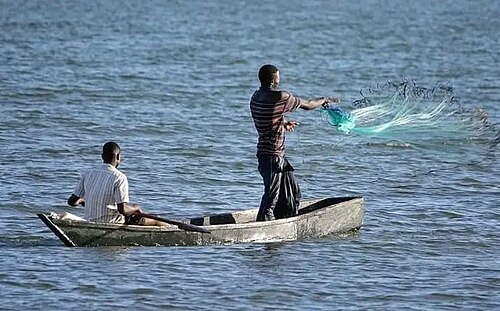
Fishing is the heartbeat of life around Lake Victoria. About 200,000 fishermen work on the lake, and the fishing industry supports the livelihoods of millions of people in the surrounding region. The most commonly caught fish include tilapia and Nile perch, which are sold in local markets and exported to countries around the world. Small wooden boats dot the lake’s surface each day as fishermen cast their nets. Beyond fishing, the lake provides drinking water, supports agriculture, and serves as a transportation route connecting communities.
Environmental Challenges
Lake Victoria faces serious environmental problems that threaten its health. In the 1950s, Nile perch were introduced into the lake to boost the fishing industry, but these large predators devastated native fish populations. Scientists consider it one of the worst ecological disasters ever caused by an introduced species. Agricultural runoff and untreated sewage flow into the lake, reducing water quality and creating algae blooms. Invasive water hyacinth plants have spread across parts of the lake’s surface, choking waterways and blocking sunlight from reaching the water below.
Protecting the Lake
The three countries that share Lake Victoria are working together to protect this vital resource. The Lake Victoria Basin Commission coordinates efforts to reduce pollution and manage fishing sustainably. Local communities are learning new methods to farm near the lake without sending harmful chemicals into the water. Programs to remove water hyacinth and restore native fish populations are underway. Protecting Lake Victoria matters not only for the people and wildlife that depend on it today, but for future generations as well.
 OtterKnow Kids Encyclopedia