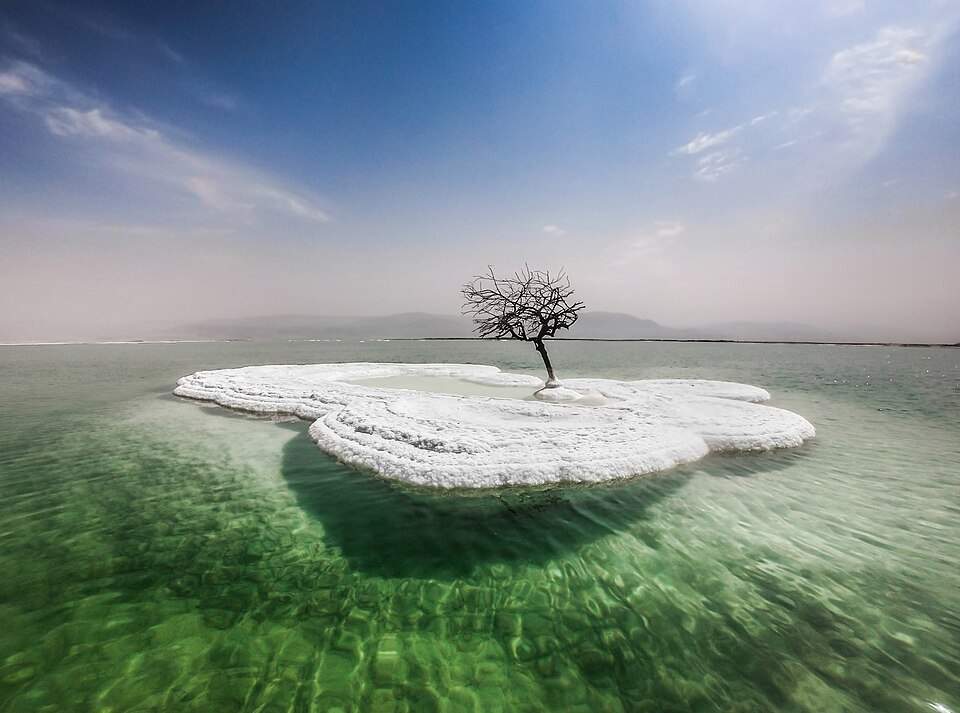
The Lowest Point on Earth
The surface of the Dead Sea sits about 430 meters (1,411 feet) below sea level, making it the lowest point on Earth’s land surface. To put that in perspective, if you stood on the shore of the Dead Sea, you would be deeper below sea level than the height of the Empire State Building. The area around the Dead Sea is extremely hot and dry, with temperatures often rising above 40 degrees Celsius (104 degrees Fahrenheit) in summer. The low elevation and thick atmosphere above the Dead Sea actually filter out some of the sun’s harmful rays, which is one reason people have visited for health purposes for thousands of years.
Why Is It So Salty?
The Dead Sea is one of the saltiest bodies of water in the world, with a salinity of about 34 percent — roughly 10 times saltier than the ocean. This extreme saltiness happens because the Dead Sea has no outlet. Water flows in from the Jordan River and other small streams, but the only way water leaves is through evaporation. When water evaporates, the salt and minerals get left behind, becoming more and more concentrated over time. The water contains high levels of minerals like magnesium, potassium, and calcium, giving it a thick, oily feel that is very different from ordinary lake water.
Floating Without Trying
One of the most famous things about the Dead Sea is that people can float in it effortlessly. The extremely high salt content makes the water much denser than fresh water or even regular ocean water, so your body is pushed upward with extra force. Visitors often enjoy floating on their backs while reading a book or newspaper — something that would be impossible in a normal lake. However, swimming in the Dead Sea can actually be difficult because your legs tend to float up to the surface. The salty water stings if it gets in your eyes or any cuts on your skin, so visitors are careful to keep their faces above water.
Life in the Dead Sea
The Dead Sea gets its name because its harsh, salty waters make it nearly impossible for most plants and animals to survive there. Fish that accidentally swim in from the Jordan River cannot survive in the extreme salt concentration. However, scientists have discovered that the Dead Sea is not completely lifeless. Certain types of salt-tolerant microorganisms, including bacteria and algae, can survive in its waters. After heavy rains reduce the salinity slightly, blooms of these tiny organisms sometimes appear, briefly turning patches of the water a reddish color.
Mud, Minerals, and Health
The shores of the Dead Sea are famous for their mineral-rich black mud, which people have used for skin treatments for thousands of years. Many visitors cover themselves in this mud, believing it helps with skin conditions and makes skin feel softer and smoother. Resorts and spas along the shores of the Dead Sea in both Israel and Jordan attract tourists from around the world who come for health and beauty treatments. The unique combination of mineral-rich water, mud, low elevation, and filtered sunlight has made the Dead Sea a popular destination for people seeking natural wellness therapies.
In 1947, a young shepherd discovered ancient scrolls hidden in caves near the northwestern shore of the Dead Sea. These documents, known as the Dead Sea Scrolls, turned out to be one of the greatest archaeological discoveries of the twentieth century. The scrolls include the oldest known manuscripts of the Hebrew Bible, dating back more than 2,000 years. They were preserved by the extremely dry climate of the region. Scholars have spent decades studying the scrolls, which have provided valuable insights into ancient Jewish history, religion, and daily life.
A Shrinking Lake
The Dead Sea is shrinking at an alarming rate, and scientists are deeply concerned about its future. Since the 1950s, the surface of the Dead Sea has dropped about 40 meters (130 feet), and it continues to drop by roughly one meter each year. The main cause is that Israel, Jordan, and other countries divert most of the Jordan River’s water for agriculture and drinking before it ever reaches the Dead Sea. As the water level drops, sinkholes have opened up along the retreating shoreline, swallowing roads and buildings. Governments and scientists are working on plans to save the Dead Sea, but finding a solution that satisfies everyone in this water-scarce region remains a major challenge.
 OtterKnow Kids Encyclopedia