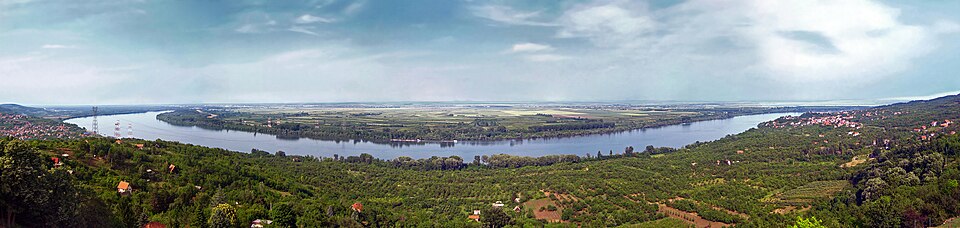
From the Black Forest to the Black Sea
The Danube begins as two small streams in the Black Forest mountains of southwestern Germany. These streams join together near the town of Donaueschingen, and from there the river flows eastward across the European continent. It passes through rolling farmland, dramatic gorges, and wide plains on its long journey. After traveling nearly 2,860 kilometers, the Danube empties into the Black Sea on the coast of Romania and Ukraine. The contrast between its humble beginning as a mountain stream and its massive mouth at the sea is one of the river’s most remarkable features.
Great Capital Cities
Four national capitals sit directly on the banks of the Danube, more than on any other river in the world. Vienna, the capital of Austria, is famous for its grand palaces, concert halls, and coffeehouses along the river. Bratislava, the capital of Slovakia, lies just 60 kilometers downstream from Vienna. Budapest, the capital of Hungary, is actually two historic cities, Buda and Pest, joined together on opposite banks of the Danube. Belgrade, the capital of Serbia, sits where the Sava River meets the Danube and has been an important crossroads for over two thousand years.
The Danube Delta
Where the Danube reaches the Black Sea, it splits into three main branches and fans out into a vast wetland known as the Danube Delta. This delta is one of Europe’s largest and most biodiverse wetlands, covering about 5,800 square kilometers. It is home to over 300 species of birds, including pelicans, herons, and cormorants, making it a paradise for birdwatchers. More than 45 species of freshwater fish live in the delta’s winding channels and shallow lakes. The Danube Delta is recognized as a UNESCO World Heritage Site because of its extraordinary natural value.
The River in History
The Danube played an important role in the ancient world as the northern boundary of the Roman Empire for several centuries. Roman soldiers built forts and watchtowers along its banks to defend against peoples living to the north. During the Middle Ages, the river became a major trade route connecting the kingdoms and empires of central and eastern Europe. Crusaders, merchants, and travelers all used the Danube to move goods and armies across the continent. The river has witnessed the rise and fall of empires, from Rome to Austria-Hungary, and remains central to European life today.
The Iron Gates
One of the most dramatic stretches of the Danube is the Iron Gates gorge, located on the border between Serbia and Romania. Here the river cuts through towering cliffs and narrow passages in the Carpathian Mountains, creating a landscape of stunning beauty. The gorge stretches for about 134 kilometers and includes some of the deepest points along the entire river. In the 1970s, a massive dam was built at the Iron Gates to generate hydroelectric power for both Serbia and Romania. The dam also helps control flooding, but it changed the natural flow of the river and affected fish migration patterns.
Music and Culture
The Danube has inspired artists, writers, and musicians for centuries. The most famous tribute is “The Blue Danube,” a waltz composed by Johann Strauss II in 1867, which became one of the most recognized pieces of classical music in the world. The river appears in folk songs, paintings, and literature from every country it touches. Each nation along the Danube has its own name for the river, from “Donau” in German to “Duna” in Hungarian to “Dunav” in Serbian. This rich cultural heritage reflects how deeply the river is woven into the identity of the people who live along its banks.
The Danube Today
Today the Danube is one of the most heavily managed rivers in Europe. Dams, shipping lanes, and flood control systems regulate its flow to support transportation, agriculture, and energy production. Large cargo ships and cruise boats travel the river, carrying goods and tourists between major cities. However, pollution and habitat loss remain serious challenges, and countries along the Danube cooperate through international agreements to protect the river’s health. Conservation efforts focus on restoring wetlands, improving water quality, and preserving the biodiversity of the Danube Delta and other important natural areas.
 OtterKnow Kids Encyclopedia