A Supervolcano Beneath the Surface
Yellowstone sits on top of one of the world’s largest supervolcanoes, known as the Yellowstone Caldera. A caldera is a giant crater left behind after a massive volcanic eruption. This supervolcano has erupted three times in the past 2.1 million years, each time with catastrophic force that spread ash across much of North America. Today, the volcano is not erupting, but the hot magma beneath the surface powers all of Yellowstone’s famous geothermal features. Scientists monitor the volcano closely, though they say another major eruption is not expected anytime soon.
Geysers and Hot Springs
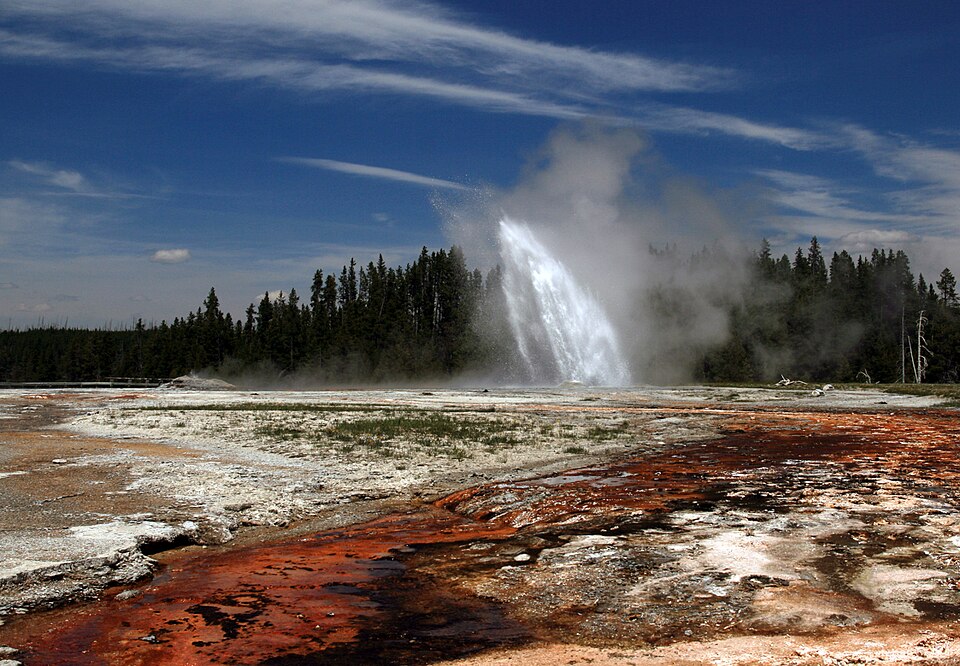
Yellowstone is home to over 10,000 hydrothermal features — more than anywhere else on Earth. These include geysers, hot springs, mud pots, and fumaroles (vents that release steam and gas). The most famous geyser is Old Faithful, which erupts approximately every 60 to 110 minutes, shooting boiling water 30 to 55 meters into the air. The Grand Prismatic Spring is the largest hot spring in the United States, stretching about 113 meters across. Its stunning rainbow colors — rings of orange, yellow, green, and blue — are caused by different types of heat-loving bacteria that thrive at different temperatures.
Wildlife of Yellowstone
Yellowstone is one of the best places in North America to see large wild animals. The park is home to grizzly bears, black bears, elk, moose, pronghorn, and gray wolves. It also has the largest wild bison herd in North America, with thousands of bison roaming the valleys and meadows. Smaller animals like coyotes, bighorn sheep, and river otters also live here. Hundreds of bird species have been spotted in the park, including bald eagles, trumpeter swans, and osprey.
The Return of the Wolves
Gray wolves were hunted and removed from Yellowstone by the 1920s. In 1995, scientists reintroduced wolves to the park, and their return changed the entire ecosystem in a process called a “trophic cascade.” With wolves hunting elk, the elk moved around more and stopped overgrazing along riverbanks. Trees and shrubs grew back, which brought back songbirds and beavers. The beavers built dams that created ponds, helping fish and other wildlife. The wolves’ return showed scientists how one species can affect an entire food web.
Indigenous Connections
Long before Yellowstone became a national park, Indigenous peoples lived in and traveled through the region for thousands of years. Nations including the Crow, Shoshone, Bannock, Blackfeet, and Nez Perce have deep historical and spiritual connections to the land. They hunted bison, fished the rivers, and used the obsidian found in the park to make tools and weapons. When the park was established, many of these groups were forced out of their homeland. Today, there is growing recognition of the importance of Indigenous history and knowledge in managing and understanding Yellowstone.
Exploring the Park
Yellowstone has hundreds of kilometers of hiking trails, boardwalks near geothermal areas, and scenic drives through mountain passes and river valleys. Popular spots include the Grand Canyon of the Yellowstone, where the Yellowstone River plunges over two massive waterfalls. Visitors can also see Mammoth Hot Springs, where terraces of white and orange mineral deposits are built up by hot water flowing over rock. In winter, the park transforms into a snowy wonderland where visitors can travel by snowcoach or cross-country skis.
Why Yellowstone Matters
Yellowstone is more than just a beautiful place to visit — it is one of the largest and most intact ecosystems in the northern temperate zone of Earth. Protecting it helps preserve habitats for hundreds of plant and animal species. The park also serves as a living laboratory where scientists study geology, wildlife, and the effects of climate change. Yellowstone’s creation in 1872 launched the idea of national parks around the world, inspiring countries on every continent to set aside wild places for future generations to enjoy.
 OtterKnow Kids Encyclopedia