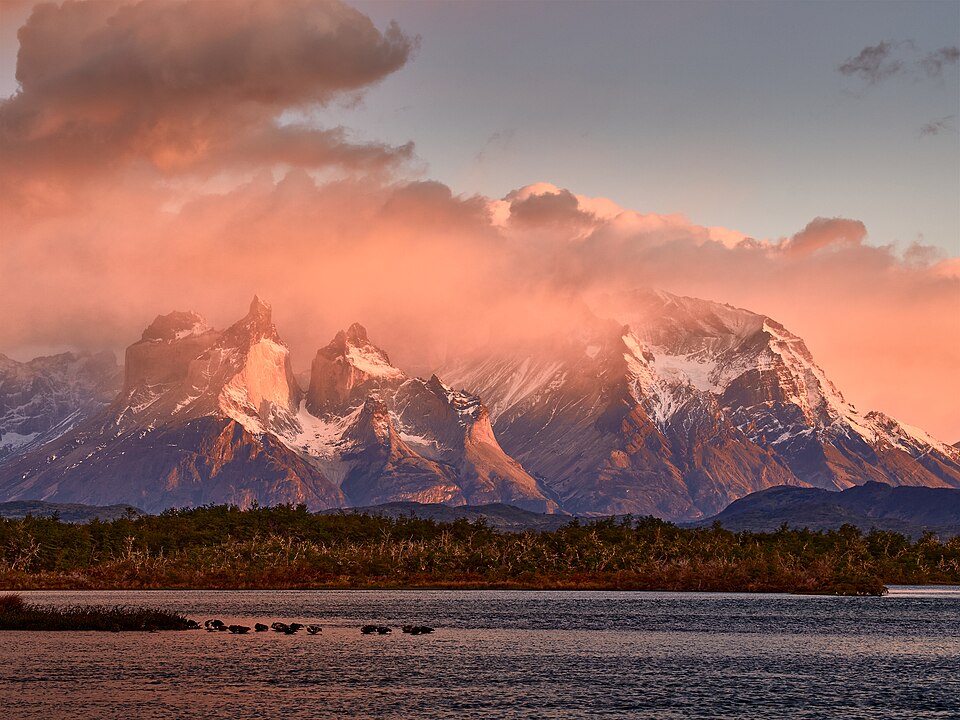
The Famous Towers
The park gets its name from three dramatic granite towers that rise high into the sky. “Torres del Paine” means “Towers of Blue” in a combination of Spanish and the language of the Mapuche, an Indigenous people of the region. The towers reach nearly 2,500 meters above sea level and are visible from many parts of the park. These formations began to take shape about 12 million years ago when hot magma pushed up beneath the surface, and over millions of years glaciers carved away the softer rock to reveal the hard granite underneath.
Glaciers and Lakes
Some of the most striking features of the park are its glaciers and lakes. The Grey Glacier is one of the largest, flowing down from the Southern Patagonian Ice Field into Grey Lake. Many of the lakes have a vivid turquoise color caused by tiny particles of rock ground up by glaciers, called glacial flour, that are suspended in the water. Sadly, the Grey Glacier and others in the park have been shrinking in recent decades because of climate change. Scientists study these glaciers carefully to understand how rising temperatures are affecting Patagonia’s ice.
Wildlife
Torres del Paine is home to many fascinating animals. Guanacos, wild relatives of llamas, roam the grasslands in large herds and are one of the most common sights in the park. Pumas, the large wild cats of the Americas, hunt guanacos and are sometimes spotted by lucky visitors. The skies above the park are ruled by the Andean condor, one of the largest flying birds in the world, with a wingspan that can reach over 3 meters. Visitors might also see rheas (large flightless birds related to ostriches), foxes, and even flamingos near some of the lakes.
Weather and Climate
Patagonia is famous for having some of the strongest and most unpredictable weather on the planet. Wind speeds in the park can be extreme, and the weather can change from bright sunshine to a blizzard in just a few minutes. Visitors are always told to bring layers of clothing and be ready for anything. The windiest and warmest months are from November to March, which is summer in the Southern Hemisphere. Even in summer, temperatures can drop quickly, and rain or snow can arrive without warning.
Hiking and Exploration
Torres del Paine is a world-famous destination for hikers and nature lovers. The two most popular routes are the “W Trek,” which takes about five days and follows a W-shaped path through the park’s highlights, and the “O Circuit,” which takes eight to ten days and loops all the way around the central mountain massif. About 250,000 visitors come to the park each year from countries all over the world. Along these trails, hikers pass glaciers, waterfalls, forests, and some of the most dramatic mountain scenery anywhere on Earth.
Indigenous History
Long before Torres del Paine became a national park, Indigenous peoples lived throughout Patagonia for thousands of years. The Kawesqar, Aonikenk, and other groups traveled across the land, hunting guanacos and gathering food from the forests and coastlines. These peoples had deep knowledge of the plants, animals, and weather patterns of the region. Their connection to this landscape stretches back far longer than any modern boundary or park designation.
Protecting the Park
Torres del Paine was established as a national park in 1959, and it became a UNESCO Biosphere Reserve in 1978. Park rangers work to protect the land from wildfires, which have caused serious damage in the past when campfires spread out of control. Visitors must follow strict rules about where they can camp and how they handle fire. Conservation efforts also focus on protecting puma populations, restoring native forests, and managing the growing number of tourists so that the park remains wild and healthy for future generations.
 OtterKnow Kids Encyclopedia