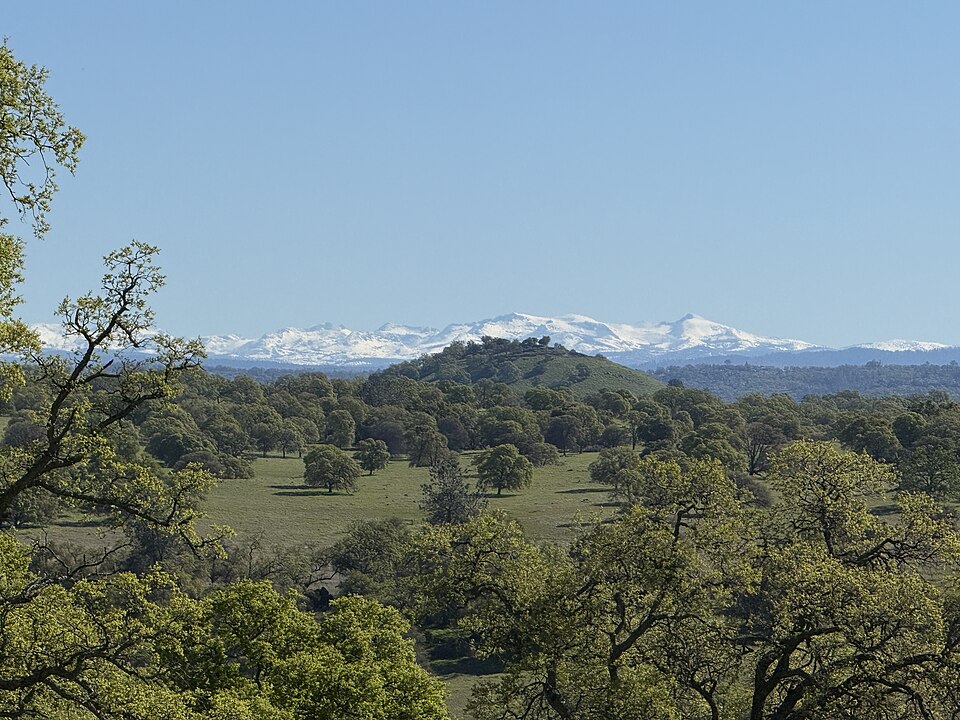
The Sierra Nevada began forming roughly 100 million years ago when molten rock called magma pushed upward beneath the Earth’s surface and slowly cooled into a massive block of granite known as a batholith. Over millions of years, tectonic forces tilted this enormous granite block upward on its eastern side, creating a dramatic steep wall that rises sharply from the Owens Valley below. The western slope is much more gradual, sloping gently toward California’s Central Valley. During the Ice Ages, glaciers carved out the valleys, lakes, and spectacular cliffs that visitors see today, including the iconic U-shaped Yosemite Valley.
Mount Whitney and Major Peaks
Mount Whitney stands at 4,421 meters (14,505 feet), making it the highest point in the contiguous 48 states. It is located in the southern Sierra Nevada on the border between Sequoia National Park and Inyo National Forest. The peak was named after Josiah Whitney, California’s state geologist in the 1860s. Today thousands of hikers attempt to reach the summit each year via the Mount Whitney Trail, which covers about 22 miles round trip. Other notable peaks include Mount Williamson, the second highest in the range, and several volcanic peaks near the northern end.
National Parks and Lake Tahoe
The Sierra Nevada contains some of the most beloved national parks in the country. Yosemite National Park is famous for its towering granite cliffs, waterfalls, and meadows. Sequoia National Park protects groves of giant sequoias, the largest trees on Earth by volume, including the General Sherman Tree. Kings Canyon National Park features one of the deepest canyons in North America. Lake Tahoe, sitting at 1,897 meters (6,225 feet) on the California-Nevada border, is the largest alpine lake in North America and the second deepest lake in the United States, reaching a maximum depth of 501 meters (1,645 feet).
Wildlife
The Sierra Nevada supports a wide variety of wildlife across its many habitats. Black bears are common throughout the range, along with mule deer, mountain lions, and bobcats. The Sierra Nevada bighorn sheep, a federally endangered subspecies, lives on the high rocky slopes above the tree line. Bird species include the Clark’s nutcracker, Steller’s jay, and peregrine falcon. At lower elevations, oak woodlands shelter gray foxes and wild turkeys, while the high alpine zones are home to pikas and yellow-bellied marmots. Rivers and streams throughout the range support several species of trout.
The Rain Shadow and Water Supply
The Sierra Nevada creates a powerful weather effect called a rain shadow. Storms blowing east from the Pacific Ocean are forced upward by the mountains, dropping heavy rain and snow on the western slopes. By the time the air passes over the peaks and descends on the eastern side, it has lost most of its moisture, creating the dry conditions of the Mojave Desert and the Great Basin. The snowpack that builds up on the Sierra during winter melts gradually in spring and summer, feeding rivers that supply water to farms and cities across California. Scientists estimate that Sierra snowmelt provides roughly 30 percent of California’s total water supply.
The Gold Rush
The California Gold Rush began in January 1848 when James Marshall discovered gold at Sutter’s Mill in Coloma, along the western foothills of the Sierra Nevada. By 1849 hundreds of thousands of people from around the world rushed to California hoping to strike it rich, earning them the nickname “forty-niners.” Mining towns sprang up throughout the Sierra foothills almost overnight. The Gold Rush transformed California from a sparsely populated territory into a state that joined the Union in 1850. Many historic mining towns still exist today as popular tourist destinations.
Indigenous Peoples
The Paiute, Miwok, Washoe, and other Indigenous peoples have lived in and around the Sierra Nevada for thousands of years. They developed detailed knowledge of the mountains, using different elevations for hunting, fishing, and gathering food at different times of year. The Miwok lived in the western foothills and valleys, while the Washoe people made their home around Lake Tahoe. These communities traded goods with groups on both sides of the range by traveling through mountain passes. Their deep connection to the Sierra landscape and its resources continues to be recognized and honored today.
 OtterKnow Kids Encyclopedia