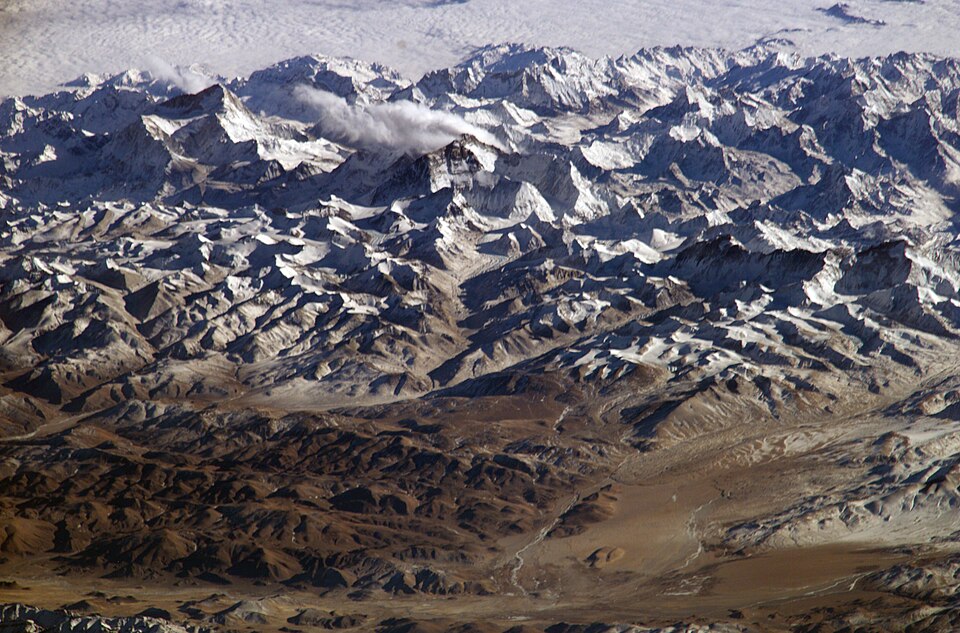
The Himalayas were created by a massive collision between two tectonic plates. About 50 million years ago, the Indian subcontinent crashed into the Eurasian plate, and the force of that collision pushed rock and earth upward to form enormous mountains. This process is still happening today — the Himalayas continue to grow by about 5 millimeters each year. Scientists study the range to understand how plate tectonics shape the surface of our planet.
The Tallest Peaks
Mount Everest is the most famous peak in the Himalayas and the tallest mountain in the world at 8,849 meters. Other giants include K2 at 8,611 meters, Kangchenjunga at 8,586 meters, and Lhotse at 8,516 meters. Climbing these peaks is extremely dangerous because of thin air, freezing temperatures, and sudden storms. Every year, mountaineers from around the world travel to Nepal and Pakistan to attempt these challenging summits.
Rivers and Glaciers
The Himalayas are sometimes called the “Third Pole” because they hold about 15,000 glaciers, which store vast amounts of freshwater ice. These glaciers feed some of the most important rivers in Asia, including the Ganges, Indus, Brahmaputra, Yangtze, and Mekong. Billions of people across South and East Asia depend on these rivers for drinking water, farming, and transportation. As global temperatures rise, scientists are closely watching these glaciers because their melting could affect water supplies for millions of people.
Wildlife
The Himalayas are home to many animals adapted to life at high altitudes. Snow leopards hunt among the rocky slopes, using their thick fur and long tails for balance and warmth. Red pandas live in the bamboo forests on the lower mountainsides, while yaks graze on high-altitude grasslands. Himalayan blue sheep and golden eagles are also found throughout the range. Many of these species are endangered because of habitat loss and climate change.
People and Culture
The Sherpa people are native to the high Himalayan region of Nepal and are known as expert mountaineers and guides. They have lived at high altitudes for generations, and their bodies are specially adapted to thrive in thin mountain air. Many Hindu and Buddhist sacred sites are found throughout the Himalayas, including ancient temples and monasteries. The mountains hold deep spiritual meaning for the people who live in and around them.
Climate and Weather
The Himalayas play a huge role in shaping the climate of Asia. The towering peaks block cold Arctic winds from reaching South Asia, helping to keep countries like India warmer than they would otherwise be. The mountains also direct the monsoon, a seasonal pattern of heavy rainfall that is essential for farming across the region. Without the Himalayas, the climate of much of Asia would be very different.
Exploring the Himalayas
People have lived in and around the Himalayas for thousands of years, but the first recorded summit of Mount Everest was in 1953 by Edmund Hillary and Tenzing Norgay. Today, trekking and mountaineering attract visitors from all over the world. National parks and conservation areas protect large sections of the range and its wildlife. Scientists continue to study the Himalayas to learn more about geology, climate, and the many species that call these mountains home.
 OtterKnow Kids Encyclopedia