Seabirds
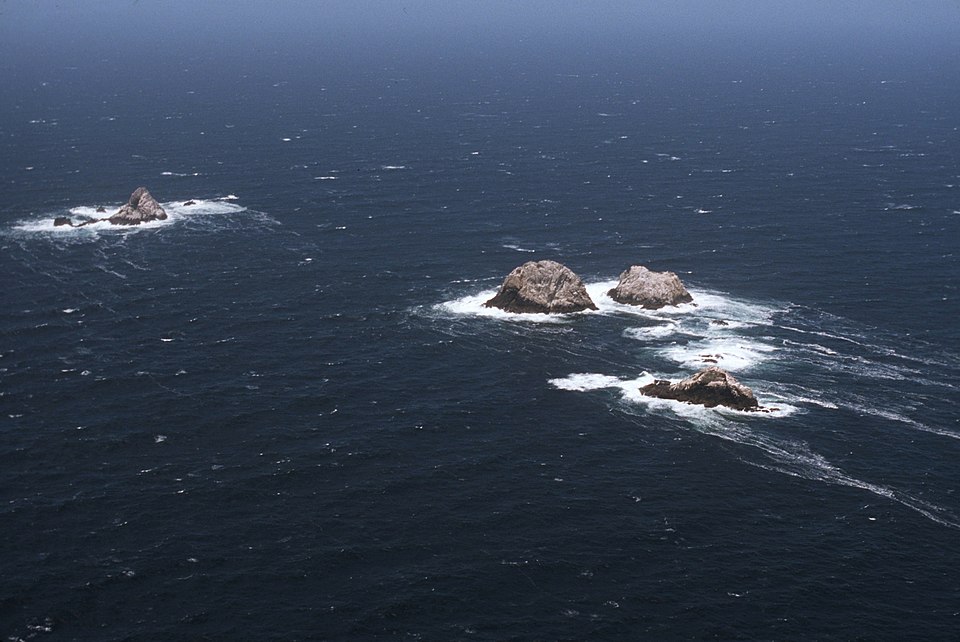
The Farallon Islands are home to the largest seabird colony in the contiguous United States. More than 250,000 seabirds nest on these rocky islands each year, including twelve different species. Common murres are the most numerous, with a population that recovered from just 6,000 birds to around 160,000 after the islands were protected. Other nesting species include Cassin’s auklets, tufted puffins, pigeon guillemots, ashy storm-petrels, and western gulls. The cold, nutrient-rich waters of the California Current bring huge amounts of fish and plankton, providing plenty of food for all these birds.
Great White Sharks
Every fall, great white sharks gather in the waters around the Farallon Islands. They come to hunt the large populations of elephant seals and sea lions that rest on the islands’ shores. Scientists first observed a shark attack near the islands in 1970, when a great white struck a Steller’s sea lion. Over the next fifteen years, researchers witnessed more than one hundred attacks on marine mammals at close range. The area between the Farallon Islands, Tomales Point, and Ano Nuevo Island is one of the most important white shark feeding grounds in the world.
Seals and Sea Lions
Five species of seals and sea lions breed or rest on the Farallon Islands. Northern elephant seals, the largest of the group, can weigh over 4,000 pounds. Harbor seals, Steller’s sea lions, California sea lions, and northern fur seals also use the islands. Northern fur seals were nearly wiped out by hunters in the 1800s but have slowly returned. The large marine mammal population is a key reason great white sharks patrol these waters.
History: The Egg Wars
In the mid-1800s, San Francisco’s population boomed during the Gold Rush, and the demand for food was enormous. Egg collectors discovered that the murre eggs on the Farallon Islands were a valuable source of food. At the peak, collectors harvested up to 500,000 eggs per month to sell in San Francisco markets. Competition over the egg trade turned violent in 1863, resulting in a conflict known as the Egg War, which left two men dead. President Theodore Roosevelt signed an executive order in 1909 to protect the islands, and egg collection was eventually banned.
Nuclear Waste Dumping
Between 1946 and 1970, the United States military and the Atomic Energy Commission dumped an estimated 47,500 barrels of low-level radioactive waste into the ocean near the Farallon Islands. The waste came from nuclear laboratories including Lawrence Livermore. When barrels floated back to the surface, workers shot holes in them to make them sink. This was the largest offshore nuclear waste dump in the country. Ocean dumping of radioactive materials was finally banned in 1970, and the area is now closely monitored.
Marine Sanctuary
Today the Farallon Islands and surrounding waters are protected as part of the Greater Farallones National Marine Sanctuary. The sanctuary covers over 3,000 square miles of ocean and is home to 29 species of whales and dolphins, more than 390 species of fish, and over 330 species of invertebrates. The Gulf of the Farallones is one of the most productive marine ecosystems on Earth. Scientists continue to study the islands year-round, tracking seabird populations, shark behavior, and ocean health.
 OtterKnow Kids Encyclopedia