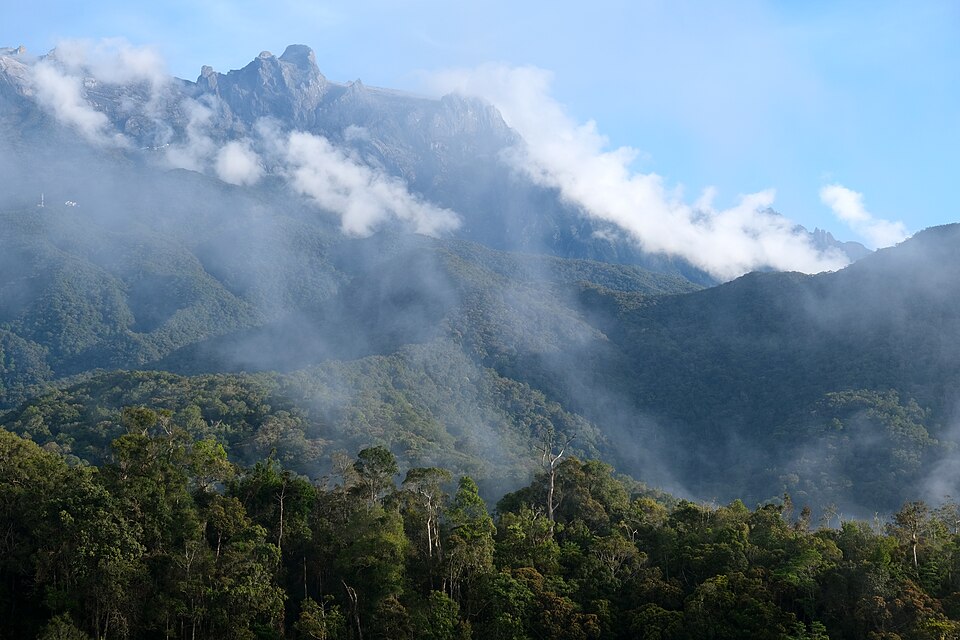
Ancient Rainforests
Borneo’s tropical rainforests are among the oldest on Earth, estimated to be about 130 million years old, which makes them even older than the famous Amazon Rainforest. These ancient forests are incredibly dense, with trees that can grow over 60 meters tall and form a thick canopy that blocks much of the sunlight from reaching the forest floor. The warm, wet climate near the equator provides year-round rainfall, creating ideal conditions for an enormous variety of plant life. Scientists continue to discover new species in Borneo’s forests, making it one of the most important places for biological research in the world.
Amazing Wildlife
Borneo is home to some of the most unusual animals on the planet. The Bornean orangutan, one of our closest relatives in the animal kingdom, swings through the forest canopy and is found nowhere else in the wild. Borneo’s pygmy elephants are the smallest elephants in Asia, standing about 2.5 meters tall, and are known for their gentle nature. The proboscis monkey, with its large, drooping nose, lives only on Borneo and uses its unusual nose to attract mates and make loud honking calls. Other notable species include the sun bear, the world’s smallest bear, the clouded leopard, and the Sumatran rhinoceros, one of the most endangered large mammals on Earth.
Unusual Plants
The plant life in Borneo is just as strange and varied as its animals. The rafflesia, which grows in Borneo’s forests, produces the largest individual flower in the world, measuring up to one meter across. This bizarre flower has no stems, leaves, or roots of its own and instead grows as a parasite on jungle vines. It is famous for smelling like rotting meat, which attracts the flies that pollinate it. Borneo is also home to thousands of species of orchids, giant pitcher plants that can trap insects and even small rodents, and towering dipterocarp trees that dominate the rainforest canopy.
The People of Borneo
The Dayak people are the indigenous inhabitants of Borneo and have lived on the island for thousands of years. Traditionally, many Dayak communities built longhouses, large communal wooden structures built on stilts that could house an entire village under one roof. The Dayak are made up of many different ethnic groups, each with their own language, customs, and traditions. Today, Borneo is also home to Malay, Chinese, and other communities, and its cities like Kota Kinabalu and Kuching blend modern life with cultural traditions.
Mountains and Rivers
Mount Kinabalu, located in the Malaysian state of Sabah, is the tallest peak in Southeast Asia, rising to 4,095 meters above sea level. It is a UNESCO World Heritage Site and a popular destination for hikers and climbers from around the world. Borneo also has many large rivers that wind through its rainforests, serving as vital transportation routes for communities that live deep in the interior. The Kapuas River in Indonesian Kalimantan is the longest river on the island, stretching about 1,143 kilometers. The waters around Borneo are part of the Coral Triangle, one of the most biodiverse marine ecosystems on Earth.
Threats to Borneo’s Forests
Despite its rich natural diversity, Borneo faces serious environmental challenges. The island has lost about 30 percent of its forest cover in the past 40 years, largely because of logging and the expansion of palm oil plantations. Palm oil is used in many everyday products, from snack foods to shampoo, and the demand for it has driven companies to clear vast stretches of rainforest. This deforestation destroys the habitats of endangered species like orangutans and pygmy elephants. Conservation organizations are working with local governments and communities to protect remaining forests and create wildlife corridors.
Why Borneo Matters
Borneo is one of the most biologically diverse places on the planet, and protecting it is important for the entire world. Its ancient rainforests absorb huge amounts of carbon dioxide, helping to slow climate change. The island’s unique species, many of which are found nowhere else, represent millions of years of evolution that cannot be replaced once lost. Efforts to establish national parks, promote sustainable farming, and support ecotourism give hope that Borneo’s forests and wildlife can be preserved.
 OtterKnow Kids Encyclopedia