A Gift from France
The idea for the Statue of Liberty came from a French political thinker named Édouard de Laboulaye, who admired American democracy and wanted to honor it with a grand monument. French sculptor Frédéric Auguste Bartholdi was chosen to design the statue, and he spent years planning every detail of Lady Liberty’s appearance. The internal iron framework that holds the statue upright was engineered by Gustave Eiffel, who later became famous for building the Eiffel Tower in Paris. The French people raised money through donations and events to pay for the statue, while Americans raised funds to build the massive stone pedestal it stands on.
How Big Is She?
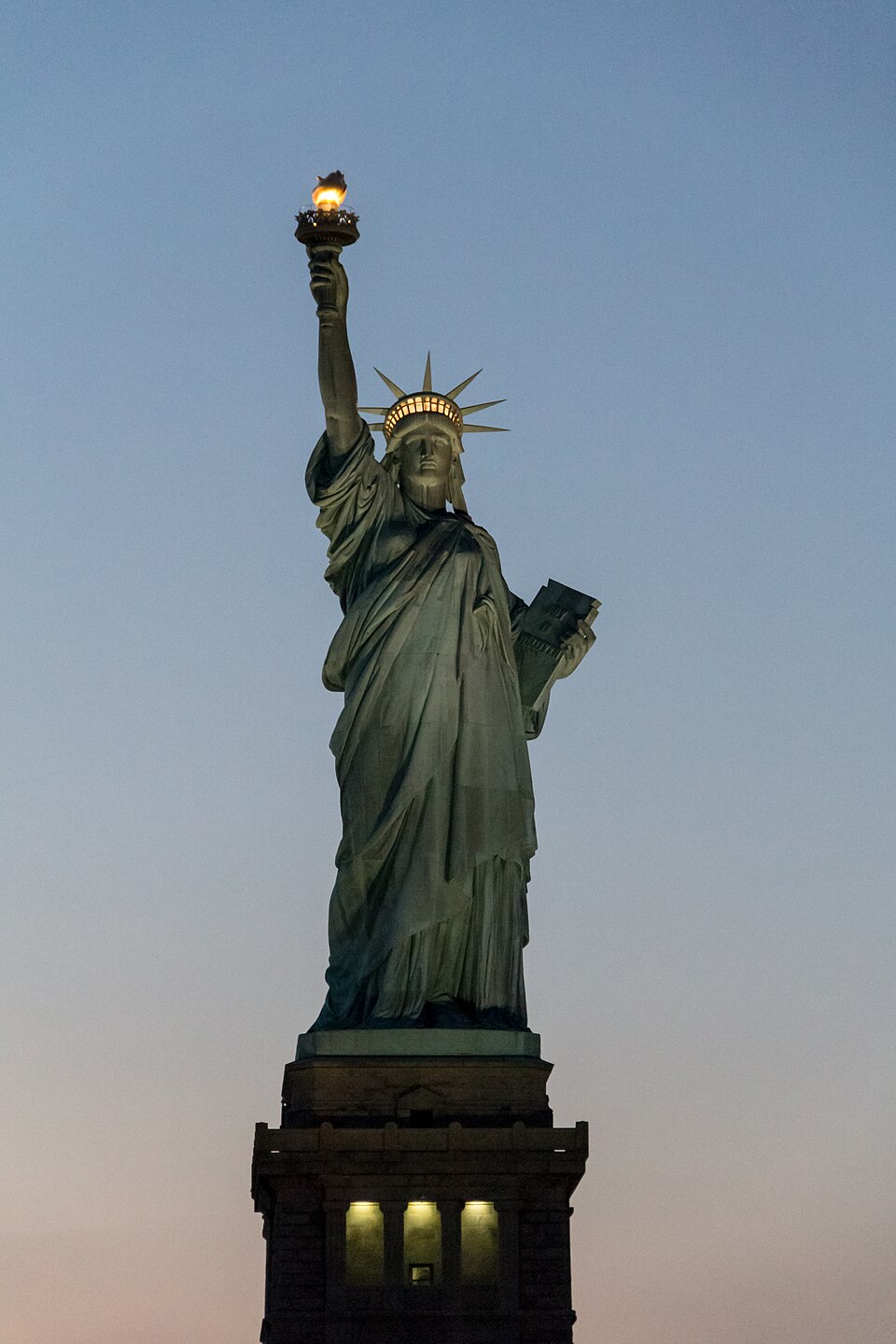
The Statue of Liberty stands about 93 meters (305 feet) tall from the ground to the tip of her torch, making her one of the tallest statues in the world. The statue itself, from her feet to the top of her head, is about 46 meters (151 feet) tall. Despite her enormous size, the outer shell of the statue is made of copper sheets only about 2.4 millimeters thick, roughly the same thickness as two pennies stacked together. Her index finger alone is about 2.4 meters (8 feet) long, and her nose measures about 1.4 meters (4.5 feet) from bridge to tip.
What She Holds and Wears
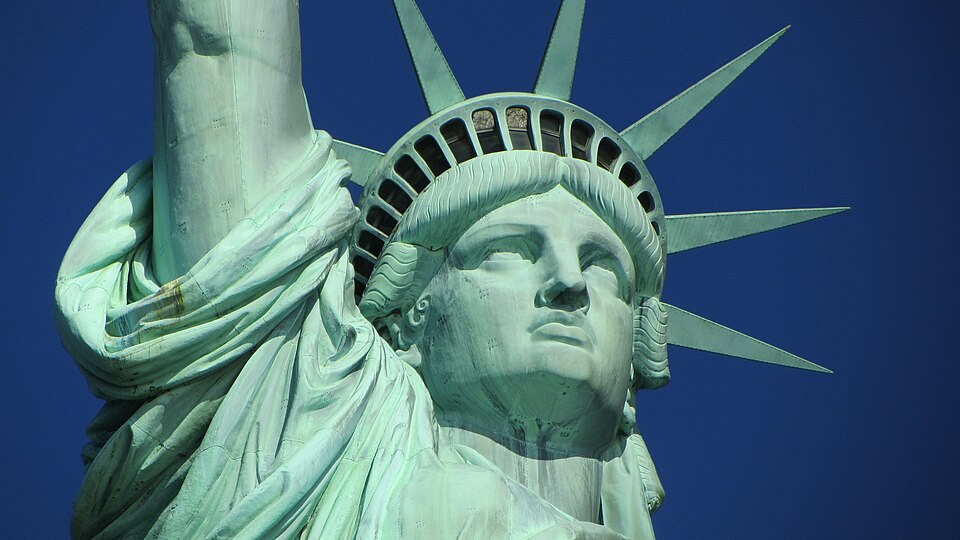
Lady Liberty holds a flaming torch high in her right hand, symbolizing enlightenment and the guiding light of freedom. In her left arm, she cradles a stone tablet inscribed with “JULY IV MDCCLXXVI,” which is the Roman numeral date for July 4, 1776, the day the United States declared its independence from Britain. Her crown has seven pointed spikes, or rays, which represent the seven continents and seven seas of the world, showing that liberty is a universal idea. At her feet, a broken chain lies partially hidden by her robes, representing freedom from oppression and tyranny.
Why She Turned Green
When the Statue of Liberty was first assembled, her copper surface was a shiny reddish-brown color, much like a brand-new penny. Over about 30 years of exposure to rain, wind, and salty ocean air, a chemical reaction called oxidation slowly changed the copper’s color to the blue-green shade we see today. This green coating is called verdigris, and it actually protects the copper underneath from further damage, like a natural shield. Engineers decided not to remove the green patina because it had become part of the statue’s beloved identity and helped preserve the thin copper sheets.
A Welcome to Immigrants
For millions of immigrants arriving in the United States by ship in the late 1800s and early 1900s, the Statue of Liberty was the first thing they saw as they entered New York Harbor. Many of these travelers had spent weeks crossing the Atlantic Ocean in crowded ships, leaving behind their home countries in search of a better life. Nearby Ellis Island served as the main immigration station from 1892 to 1954, processing about 12 million newcomers during that time. A famous poem by Emma Lazarus, mounted inside the pedestal, welcomes the world’s tired and poor to America’s shores.
Visiting the Statue of Liberty Today
The Statue of Liberty is part of a national monument managed by the National Park Service, and visitors can reach Liberty Island by ferry from Manhattan or New Jersey. Guests can explore the museum in the pedestal, which tells the story of how the statue was designed, built, and shipped across the ocean in 350 individual pieces packed into 214 crates. Visitors who reserve tickets far in advance can climb 377 steps inside a narrow spiral staircase to reach the crown, where small windows offer views of the harbor and the New York City skyline. The statue was designated a UNESCO World Heritage Site in 1984, recognizing its importance to people around the world.
Fun Facts About the Statue of Liberty
The Statue of Liberty was shipped from France to New York in pieces aboard a French naval ship called the Isère, and it took four months to reassemble her on the pedestal. Lightning strikes the statue about 600 times per year, but the copper and iron structure conducts electricity safely into the ground. In strong winds, the statue can sway up to 7.6 centimeters (3 inches), and her torch can move up to 12.7 centimeters (5 inches). The statue’s full-size replica in Paris, located on a small island in the Seine River, faces west toward her larger sister across the Atlantic.
 OtterKnow Kids Encyclopedia