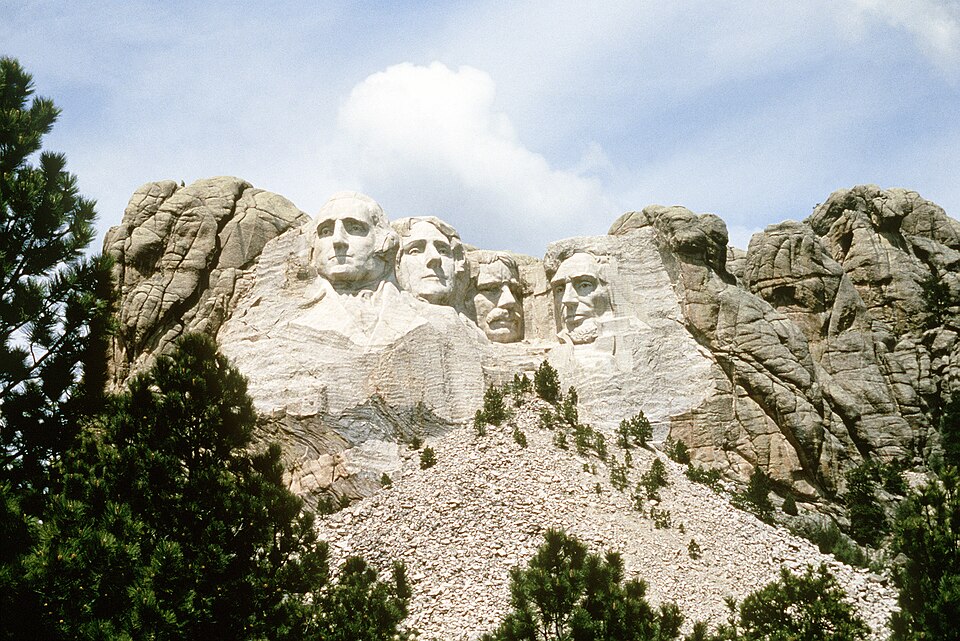
The Four Presidents
The four presidents on Mount Rushmore were chosen to represent important parts of American history. George Washington, the 1st president, represents the birth of the nation because he led the country through the Revolutionary War and helped establish the new government. Thomas Jefferson, the 3rd president, represents the growth of the country because he arranged the Louisiana Purchase, which doubled the size of the United States. Theodore Roosevelt, the 26th president, represents the development of the nation because he worked to build the Panama Canal and protect natural lands. Abraham Lincoln, the 16th president, represents the preservation of the country because he held the nation together during the Civil War and ended slavery.
How It Was Built
Sculptor Gutzon Borglum designed Mount Rushmore and led the construction project, which began on October 4, 1927. Workers used dynamite to blast away about 90 percent of the rock, removing around 450,000 tonnes of granite from the mountainside. After the blasting, skilled carvers used pneumatic drills and chisels to shape the fine details of each president’s face. The project employed about 400 workers who hung from the cliff face in special harnesses, and remarkably, no one died during the entire 14 years of construction.
Gutzon and Lincoln Borglum
Gutzon Borglum was an ambitious sculptor who had already worked on large projects before Mount Rushmore. He spent years planning every detail of the memorial, creating scale models and directing the workers on the mountain. Sadly, Borglum died in March 1941, just months before the project was completed. His son, Lincoln Borglum, took over and supervised the finishing work, bringing the memorial to its completion on October 31, 1941.
The Black Hills and the Lakota People
The Black Hills, where Mount Rushmore stands, are sacred land to the Lakota Sioux people, who have lived in the region for centuries. The Lakota call the Black Hills “Paha Sapa” and consider them the center of their world. In 1874, gold was discovered in the area, and the United States government forced the Lakota from their homeland despite earlier treaties that had promised the land would remain theirs. The creation of Mount Rushmore on this sacred land remains a source of deep disagreement, and the Lakota people continue to seek recognition of their rights to the Black Hills.
The Unfinished Hall of Records
Gutzon Borglum originally planned to carve a grand Hall of Records into the canyon behind the carved faces. He imagined a large chamber that would hold important American documents and tell the story of the nation’s history. Construction began on the hall, but only a small entrance tunnel was carved before funding ran out and work shifted back to the faces. In 1998, a repository of porcelain panels was placed inside the unfinished chamber, containing the texts of the Declaration of Independence, the Constitution, and other key documents.
Visiting Mount Rushmore Today
Mount Rushmore is open year-round and does not charge an entrance fee, though visitors pay for parking. The Avenue of Flags, a walkway lined with flags from all 50 states, leads visitors toward a grand terrace with a clear view of the carved faces. At night during the summer, the memorial is lit up and a special ceremony honors military veterans. The surrounding Black Hills area also offers other attractions, including Crazy Horse Memorial, a much larger mountain carving that has been under construction since 1948.
Fun Facts About Mount Rushmore
Each president’s nose on Mount Rushmore is about 6 meters (20 feet) long, and their mouths stretch about 5.5 meters (18 feet) wide. The original plan included carving the presidents down to their waists, but a lack of funding meant only the faces were completed. Thomas Jefferson’s face was originally started on Washington’s right side, but the rock there was too crumbly, so workers blasted it away and recarved Jefferson on Washington’s left. Mount Rushmore was named after Charles E. Rushmore, a New York City lawyer who visited the area in 1885 and jokingly said the mountain had no name, so they named it after him.
 OtterKnow Kids Encyclopedia