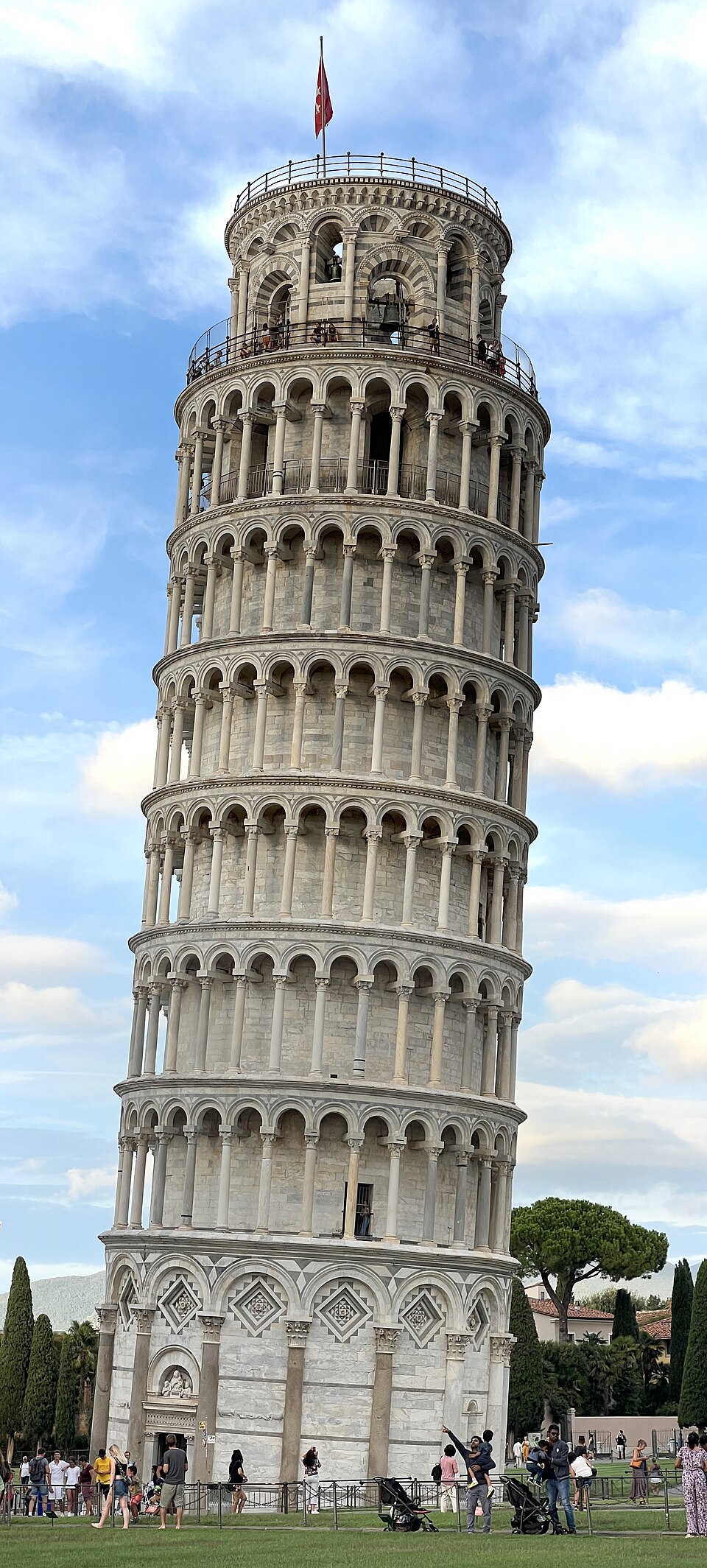
Why Does It Lean?
The tower began leaning during construction because the ground beneath one side was too soft to support its weight. Pisa sits on a plain made up of clay, sand, and shells deposited by rivers over thousands of years. This kind of soil compresses unevenly under heavy structures, which caused the foundation to sink more on one side. Engineers at the time tried to correct the lean by making the columns and arches on one side slightly taller, but this was not enough to fix the problem. Over the centuries, the lean continued to grow worse as the soil shifted further.
Building the Tower
Construction of the tower began in 1173 and took about 200 years to complete, largely because work was interrupted by wars and political conflicts. The tower has eight stories, including a chamber at the top where the bells hang. It stands 56 meters (184 feet) tall on its lower side and 56.7 meters on its higher side, with 294 steps leading to the top. The building is made of white and gray marble, with rows of elegant arched columns circling each level. Its round shape and decorative columns make it a fine example of Romanesque architecture, a style popular in medieval Europe.
Galileo and the Tower
According to a famous story, the Italian scientist Galileo Galilei dropped two balls of different weights from the top of the Leaning Tower around 1589. He wanted to show that gravity pulls all objects downward at the same speed, no matter how much they weigh. If the story is true, both balls would have hit the ground at nearly the same time, proving his point. Many historians believe the experiment may be more legend than fact, since Galileo never described it in his own writings. Whether or not it really happened, the story helped make both Galileo and the tower famous around the world.
Saving the Tower
By the late 1900s, the tower’s lean had reached about 5.5 degrees, and engineers worried it could eventually topple over. The Italian government closed the tower to visitors in 1990 and began a major stabilization project. Workers carefully removed small amounts of soil from beneath the higher side, allowing the foundation to settle more evenly. They also added lead counterweights and anchored steel cables to help hold the tower in place during the process. By 2001, the lean had been reduced to about 3.97 degrees, and the tower was declared safe and reopened to the public.
The Piazza dei Miracoli
The Leaning Tower is just one part of an impressive group of buildings in the Piazza dei Miracoli. The Cathedral of Pisa, a large church with a richly decorated facade, is the centerpiece of the square. Nearby stands the Baptistery of Pisa, one of the largest baptisteries in Italy, known for its unusual acoustics. A long, walled cemetery called the Camposanto Monumentale completes the group. All of these buildings were constructed between the 11th and 14th centuries and together they showcase the wealth and artistic talent of medieval Pisa.
Fun Facts
The tower currently leans about 3.9 meters (13 feet) from where it would stand if it were perfectly vertical. There are seven bells at the top of the tower, one for each note of the musical scale, though they are no longer rung by swinging because of concerns about vibration. The tower was nearly destroyed during World War II when American forces considered demolishing it to prevent German soldiers from using it as a lookout post, but a last-minute retreat by the Germans saved the building. Engineers estimate that the stabilization work done in the 1990s should keep the tower safe for at least another 200 years. Pisa is not the only city with a leaning tower — there are several others around the world, but none as famous as this one.
 OtterKnow Kids Encyclopedia