A Royal Forest
In medieval England, a royal forest was a large area of land set aside for the king’s use, especially for hunting deer and wild boar. Sherwood Forest was one of the largest royal forests in the country, stretching across roughly 100,000 acres during the reign of King John in the early 1200s. Harsh laws protected the animals and trees within the forest, and anyone caught poaching could face severe punishment. Over the centuries, much of the land was cleared for farming, mining, and development, shrinking the forest to the roughly 1,000 acres that remain today.
The Legend of Robin Hood
Robin Hood is one of the most famous characters in English folklore. According to legend, he was an outlaw who lived in Sherwood Forest with his band of Merry Men, stealing from the rich and giving to the poor. The earliest written references to Robin Hood appear in poems and ballads from the 14th century, making the stories at least 600 years old. Historians are unsure whether Robin Hood was a real person, a composite of several historical outlaws, or entirely fictional. Regardless of his origins, his tales of courage, justice, and adventure have inspired countless books, plays, and movies.
The Major Oak
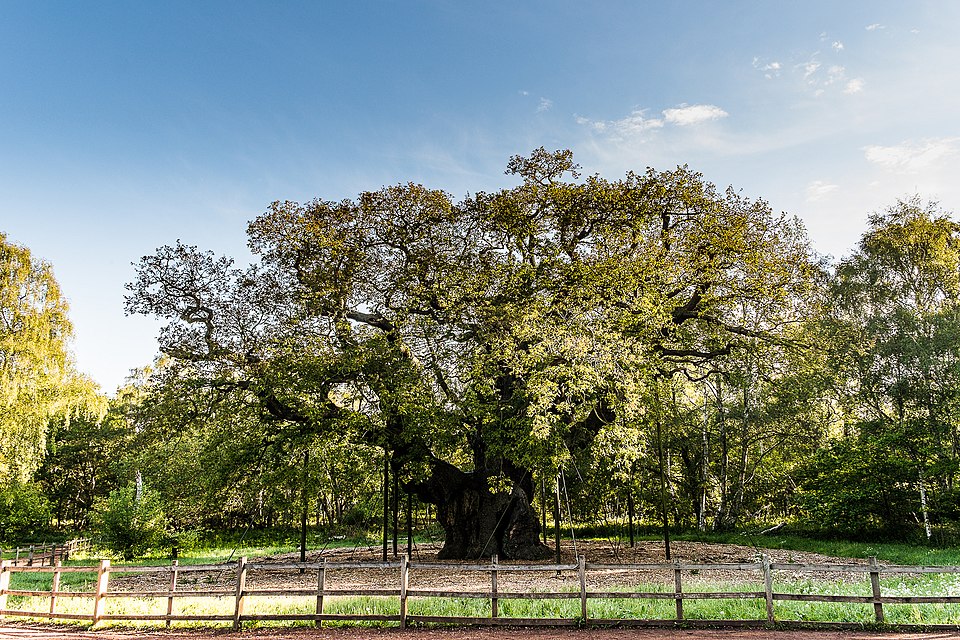
The most famous tree in Sherwood Forest is the Major Oak, an enormous English oak tree estimated to be between 800 and 1,000 years old. Its massive trunk measures about 33 feet (10 meters) around, and the whole tree weighs an estimated 23 tons. The trunk is partially hollow, and legend says that Robin Hood and his men used it as a hiding place. Today, the tree’s heavy branches are supported by a system of poles and cables to prevent them from breaking. The Major Oak draws hundreds of thousands of visitors each year and has been voted England’s favorite tree.
Ancient Oaks and Their Inhabitants
Sherwood Forest is home to hundreds of ancient oak trees, many of which are several centuries old. These old trees are far more than just impressive to look at — they are vital habitats for wildlife. As oak trees age, their trunks develop cracks, hollows, and decaying heartwood that support communities of fungi, mosses, and invertebrates. Sherwood’s ancient oaks are especially important for rare beetles, including species that are found in very few other places in Britain. The forest has been designated a Site of Special Scientific Interest (SSSI) because of the extraordinary biodiversity these veteran trees support.
Wildlife and Nature
Beyond its famous oaks, Sherwood Forest supports a wide variety of plants and animals. Woodpeckers, nuthatches, and treecreepers nest in the older trees, while warblers and nightjars breed in the heathland and birch scrub. The forest floor is carpeted with bluebells in spring and is dotted with bracken and heather. Badgers, foxes, and several species of bats live in and around the woodland. The mix of ancient woodland, heathland, and open grassland creates a patchwork of habitats that makes Sherwood one of the most ecologically important forests in central England.
The Robin Hood Festival
Each year, about 500,000 people visit Sherwood Forest to enjoy its trails, see the Major Oak, and learn about its history. One of the biggest events is the Robin Hood Festival, a celebration held every summer that brings the legends to life with jousting tournaments, archery demonstrations, medieval crafts, and performances by actors dressed as Robin Hood and his Merry Men. The Sherwood Forest Visitor Centre provides exhibits about the forest’s ecology and history, and miles of walking paths wind through the trees. The festival has become one of Nottinghamshire’s most popular tourist attractions.
Conservation Today
Protecting Sherwood Forest for future generations is an ongoing effort. The Royal Society for the Protection of Birds (RSPB) manages much of the forest as a nature reserve, working to restore areas of heathland and ensure that young oak trees grow to eventually replace the aging ancient ones. Climate change, disease, and the natural aging process all pose threats to the veteran trees. Conservationists carefully monitor the health of the Major Oak and other ancient trees, and controlled grazing and habitat management help maintain the diverse ecosystems that depend on the forest. Sherwood Forest remains a place where history, legend, and nature come together.
 OtterKnow Kids Encyclopedia